The first machine in Avery Ching’s public story is a circuit on a classroom table. He arrived at Northwestern University unsure which subject to claim as his own. Then he took a circuit-design course. The appeal was practical: he could make a thing, examine how it worked, and change it. For a student raised in Honolulu, that encounter opened a path into computer engineering, a doctorate in high-performance computing, and eventually a career spent on systems so large that most of their users would never know his name.
Today Ching is the co-founder and CEO of Aptos Labs. The company builds software around a blockchain intended to handle payments and digital assets at scale. His appointment as CEO in December 2024 made for a tidy business headline. The more interesting part is the long apprenticeship beneath it: research laboratories, a search engine, Facebook’s data machinery, and Meta’s discontinued Diem project. For roughly two decades, Ching has been studying what happens when a good idea meets an inconvenient number of people.
That number keeps growing. At Facebook, the systems his teams worked on supported products used by billions. At Aptos, the ambition has moved from processing information to moving value. The engineering question is familiar. The social question is harder. Who will trust the machinery enough to use it?
A mentor, a circuit, and an appetite for scale
At Northwestern, Ching found a mentor in professor Alok Choudhary. Choudhary introduced him to high-performance computing, the discipline of making immense calculations run efficiently across many machines. Ching completed a bachelor’s degree in computer engineering in 2002 and a PhD in the same field in 2007. His doctoral work ranged across supercomputing, parallel computing frameworks, and high-performance file systems. The tools may sound distant from a payment app; the underlying problem is much the same. Work arrives faster than one machine can handle it. The system must divide it, coordinate it, and still return a trustworthy result.
He credits the PhD with more than technical training. It taught him to identify a problem, sharpen an idea, and put it into practice. He also worked at Los Alamos and Sandia national laboratories, places where computing power serves research with little tolerance for sloppy assumptions. The story of Aptos is often told from the death of Diem onward. Ching’s habits were formed much earlier, in rooms where a faulty answer could not be rescued by a better slogan.
“Always taking initiative, sharpening your ideas, and then turning them into practice is something I got out of my PhD.”Avery Ching
After his doctorate, Ching joined Yahoo. For four years he worked on web search and Apache Giraph, a system for processing huge graphs. A graph is a map of relationships: pages linking to pages, people connected to people, one event affecting another. Making sense of one at internet scale requires patience with details nobody sees on a screen. Leaders at Facebook noticed his work and recruited him in 2011.
- 2002–07Northwestern: computer engineering and high-performance computing
- 2007–11Yahoo: search and graph processing
- 2011–21Meta: data systems, then Libra and Diem
- 2021–nowAptos Labs: co-founder, CTO, then CEO
The invisible work behind a very visible company
At Facebook, Ching became the overall technical lead for batch-processing teams. Their portfolio included Spark, Apache Giraph, Facebook’s Hive and Hadoop systems, distributed scheduling, and the frameworks that let engineers describe data pipelines. These are the backstage workers of an internet platform. They sort, analyze, and prepare information that many products depend on. Aptos Labs says the systems ran across hundreds of thousands of machines. In Ching’s account, the data infrastructure team grew from about 20 or 30 people when he joined to around 200 when he left.
It was also an education in leadership without a spotlight. A small team can coordinate by walking across an office. Two hundred people need shared conventions, careful handoffs, and reasons to trust one another’s work. Those lessons matter when the product is a blockchain, where separate participants must agree on a common record. They matter even more when the engineer becomes a chief executive, where every technical decision has a partner, customer, or regulator somewhere on the other end.
The turn toward crypto came through another Northwestern connection. Hui Ding, a fellow alumnus, persuaded Ching to join Meta’s Libra project, later called Diem. Ching led the crypto platform team, covering blockchain technology and wallet infrastructure. He described the experience as a startup inside a large company: the parent supplied talent and reach, while the new team confronted a problem without a settled playbook. The aim was a global payment system. The project ended before it could become that system.
The end of Diem could have made the work a footnote in a corporate history. Ching and Mo Shaikh chose a more active punctuation mark. They co-founded Aptos Labs in 2021, drawing on open-source work and the Move programming language developed in the Diem orbit. The company announced itself in 2022, and Aptos mainnet went live that October. The name came with a different corporate home, but the questions about scale, security, and everyday use came along for the ride.
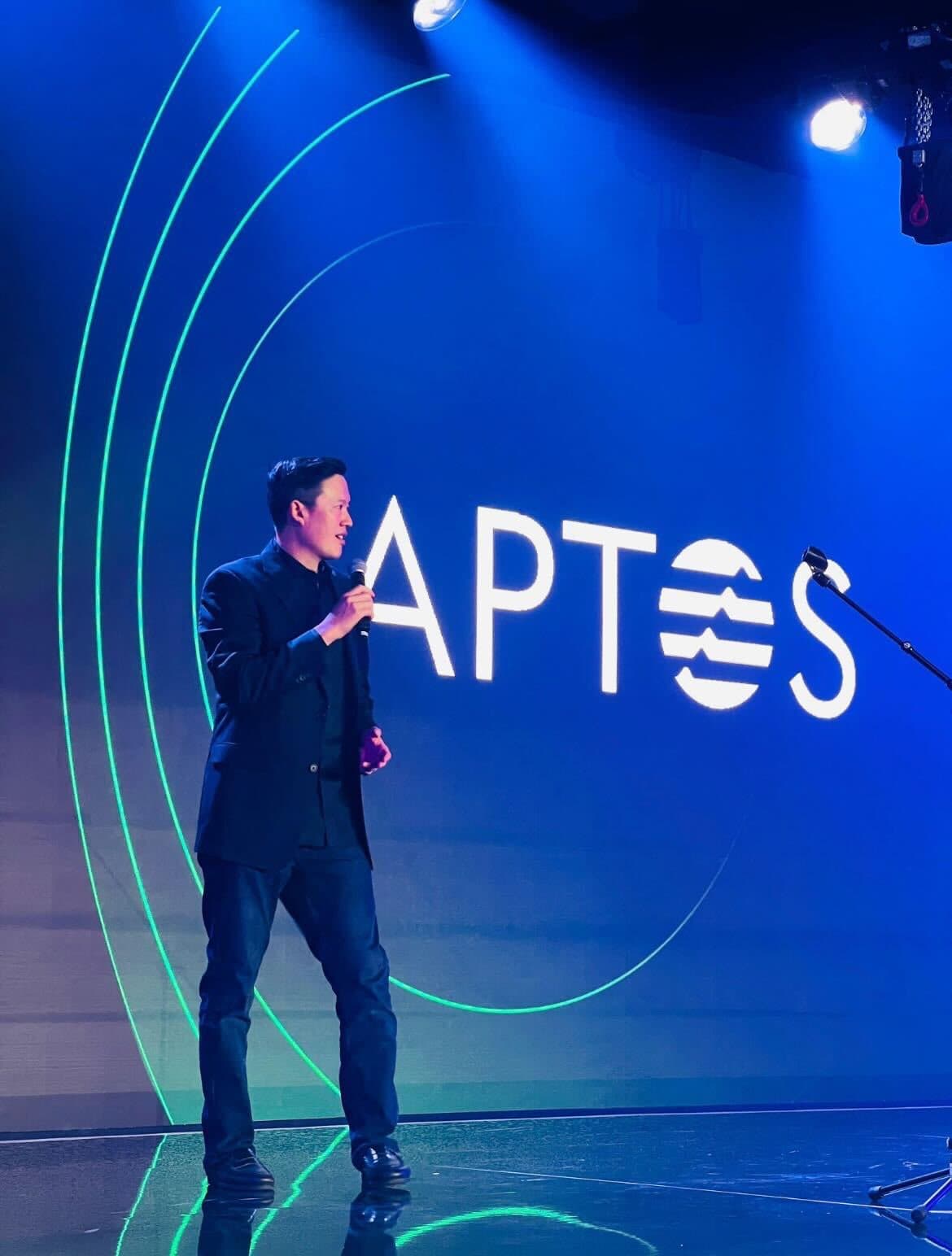
The CTO becomes the person with the microphone
As CTO, Ching could talk in the natural vocabulary of an engineer: latency, parallel execution, transaction volume, the Move language. Those measures matter, but none is a human reason to open an app. The company’s early public pitch had to connect capacity with uses that ordinary businesses and developers could recognize. Its partnerships and integrations ranged across payments, digital assets, and entertainment. In 2024, CoinDesk included Ching in its Most Influential package, and he described Aptos’s first developer conference in Seoul as a personal highlight. Hundreds of builders in one place made the network feel less like a specification and more like a community.
Then Mo Shaikh left the chief executive role, and Ching succeeded him in December 2024. It changed the center of gravity of his public job. He still spoke about technical improvements, but he increasingly described Aptos as a place for open finance and, later, a global trading engine. The phrase is intentionally broad. It reaches from payments to tokenized assets and from people trading with people to software acting on their behalf. It also invites an exacting response: show what runs on it, who benefits, and whether the experience is good enough to repeat.
Ching has not hidden how much remains to be built. In a 2024 interview, asked about the hardest part of building Aptos, his answer began with a word any software team recognizes: “Time!!” Infrastructure must be built, integrated, upgraded, and connected to other systems. A blockchain can make a transaction fast; it cannot make the surrounding work disappear. If anything, speed raises expectations for every part around it.
A market needs more than a stopwatch
The attraction of Aptos’s technical design is straightforward. A network that processes transactions quickly and at low cost can support applications that would be awkward or expensive elsewhere. Move gives developers a way to describe digital assets with rules about ownership and transfer. Those features help explain why Ching talks about payments, tokenized assets, and trading in the same breath. If the base layer works well enough, he argues, more financial activity can happen in a shared environment that is accessible to developers across borders.
Still, a fast network is only one ingredient in a market. Traders need liquidity. Businesses need tools and support. People need predictable experiences and a way to recover from mistakes. Ching’s own background suggests an understanding of that distinction. At Meta, the data system was useful because the products above it had enormous audiences. At Aptos, the audience and applications must be built alongside the machinery. The CEO’s task is therefore part engineering, part recruitment, and part patient translation between people who use very different definitions of “ready.”
“The focus has to be on adoption now.”Avery Ching, at Consensus, 2026
By 2025, he was making that case outside conference halls. In June he testified before the US House Committee on Agriculture about digital assets, presenting Aptos as a platform for payments, commerce, and identity. It was a moment that joined several strands of his career: an American-born engineer, trained on national research systems and global internet platforms, speaking to lawmakers about software meant to cross borders. The format was formal. The ambition sounded like the one he had been pursuing for years: systems should be able to serve very large groups without losing their reliability.
His newer public conversations have moved into privacy, AI, institutional use, and the possibility of markets run partly by software agents. In May 2026, he spoke with The Block at Consensus about the industry’s shift toward infrastructure and adoption. These are proposals and directions, not finished outcomes. That distinction makes the story more compelling. Ching’s company has to earn the use cases implied by its own language, transaction by transaction and developer by developer.
The engineer’s wager
There is a modest irony in the career arc. The student who liked a circuit because he could touch and test it now leads a company whose central product is almost entirely invisible. A customer will never inspect parallel execution or thank a consensus mechanism. They will judge whether money arrives, whether a market opens, whether an application works as promised. The closer Aptos comes to that ordinary standard, the less often its users may think about the elaborate system beneath them.
Ching has spent his career preparing for that kind of anonymity. At Yahoo and Meta, success meant making giant networks of machines behave as if they were dependable, simple tools. At Aptos Labs, he has a harder proposition: that a dependable tool can help make financial access more open. The result will be decided by people outside his engineering team. He can build the pipes. Whether the world sends its money through them is the next test.