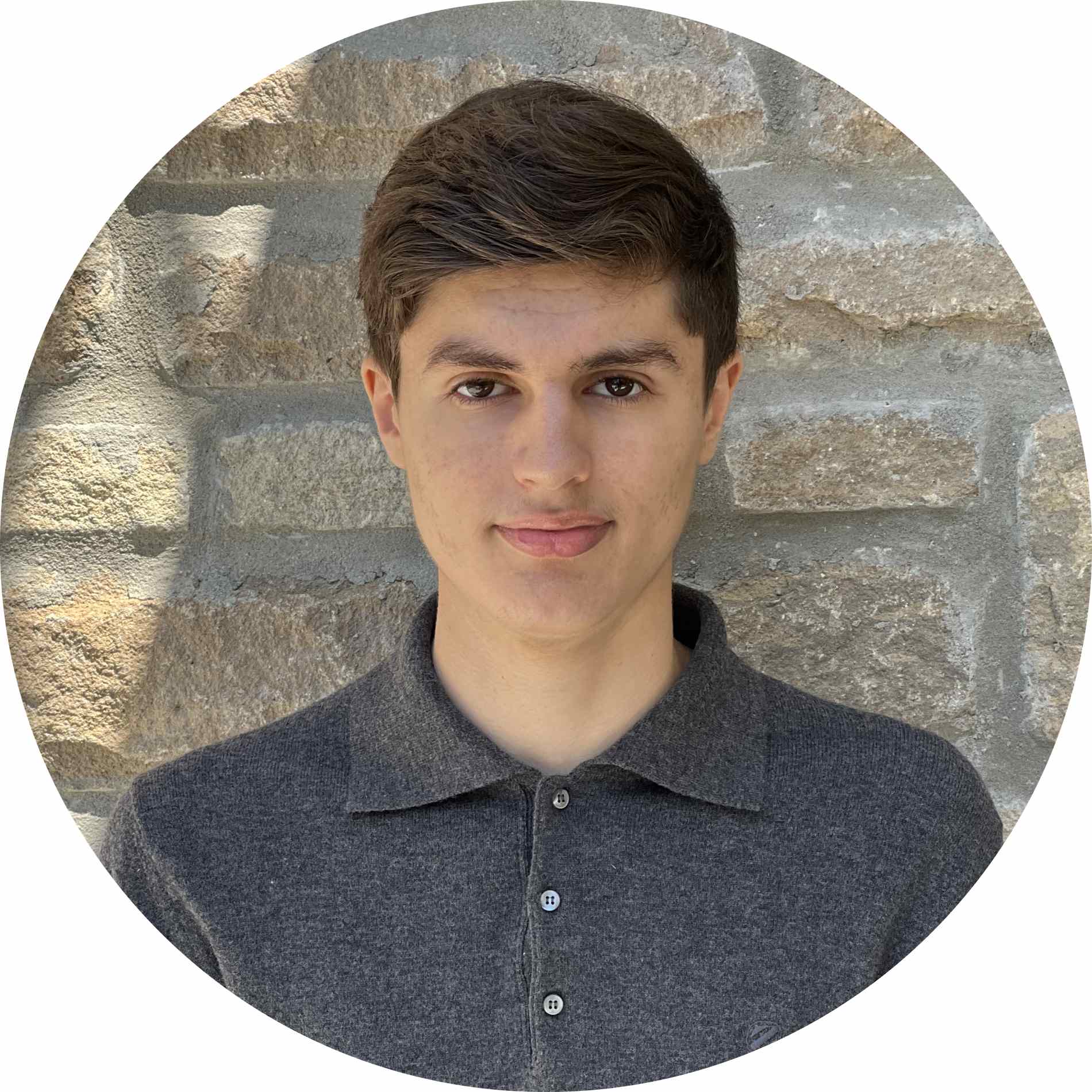
His GitHub bio has four words: sumcheck is love sumcheck is life. That is not a joke. The sum-check protocol is a fundamental building block of modern zero-knowledge proofs, and Markos Georghiades has staked his early career on making it faster, smaller, and more useful than anyone thought possible.
At an age when most engineers are still building their first React app, Georghiades is an Engineering Partner at Andreessen Horowitz's crypto division - one of the world's most competitive VC firms - working on Jolt, a16z's flagship open-source zero-knowledge virtual machine. He studies Computer Science and Mathematics at the University of Waterloo. He lives in New York City. And he has co-authored four research papers that are actively reshaping how the zkVM space thinks about performance, simplicity, and privacy.
Jolt: A Simpler Path to High-Performance zkVMs
Markos Georghiades - Keynote title, Crypto Conference, December 2025The name Jolt is not an accident. The project exists to jolt the zero-knowledge ecosystem out of its complexity spiral - the tendency to build systems that work only for a narrow class of computations, require trusted setups, or demand proof sizes that dwarf the data they're supposed to prove. Jolt's thesis: a zkVM built on the sum-check protocol and SNARK arguments can be simpler, faster, and more extensible than anything the field has produced so far.
Per Second
The 6x speedup milestone - enabling Jolt to process over one million RISC-V cycles per second on a 32-core CPU, or 500,000 cycles per second on a MacBook - came from integrating Twist and Shout memory-checking arguments. The insight was straightforward once someone found it: virtual machines repeatedly execute the same primitive instructions, and batch-evaluation arguments can exploit that repetition. The result is proof sizes around 50KB - small enough to matter in real applications.
Zero-knowledge proofs solve a specific, elegant problem: how do you convince someone you know something without revealing what you know? The math - developed over decades by cryptographers including Goldwasser, Micali, and Rackoff - is beautiful in theory and brutal in practice. Making it fast enough for real-world use is an engineering challenge that has consumed some of the sharpest minds in computing for years.
The zero-knowledge VM takes this further: instead of proving a specific computation, a zkVM lets you prove that any program ran correctly. Write your code, compile it, prove it. For blockchain infrastructure, that unlocks a new category of trustless computation. For Georghiades, it is where his obsessions in mathematics, cryptography, and systems engineering converge.
"NovaBlindFold gives Jolt true zero-knowledge. Proof size increases by just 3KB. Additional prover time: essentially zero."
The NovaBlindFold work - published in March 2026 and co-authored with Sagar Dhawan, Justin Thaler, Andrew Tretyakov, and Michael Zhu - solved a problem that had been lurking in Jolt's architecture since the beginning. Jolt was fast and small, but it was not truly zero-knowledge: a determined adversary could potentially infer information about the computation being proved. NovaBlindFold closed that gap. The technique adds privacy without a trusted setup - a significant constraint in the zk world - and does so at essentially no additional cost. Three kilobytes of extra proof size for full zero-knowledge is not a tradeoff. It is a gift.
Waterloo's co-op program - the engineering internship structure that has sent graduates to every major tech company in North America - placed Georghiades at a16z crypto. What happened next was not typical co-op territory. Rather than shipping features or fixing bugs in a legacy codebase, he found himself in the middle of original cryptography research, co-authoring papers with some of the field's most respected names, and eventually delivering a keynote presentation on Jolt's architecture in December 2025.
The keynote title - "Jolt: A Simpler Path to High-Performance zkVMs" - is a statement of philosophy as much as engineering. The zero-knowledge space has a tendency toward baroque complexity: systems that work, but only if you understand seventeen layers of cryptographic machinery. Jolt's bet is that simplicity and performance are not in tension. The sum-check protocol, applied carefully, can do what more elaborate constructions do, faster and with less code.