At Hotel Saint in London, a booking could arrive by email, leaving somebody to allocate the room by hand. Reaching another tour operator meant another connection, or another static allocation of rooms and prices. The problem was multiplication. Each new commercial relationship brought another little administrative system for a small team to maintain.
In Hotel Trader's published case study, the hotel's attraction to the platform was wonderfully practical: existing SynXis and Sabre relationships reduced the technical work. After joining in June 2024, the team could identify buyers worth inviting for property visits. A distribution connection had become a way to decide whom to meet.
- The product: a B2B exchange connecting hotels with travel buyers.
- The bargain: one connection, with control over individual partners.
- The catch: clean rates and inventory still need an owner.
01 / A room has a supply chain
A guest sees a room, a price, and a booking button. The hotel has a different view: inventory, contracts, payment terms, and businesses selling on its behalf. Hotel Trader puts that less photogenic side of hospitality at the center of its product, The Exchange.
The company, founded in 2017, is led by CEO and co-founder Dermot Quigley and CTO and co-founder Mitul Gandhi. Its customers include independent hotels, chains, tour operators, online agencies, airlines, and membership programs. Travelers encounter the result through those businesses rather than shopping on Hotel Trader itself.


The expertise is in the unglamorous joins: how room types match, how promotions travel, how bookings return, and how money gets reconciled. Those joins determine whether adding a sales channel creates useful demand or simply creates work.
02 / Start where the price lives
The Exchange's core design takes availability, rates, and inventory from a hotel's property management system or central reservation system: PMS or CRS in hotel shorthand. Instead of sourcing rooms from other resellers, Hotel Trader builds connections to the systems where hotels manage what they intend to sell.
For developers, the Pull API uses GraphQL, allowing multiple resources to be retrieved in one query. There is also a Push integration. For commercial teams, HT Connect brings direct contracts into the shared connection; HT Pay handles settlement and reconciliation. The pitch joins technical plumbing to the work that follows a sale.
That puts Hotel Trader between several familiar categories. A hotel could use a channel manager, work through a wholesaler, or build direct connections itself. The Exchange combines connectivity with a buyer network and managed operations. Its own directory includes Hotelbeds and WebBeds as buyers: adjacent businesses can also be customers.
03 / The stopwatch has conditions
In February 2026, Hotel Trader announced Supplier Launchpad, promising eligible hotels could connect, configure, and begin selling in under eight minutes. The initial announcement named nine connected providers. The workflow pulls property data, lets the hotel complete missing details, then validates availability and rates before a test reservation.
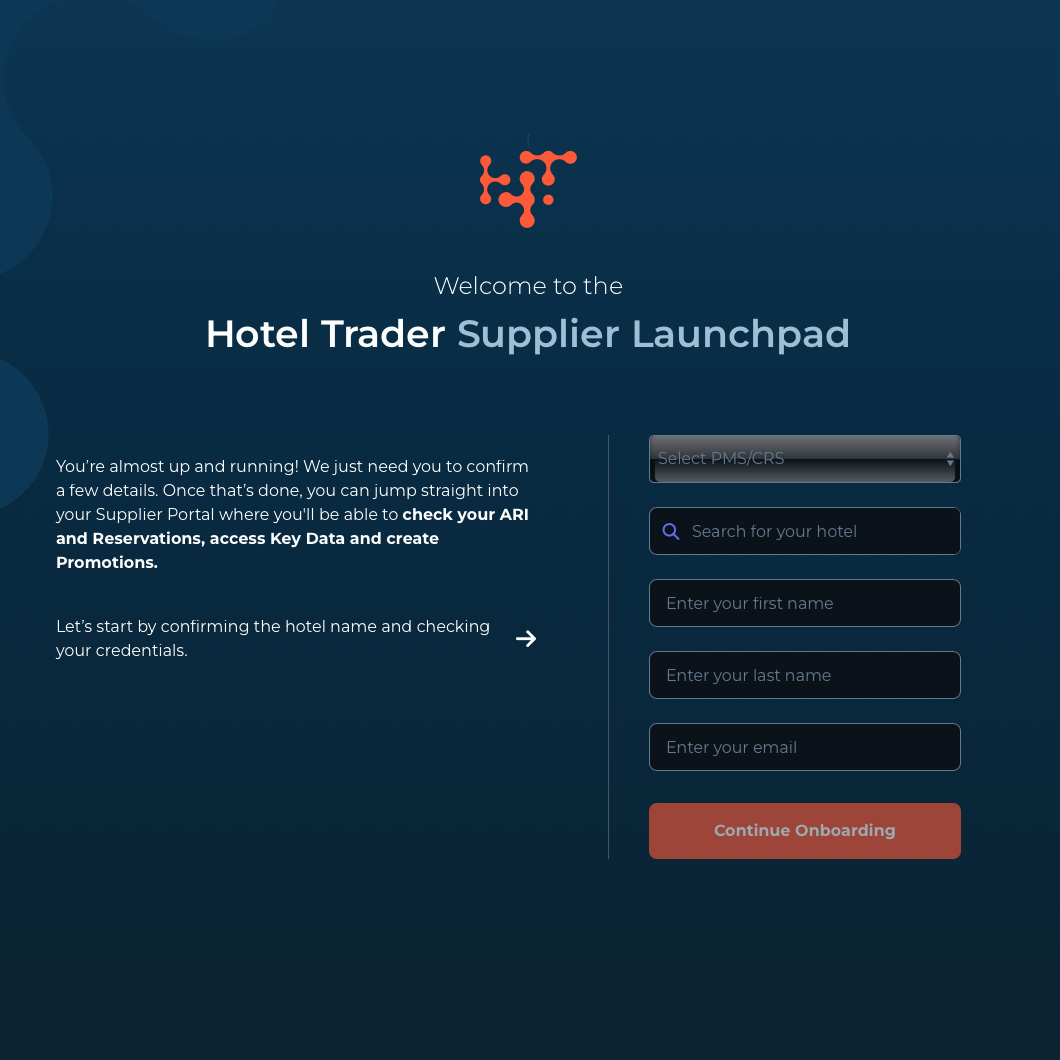
The stopwatch starts inside a system of prerequisites. Current Launchpad guidance requires a supported connection, sufficient inventory alignment, at least twelve months of valid availability, rates, and inventory within the next twenty-four months, and a successful test booking. Automation makes those checks part of the launch.
This is also the useful lesson for another business: automate the handoff as well as the form. A setup wizard saves little time if a completed application waits in somebody's inbox. Launchpad's design moves an eligible property from onboarding to live inventory without a separate manual release.
04 / A marketplace that remembers
Getting connected is only the beginning. Hotels can examine buyer behavior, including booking lead time, length of stay, and cancellation patterns, then choose partners and tailor promotions. The commercial question becomes more precise: which buyer brings the kind of business this property wants?
Alignment Score adds another discipline. Hotel Trader describes it as a measure of how reliably a buyer can book a hotel directly, checking the relationship between intended offers and available rates. A cheaper rate elsewhere can expose a promotion missing from The Exchange, a pricing mismatch, or a leak into an unintended channel.
The Action Center takes the next step, presenting up to three recommended actions: expand buyer coverage, repair availability gaps, or create targeted promotions. September 2026 release notes added promotion-expiry reminders. It is an agreeably ordinary innovation: make sure an offer does not quietly disappear because its end date passed.
“B2B distribution does not have to be so complicated.”
Dermot Quigley · Pegasus announcement, 2020
05 / Follow the hidden bill
The same attention to handoffs shows up in engineering. In a May 2026 AWS guest article, Hotel Trader engineers described cache requests crossing availability zones unnecessarily. Traffic analysis showed requests going to remote nodes even when local replicas were available.
They switched to Valkey GLIDE, favored local reads, and batched requests. Development took one engineer two weeks; rollout proceeded gradually over fifteen days with a rollback option. Reported daily inter-zone transfer cost fell from about $420 to $18, while average latency improved 49%. The team reported no downtime.
The transferable method is specific: inspect traffic before buying more capacity, keep reads close to the application, and test changes incrementally. A workload requiring the freshest primary data would need a different read strategy. The saving depends on the architecture.
06 / The relationship is the product
For hotels and buyers, joining The Exchange is free, according to Hotel Trader. The company earns revenue linked to sales volume. Its commercial ambition is therefore tied to transactions flowing through the network, alongside the operational support those transactions require.
There are practical boundaries. A property needs usable data and an appropriate connection to benefit from rapid onboarding. The FAQ excludes group bookings. More buyers also do not automatically mean more valuable demand; the hotel still has to decide which relationships fit its business.
Hotel Trader's 2023 ANIXE partnership illustrates the opportunity: existing supply gained another route into European travel retail through Resfinity. The enduring idea is simple enough for a hotelier to act on tomorrow. Identify the buyer, inspect the behavior, and invest in the relationship worth keeping.
Keep the connection
Explore the platform, watch the walkthroughs, or open the technical docs.