In 2009, a modest academic homepage at UC Irvine announced that Hojjat Jafarpour had finished his PhD and joined the data-management department at NEC Labs. The page looked like its era: compact, practical, made mostly of links. Its research interests were more prophetic. Continuous analytics. Distributed publish-and-subscribe systems. Stream and event processing. Jafarpour was already working on the question that would occupy his career: what should computers do with information that refuses to sit still?
There are easier ways to become fashionable than choosing a database problem and waiting for the world to catch up. Yet that is roughly the arc. Data used to arrive with the manners of post. It was collected, stored and processed in batches. Today it behaves more like weather. Purchases, clicks, sensor readings, account changes and application events pour through systems continuously. Artificial-intelligence agents have made the old plumbing newly conspicuous. A machine expected to act now needs to know what is true now.
Jafarpour's answer has remained stubbornly accessible: let people ask in SQL. The language dates to the 1970s, but its familiarity is the point. Progress, in his telling, does not require every developer to become a specialist in distributed systems. It requires the specialist to make the machinery disappear.
The research problem that became a career
At UC Irvine, Jafarpour worked with professor Sharad Mehrotra and research groups concerned with information dissemination and distributed systems. His papers examined how subscriptions could be matched efficiently, how load could be balanced, and how content could travel through large systems without the whole enterprise wheezing under the effort. The nouns were academic. The practical concern was not: growing volumes of data had to reach the right place quickly.
He later described being fascinated by data's central role in every organization and by the difficulty of managing more of it. After the doctorate came NEC Laboratories America, then Informatica, Quantcast and Tidemark. The jobs moved between research and product engineering, but the terrain barely changed: databases, analytics, computation at scale.
One idea, moving downstream
Then came Confluent. Jafarpour joined in August 2016 because he was offered a project unusually aligned with everything before it: build a SQL layer on top of Apache Kafka. Kafka was becoming the central conveyor belt for enterprise events. It was fast and powerful, but power tends to arrive with a manual. KSQL, later known as ksqlDB, let a developer express a continuous query in SQL and keep it running as new events arrived.
“KSQL aims to make stream processing available for much broader audience than only hardcore software engineers!”Hojjat Jafarpour, 2018
His 2018 exclamation point is charming because infrastructure engineers are not famous for them. The enthusiasm was attached to an unshowy act of translation. A team that knew SQL could enrich, filter and aggregate a stream without first writing a dedicated Java application. The query did not wait politely for a dataset to be complete. It stayed open, consuming the world as the world changed.
The sequel hidden inside the first product
Creating KSQL also gave Jafarpour a close view of its boundaries. It was coupled to Kafka and to a single Kafka cluster. In his last year at Confluent, he spent substantial time with field teams, customers and prospects. The experience changed his appreciation for customer-facing work and sharpened the product gap. Enterprises did not live inside one clean box. Their streams and tables sprawled across clusters, stores and clouds. They needed governance as much as velocity.
The founder's temptation is to describe every new company as a revolution. Jafarpour's own explanation for DeltaStream is more useful: the next platform needed a clean start. Users should worry about writing SQL queries. The system should handle fault tolerance, elasticity and the delicate opera of keeping Flink clusters alive. It should read across Kafka, Kinesis, databases and data lakes. It should provide one hierarchy and one permission model over an untidy estate.
The product argument, without the plumbing
keep arriving
computing
see the present
DeltaStream uses Apache Flink as a processing engine but hides the operational complexity behind a serverless surface. Queries run in isolation, preventing one unruly job from becoming everybody's problem. The platform added role-based access, a catalog, private-cloud deployment and materialized views with sub-second latency. Its design is less a cathedral than a cloakroom: hand over the burden at the door.
Investors funded the argument in two installments. A $10 million seed round led by New Enterprise Associates was announced in 2022. A $15 million Series A followed in September 2024, with NEA, Galaxy Interactive and Sanabil Investments. Jafarpour thanked the team, customers, community and partners. The total, $25 million, bought time for a compact company to continue sanding away at an enormous technical surface.
A fondness for things that keep moving
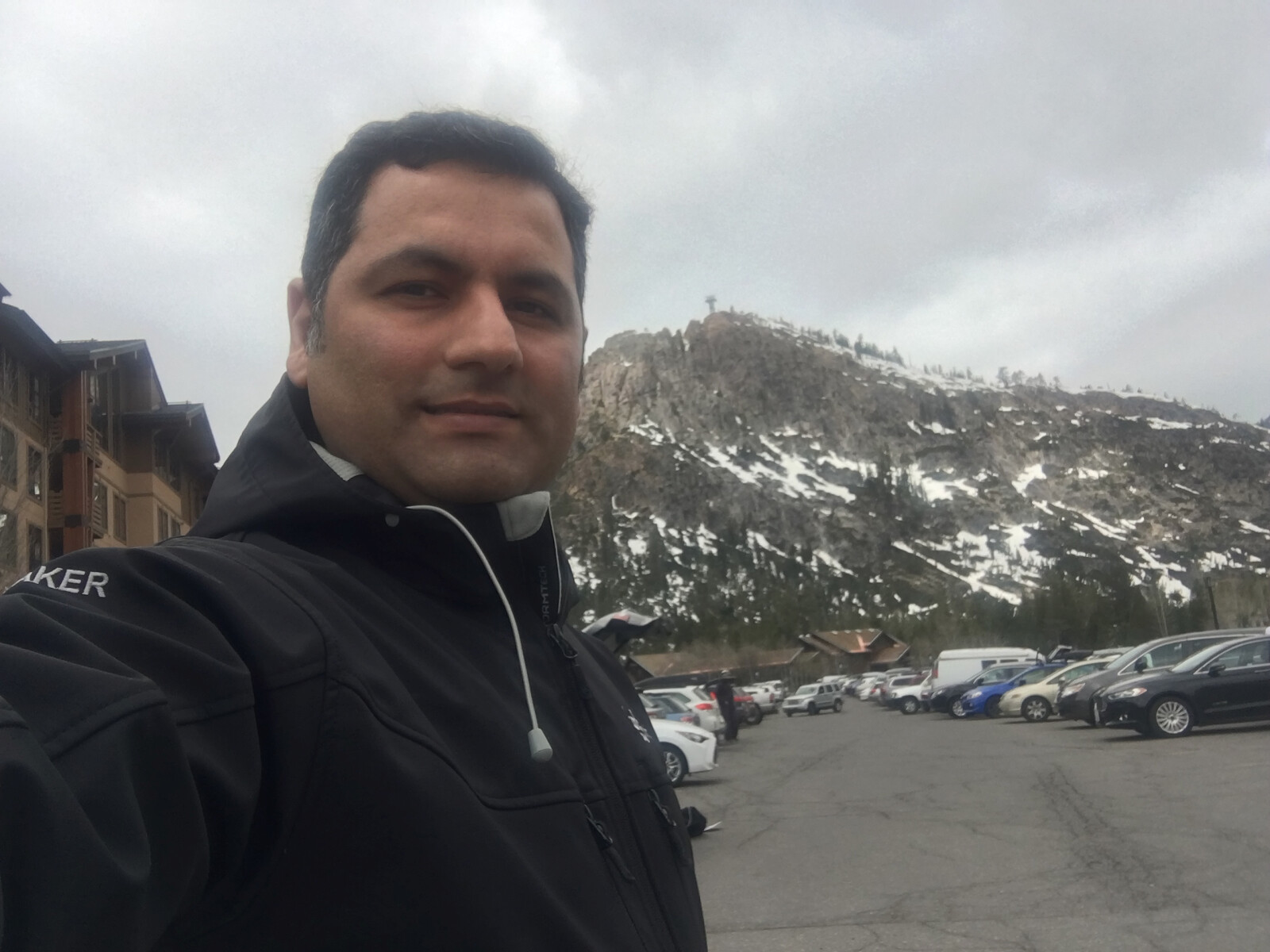
The Tahoe photograph accompanied an interview about Kafka and KSQL, but it captures a different register of the person. Jafarpour named travel and the outdoors among his pleasures, specifically Yosemite, Tahoe and California's abundance of places worth escaping to. Years later, a podcast found him living in California with his family, enjoying travel and looking ahead to larger trips when his children are older.
It would be tidy to turn this into metaphor, to make the mountain a database and every footpath a query plan. Let the man have his weekend. The detail matters because infrastructure careers can otherwise sound like lists of abstractions. They are lived by people who take family trips, appreciate colleagues, attend conferences, and spend years persuading software to do something that will later be described as obvious.
Jafarpour's public comments about Confluent's field team reveal a similar instinct. Technology adoption, he learned, is collective. Engineers build; customer advocates translate; users expose the gap between a diagram and a working system. His gratitude is not decorative. DeltaStream itself emerged from listening to those gaps.
The present tense becomes an AI problem
By 2025, DeltaStream's language began to shift. Streaming, batch and real-time analytics converged in its Fusion platform. Then AI agents moved from demonstrations toward production systems, and Jafarpour saw a familiar failure wearing new clothes. A model might be capable of reasoning, planning and acting, yet receive yesterday's inventory, an incomplete account state or a security picture assembled from mismatched timestamps.
His phrase for the requirement is “fresh context.” Instead of asking an agent to fetch raw fragments and reconstruct reality every time someone asks a question, DeltaStream continuously joins, filters and prepares the relevant state. The agent gets something closer to a maintained materialized view: compact, current and governed. Reasoning remains the model's job. Knowing what just happened becomes infrastructure's job.
“An agent can only make a good decision if it understands what is happening now.”Hojjat Jafarpour, 2026
This is a founder's second act that resembles the first closely enough to be credible. KSQL argued that stream processing should not belong only to specialists. DeltaStream argued that operating the stream processor should disappear too. The AI context thesis pushes the same logic one layer higher: the application should not have to assemble the present from scratch.
In 2026, the company made that mission explicit. It demonstrated agents for changing markets and brought DeltaStream to Google Cloud, adding to its cloud reach. At an AI agents conference in April, Jafarpour spoke about temporal correctness, a technical phrase with a plain-English consequence: a correct answer delivered from an obsolete picture of the world can still be wrong.
There is restraint hidden inside this ambition. Jafarpour is not promising to make models wise. He is trying to make their evidence timely. The distinction is valuable in an industry prone to giving every new product a cape. A current balance will not produce judgment. A stale one can sabotage it.
The oldest tool in the new stack
SQL has survived fashions because it lets people say what they want without narrating every movement of the machine. Jafarpour's career has repeatedly stretched that bargain. Say what you want from events. Let KSQL maintain the query. Say what context an agent needs. Let DeltaStream keep it fresh.
The aspiration is less to crown every developer a streaming engineer than to retire the requirement. This is the peculiar achievement of good infrastructure: success makes the underlying expertise less visible. The clusters vanish. The query remains. Somewhere beneath it, a career's worth of research is still running.
Twenty years after that UC Irvine homepage listed stream and event processing among Jafarpour's interests, the rest of technology has arrived at the same subject through AI. The vocabulary is louder now. The question is unchanged. Information keeps moving. What will you build if you can meet it in the present tense?