A credit-card payment leaves almost no room for a committee meeting. Approve it too slowly and the customer abandons the purchase. Approve it too casually and the bank may buy somebody else’s fraud. A top-ten U.S. bank, unnamed in Hazelcast’s published case study, had a more specific problem: the old relational database could not feed its fraud algorithms quickly enough. Transaction-rate limits were threatening service commitments and, the bank said, blocking new business.
Hazelcast’s answer was to put the information needed for a decision closer to the decision itself. The bank moved 2 terabytes of customer data into memory, used Hazelcast to process roughly 5,000 transactions a second, and planned for 10,000. The extra speed allowed several fraud models to score the same payment in parallel. Hazelcast attributes $100 million in avoided annual fraud losses to the resulting system. That figure is a vendor-reported customer outcome, not a forecast for anyone who installs the software.
- Hazelcast combines a distributed in-memory data store with stream processing and compute.
- Its strongest use case is a live decision that needs recent context before a deadline.
- The free Community Edition opens the door; Enterprise subscriptions sell operational depth, patches and support.
- Buyers should test their full workload, including replication and failure, before believing any latency claim.
Where the clock starts
The bank’s first failure was ordinary: the database was asked to be both archive and sprint runner. A record of account history is useful, but a fraud check needs the right slice of it now: the account, recent transactions, perhaps an evolving score. If each model has to fetch that context over and over, adding models can make the decision slower just when a bank wants it to become smarter.
With Hazelcast, the bank kept account details and recent history in a distributed memory layer. Scoring code could run where the data lived, and multiple algorithms could calculate separate scores before a composite result. Its clusters also used wide-area replication so a regional data-center outage would not end service. Hazelcast says the project required no incremental IT resources and had zero downtime. It does not publish the bank’s implementation bill, license price, or independent audit of the savings.
The transferable idea is less glamorous than “real time.” Find the context every decision repeatedly asks for, hold it near the code that decides, and measure whether the whole journey gets faster. A good benchmark includes the network, serialization, backup copies and a node failure. Memory is quick, but it is not free; keeping terabytes hot creates an operations and infrastructure bill even when the vendor price is undisclosed.
A map with bigger ambitions
The company’s beginning was modest enough to be almost comic beside the bank case. Talip Ozturk started an open source project in 2008 around a distributed Java map. In a 2014 interview, he recalled that rival systems around 2007 felt expensive or difficult to use. His aim was familiar Java interfaces, little configuration and a four-node cluster a developer could evaluate in roughly two minutes. The company dates its formal founding to 2012.
“The very first idea was that we take the well-known Java interfaces.”Talip Ozturk, founder, in a 2014 Hazelcast interview
That idea changed shape because a quick map solves only part of a live-data problem. A company might cache customer details, then send events to a separate processor, then ask another service to update a score. Each handoff adds delay and another system to operate. Hazelcast introduced its stream processing engine in 2017 and launched its unified platform in 2022, joining a fast data store, distributed compute and streaming jobs in one runtime. Java remains central, but clients and integrations let other applications use the cluster.
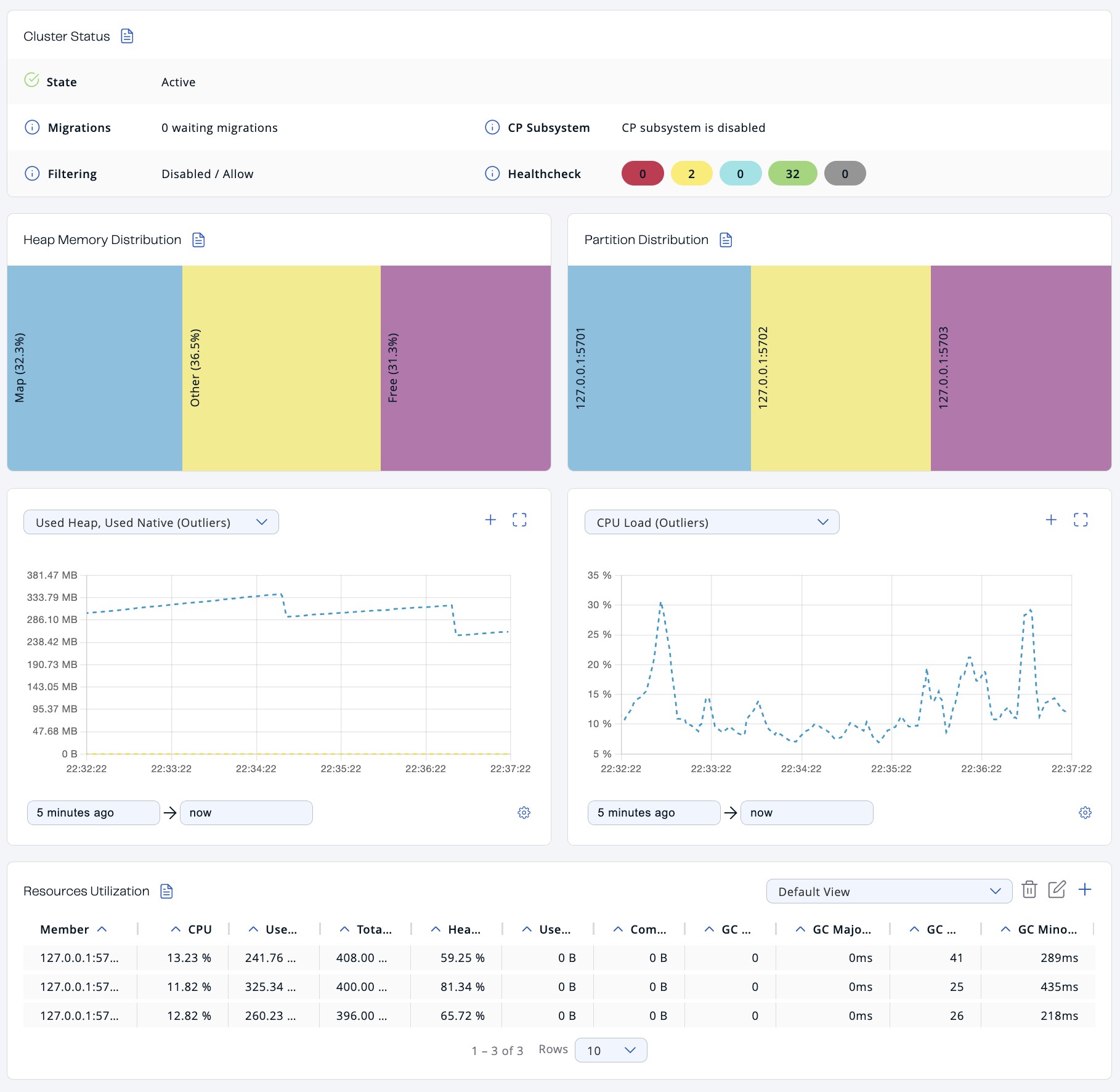
Management Center gives operators a web view of members, data structures and cluster health. For the applications Hazelcast courts, that matters as much as a fast lookup. An outage or a stale fraud score is not excused by an elegant architecture diagram. The product has to be patched, watched and tested through ugly days.
The free door and the paid room
Hazelcast sells software to enterprises while maintaining a free Community Edition. The company says the free edition includes the core fast store and stream processor. Enterprise is a subscription with more security, resilience, operational features, support and patch releases. In the 5.7 release line, later patch releases are Enterprise-only. A buyer should therefore compare the full cost of running a production cluster, not merely the fee for getting started. Public list pricing is not available in the material reviewed.
The customers explain the commercial logic. Hazelcast names banks including BNP Paribas Bank Polska and ING Türkiye, as well as PSA Antwerp and Swiss Federal Railways. A retailer may want popular product pages to load during a launch. A port operator needs a fresh view of assets and schedules. A bank may want a payment decision before the person holding the card notices any pause. The common problem is not the same industry; it is the cost of arriving late.
Start with one deadline-bound decision. Map every read and write it needs, select the context that must stay hot, and test a small cluster against real peak traffic. Measure p99 response time, correctness, recovery and operating cost together. Add more machinery only when the measured bottleneck warrants it.
Hazelcast’s alternative depends on what a team already owns. Redis can provide fast caching; Apache Ignite offers distributed in-memory compute; Kafka Streams and Flink process events. A separate database and streaming stack may be perfectly sensible. Hazelcast’s wager is that some teams benefit from putting the hot data and the computation in one operational layer. That wager pays when network hops and coordination are costly; it weakens when the workload is small, mostly batch-oriented, or already meets its latency and reliability targets with simpler tools.
The next question is correctness
The company’s recent releases sound less like a speed contest and more like the concerns of a systems operator. Platform 5.7, announced in May 2026, introduced Advanced CP features for strong consistency across demanding multi-data-center setups. It added changes for stream-job recovery, Kubernetes operations and client performance. Vector Collections, introduced earlier for similarity search, reached release candidate status. Hazelcast itself advised customers to wait for general availability before putting that feature into mission-critical production.
That caution is useful. A payment system is not helped by a quick wrong answer. Nor is an AI feature improved by being bolted onto the path before its failure modes are understood. Hazelcast’s most persuasive claim remains the humbler one from the bank case: when a system has enough room to inspect more evidence before the deadline, it may make a better decision. The headline number catches the eye. The engineering lesson sits in the fraction of a second beneath it.