Before Hoan Ton-That helped make a face searchable, he made one easier to laugh at. His Trump Hair app put Donald Trump’s hairstyle onto other people’s photographs. It was 2015, and the joke required very little explanation. A picture went in; a more ridiculous picture came out. Within a few years, he was working on software that could take a face and return links to photographs of the same person elsewhere online. The distance between those products is the distance between a party trick and a public argument.
Clearview AI, which he co-founded in 2017, gave that argument a business address. Police could use its search results as investigative leads. People whose photographs supplied the database had generally never been asked to join it. Ton-That spent years defending that arrangement. His career has since moved into finance, but the question attached to his name remains remarkably plain: what, exactly, have you agreed to when a photograph of you appears online?
A programmer with a change of scenery
Ton-That was born in Melbourne and grew up in Australia. His father came from Vietnam; his mother was Australian. He describes himself as a self-taught engineer who competed in informatics and classical guitar, reporting a first-place solo result in Australia’s Informatics Olympiad and second place in an under-16 National Eisteddfod guitar competition. There were two plausible ways to spend hours mastering an instrument. One involved strings; the other eventually involved a keyboard.
He left university and moved to San Francisco in 2007, aged 19. The timing had an obvious attraction for someone interested in writing applications: the iPhone had arrived. He worked on consumer software, including Facebook and iPhone apps. He reports a combined installation count above ten million. That number describes distribution, however, rather than the durability of any particular business. The Trump hairstyle app would become a memorable footnote precisely because the next venture carried such different stakes.
New York supplied a different setting in 2016. He met Richard Schwartz, a former aide to Rudy Giuliani, at a Manhattan Institute book event. Their partnership paired a programmer with someone who had political and commercial contacts. In the early account of Clearview’s formation, the division of labor was straightforward: Ton-That would build the technology; Schwartz would help find buyers. A useful program still needed someone with a reason to purchase it.
The customer changed the story
Facial recognition did not arrive with a ready-made business plan. Ton-That later described an initial interest in automated building security. A former police officer suggested trying the product with police departments. That suggestion gave a general technical capability a specific customer. An officer with a photograph of an unknown person had a concrete problem that a search tool might help address. The question moved from what the software could do to what an investigator could do with its results.
Ton-That’s account of the change is revealing. Consumer apps and games had begun to seem unsatisfying to him, despite Silicon Valley’s fondness for describing almost every startup as a contribution to humanity. Once departments began solving cases, he felt he had found a stronger claim to significance. In a January 2024 interview, he described his reaction this way: “we’re unironically changing the world”. The adverb is a small concession to an industry in which changing the world can sound suspiciously like ordering business cards.
“we’re unironically changing the world”
Hoan Ton-That, January 2024
His enthusiasm helps explain his persistence. It also explains why the criticism never quite met him on his preferred ground. He wanted to discuss an investigation that might succeed. Critics wanted to discuss the collection that made the investigation possible. Both were talking about the same product. They were starting at different ends of it.
- 01A face goes inAn investigator supplies a photograph.
- 02The collection is searchedThe system compares it with indexed facial images.
- 03Links come backPossible matches point to online pages for further investigation.
Public is doing a lot of work
The design was easy to describe. In a television interview, Ton-That explained a search experience that resembled putting a face where a text query would ordinarily go. A detective could submit a photograph, receive possible matches and follow links. He emphasized that the result belonged at the beginning of an investigation. That qualification matters: finding a similar photograph and establishing who committed a crime are separate tasks, with room for error between them.
He also described safeguards in his 2023 policy statement: an intake form requiring an officer to enter a case number and document a search’s purpose, along with oversight tools for agency leaders. Those measures addressed how customers used the service. They left the separate dispute about collecting the photographs unresolved.
The less visible work happened before the search. Clearview collected photographs from publicly accessible websites and extracted information that made faces comparable. Its ability to connect one image with other appearances of a person depended on that assembled collection. The individual running a query could be an authorized customer. The individual in the result might have had no relationship with Clearview at all. Permission became difficult to discuss because those two people entered the system through very different doors.
In 2021, Canadian privacy authorities concluded that Clearview’s activities violated federal and provincial privacy laws. They rejected the argument that public availability removed the need for consent. Their concern included people with no involvement in crime whose faces could nevertheless become searchable. From their perspective, the fact that an image could be seen online did not settle whether a company could process it into a commercial identification service.
That November, Australia’s privacy commissioner announced a finding that Clearview had breached Australians’ privacy. The findings included collecting sensitive information without consent and collecting personal information unfairly. The resulting order required it to stop collecting images and biometric templates from individuals in Australia and destroy those already collected. For a founder raised there, the dispute had a geographic irony as well as a legal one: his work had found objections at home.
A settlement in Illinois made the disagreement tangible in the United States. In May 2022, a consent order restricted most private-sector access to Clearview’s faceprint database nationwide and imposed a five-year restriction on access by Illinois entities, including state and local police. The ACLU emphasized the limits it had secured. Clearview’s own announcement emphasized continuing government business, while distinguishing the database from other algorithm offerings. The same agreement could support two very different victory speeches.
A different reception in Kyiv
Ukraine offered a setting where Ton-That’s preferred argument had a receptive audience. After Russia’s full-scale invasion, he wrote to the Ukrainian government proposing uses for Clearview’s technology. Clearview says the Ministry of Defense responded in March 2022, received a demonstration and began using accounts. The suggested applications included finding separated family members, identifying Russian operatives and checking claims circulating online. War gave a face-search tool urgent, specific tasks.
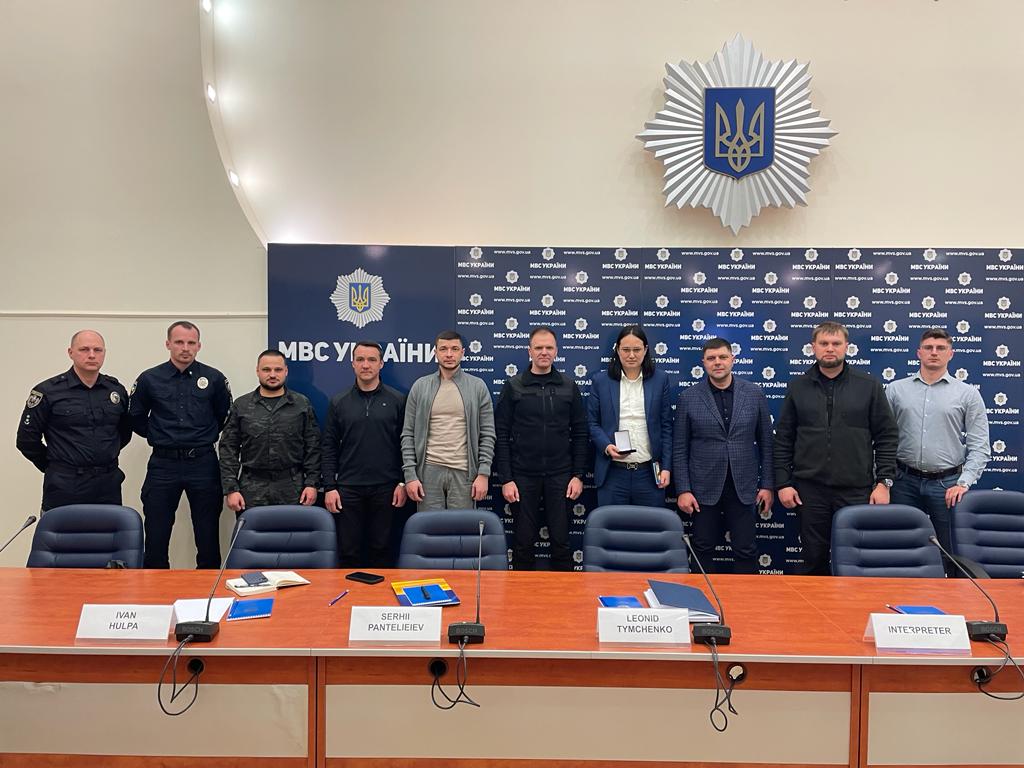
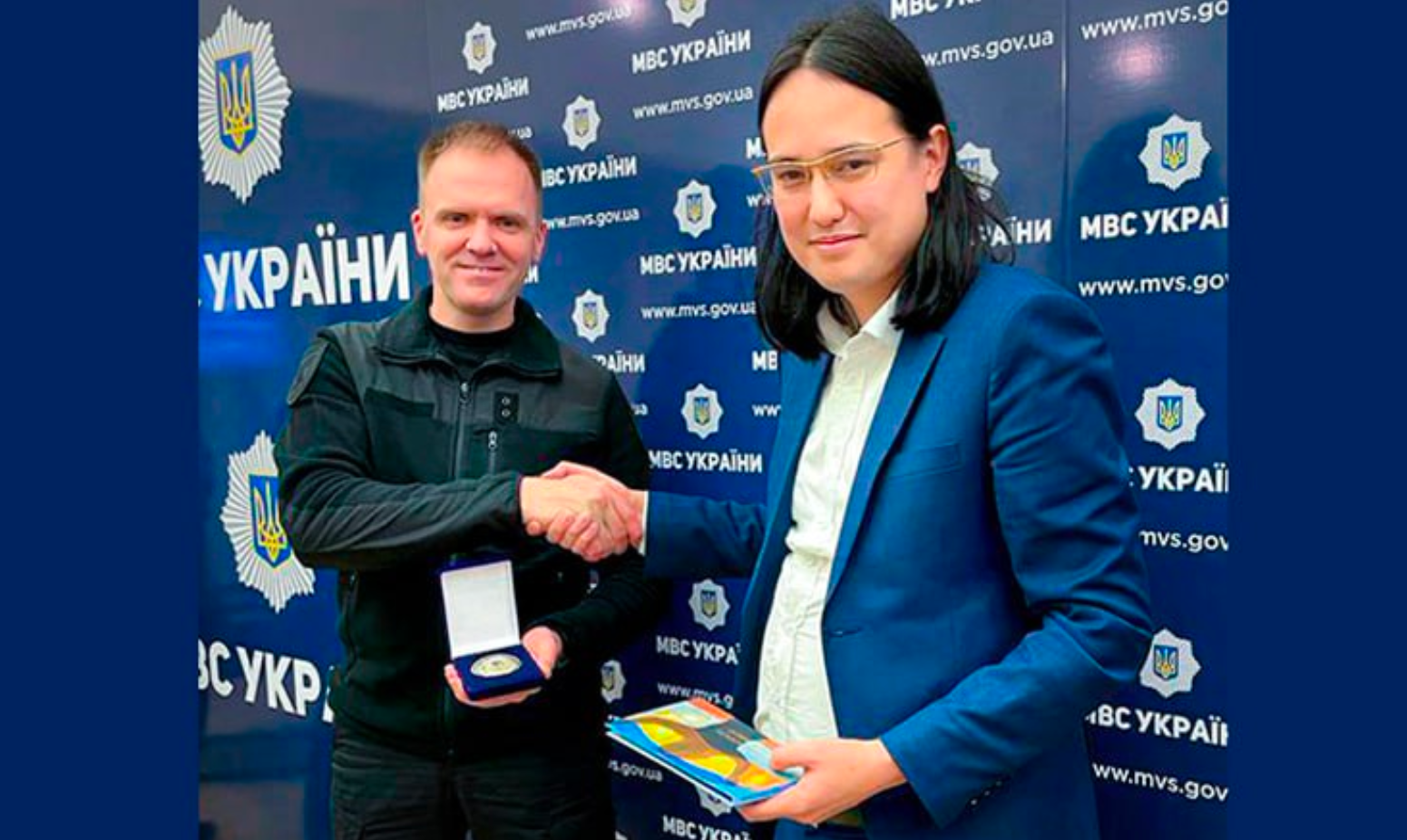
In April 2023, he met Ukrainian officials, including Deputy Interior Minister Leonid Tymchenko. An account of the visit reported that border guards had used the software to identify more than 10,000 people across several categories. That was an official claim about use, rather than an independent audit of each identification. The photographs record something narrower and unmistakable: Ton-That, in a blue suit, being received by officials who wanted to continue working with his company.
He also carried his case for the technology into policy discussions. In a statement for an AI Insight Forum, he argued for oversight that would preserve investigative uses and suggested facial recognition could help address deepfakes and impersonation. The ambition extended beyond finding a person in an existing photograph to deciding whether an apparent person in a video was authentic. The proposed uses grew; the need to establish boundaries traveled with them.
Three exits, then another business
The end of his Clearview leadership came in stages. He stepped down as CEO in December 2024 and became president. In February 2025, he resigned from that role while initially retaining a board seat. Hal Lambert and Schwartz had taken over as co-CEOs. The distinction between these dates matters. An executive job and a board position give different forms of influence; losing one does not automatically end the other.
CEO → president
Resigns as president
Architect CTO role reported
Removed from Clearview board
In April, shareholders voted him off the board. Ton-That said the removal was unexpected. By then, his move to Architect Capital as chief technology officer had been reported. Discussions about possible debt financing for Clearview had preceded that move, although the financing did not proceed. A business conversation had supplied a connection to a different kind of work.
His personal website now identifies him as president at Architect, a San Francisco-based asset manager. The move takes him into finance after years of defending a facial-search business. There is a modest caution in the changing titles: a founder remains a founder after leaving, but that historical description says little about who currently runs a company. For Ton-That, Clearview is part of his biography rather than his present executive job.
Away from those titles, he can be more amusingly particular. He once compared his early taste for programming languages to being a cheese snob, with nerds supplying the audience. He also recalled selling his books to buy a Kindle and regretting the transaction. These small preferences offer a glimpse of someone whose public identity became attached to a vast collection of other people’s images. His own story now has another chapter. The question of what a photograph permits remains available for discussion.