A shopping cart is an unlikely place to begin a story about a philosopher. Yet in 2014, Hirbod Human had one to announce. His Beverly Hills agency, TRIXMEDIA, had developed an ecommerce platform called Goozga, and six retail businesses were already using it. There were new websites for Hilton Universal City and Cyrus Artisan Rugs. There were staff to hire. The work was practical, commercial and full of the small complications that arrive when an idea meets a customer.
Twelve years later, the same founder’s public work includes a book of short stories about political repression in Iran, a documentary about Baroque fashion and an experimental interview with an artificial intelligence system. He is pursuing a doctorate in Design, Aesthetics, and the Arts at Florida Atlantic University. A conventional career biography might tidy these activities into successive chapters. Human makes that difficult. The business, the artwork and the questions keep overlapping.
Seen together, they suggest an absorbing subject: how an arrangement of words, pictures or objects changes what someone notices. A website asks for attention. An exhibition directs it. A short story can make a reader stay with a life that would otherwise disappear into a headline. The purposes differ; the care over presentation travels between them.
The audience gets a vote
TRIXMEDIA identifies Human as its founder and CEO. Its work spans branding, naming, packaging, graphic design, websites and online advertising. Coca-Cola and Hilton appear in his professional portfolio. Those names supply a familiar shorthand for a design career, but the more revealing detail is his concern with the person on the receiving end.
His explanation of the agency’s origins criticizes websites built to satisfy their owners rather than their intended audiences. He wanted a business that would keep working with clients as their needs changed. There is an unglamorous discipline in that ambition: the attractive presentation must survive use. The customer arrives with an objective, a limited amount of patience and absolutely no obligation to admire the designer.
The 2014 expansion makes that principle concrete. Copywriter Ted Myers had joined the staff the previous year, bringing experience in music, editing and advertising. Human was adding people as new accounts arrived. “We’ve had to increase our staff,” he said. Goozga put another task on the desk: helping retailers turn a website visit into a purchase. Creative work here included language, software and the machinery behind the picture.
That experience also became teaching material. The open educational course Branding and Reputation, credited to Human and dated February 28, 2022, forms part of the Entrepreneurship for Creatives microcredential series. It introduces brands and their relationship to marketing a product. The intended learners are creative people bringing designs, products and services to market. A good idea still has to explain itself when it leaves the studio.
Audience & identity
Objects & context
Perception & experience
“Your success is our success.”
TRIXMEDIA’s stated approach
Art leaves the meeting room
Human moved to the United States in 2002. He studied art and business, and his engagement with filmmaking included cinema studies at Los Angeles City College. His filmography stretches back to The Angel, a short film from 2004, and Banooye Sarbandan, a biographical documentary from 2005. The moving image was already part of the story before the agency’s public announcement about shopping carts.
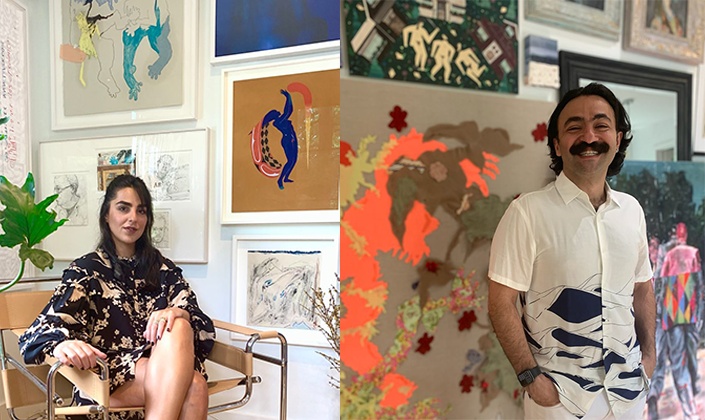
In Toronto, art became an institutional undertaking as well as a personal interest. He founded Mayten’s Contemporary Art Gallery and took part in the life of The Power Plant Contemporary Art Gallery. In July 2021, The Power Plant invited him and curator Farnoosh Talaee to a public conversation about collecting, moderated by Josh Heuman. The questions were wonderfully direct: what makes someone collect, how do they choose, and what happens after the work comes home?
The photograph accompanying that event places Talaee and Human among artworks. Paintings occupy the walls around them with the confidence of permanent houseguests. It is an apt setting for a conversation about possession and responsibility. Collecting gives the buyer an object; it also gives that object a new context, new neighbors and a different audience.
In 2022, Human produced Earth Oracles at Mayten’s as director of exhibition and programming, with Talaee serving as curator. Its participating artists included Linda Sormin, Laurent Craste, Sami Tsang and Roxanne Jackson. The exhibition brought together works that unsettled familiar expectations of material, form and history. It gave the business of looking a physical address, and visitors something more demanding than a neatly behaved decorative object.
A city, rearranged by color
By 2024, Human was working with photographer Dennis Church on AMERICOLOR: Exploring Urban Color Fields. The project became both a book and an exhibition at Palm Beach Atlantic University. Human curated the exhibition and authored the book’s text; Church made the photographs. That division matters. Human’s role was to arrange an encounter with another artist’s way of seeing.
The exhibition ran from August 12 to October 4 at the Tauni De Lesseps Gallery of Art in the university’s Warren Library. Twenty selected photographs drew on ordinary urban environments: streets, construction sites, alleys and the visual interruptions of advertising. The accompanying book widened that selection to more than one hundred photographs.
There is a pleasing complication here for someone who runs a branding firm. In these photographs, commercial signs become part of the city’s visual material. An advertisement may be trying to sell something while a photographer is recruiting it for an entirely different composition. The message acquires a second life. A curator, in turn, decides which of those encounters belong beside one another.
Thirteen minutes in Baroque Spain
At Florida Atlantic, Human’s research places perception and cultural experience under closer examination. He works with philosopher Richard Shusterman at the Center for Body, Mind, and Culture. His doctoral field brings design into conversation with aesthetics and the arts, a setting broad enough to accommodate questions that do not sit politely inside one profession.
One result is Baroque Bodies: Somaesthetics and the Art of Appearance, his 2025 academic documentary. Running thirteen minutes and twenty-four seconds, the film examines fashion, movement and visual appearance in Baroque Spain. Its paintings are drawn from the exhibition Splendor and Passion: Baroque Spain and Its Empire. Clothing becomes a way to examine power and identity.
The film developed alongside his research presentation, Dressing the Body, Structuring the Mind: Somaesthetics and Baroque Fashion, presented at the Boca Raton Museum of Art in March 2025. Paper and film address related questions through different forms. An argument on a page and an image held on a screen give an audience different ways into the same subject. Human used both.
Baroque Bodies turns paintings, clothing and movement into an inquiry about power.
Six stories, and the duty to listen
His fiction approaches authority from a more intimate distance. Last Moments: The Dark Shadows of Protest in Iran consists of six short stories informed by personal experience and interviews. Human was born in Iran in 1978 and grew up amid war and political upheaval. By sixteen, he was working as a reporter and had acted in a television production that was withheld from broadcast.
For this book, the brevity is deliberate. Rather than build a long explanatory structure around political repression, he places readers inside particular moments. The short form offers little room to settle in. It brings ordinary people close before a reader has the comfort of treating their lives as a distant historical subject.
In discussing the writing, Human has described changing identifying details, combining experiences and moving settings to protect the people who spoke with him. The decisions are central to the work. An interview gives a writer material, but it also creates an obligation to the speaker. He used fiction to carry those experiences without making the page a map back to an individual.
In 2026, Last Moments received finalist recognition in Regional Fiction at the Next Generation Indie Book Awards. Human greeted that recognition with a little theatrical caution about calling himself an award-winning author. The joke offers a welcome glimpse of lightness around serious work. He also wrote about the pleasure of meeting readers at Arts Launch Broward and being asked to sign a book. Publication becomes a conversation with an actual person holding the object.
The interviewer meets the machine
Human’s 2025 video work Project No Witness stages an interview between himself and an AI system. It examines censorship, silent updates and private digital exchanges. Selected for the Future Frames exhibition at the University of Maryland, it brings his interest in presentation into a setting where the other participant can change without announcing the change.
His university recognized the work alongside two fellowships for 2025-26: the Newell Doctoral Fellowship and the Graduate Access Fellowship. The 2026 Design Principles and Practices conference also named him an Emerging Scholar Award recipient. These are distinct kinds of recognition for a practice that keeps moving between making an object and examining the conditions around it.
Conversation continues in audio. Human produces and directs atmospheres, hosted by Shusterman, drawing on exchanges recorded during the 2024 conference at Florida Atlantic. Philosophy, art, architecture and design share the microphone. The recording gives a meeting a life beyond its original room.
Then there is golf. In a public birthday reflection, Human described finally taking up a sport he had wanted to learn as a teenager in Iran. “Some dreams don’t expire,” he wrote. After the agencies, exhibitions, films and manuscripts, the detail feels agreeably ordinary. There is another skill to learn, another kind of attention to practice, and a ball with very little interest in anyone’s credentials.
Follow the work
Read, watch and listen across Human’s practice.