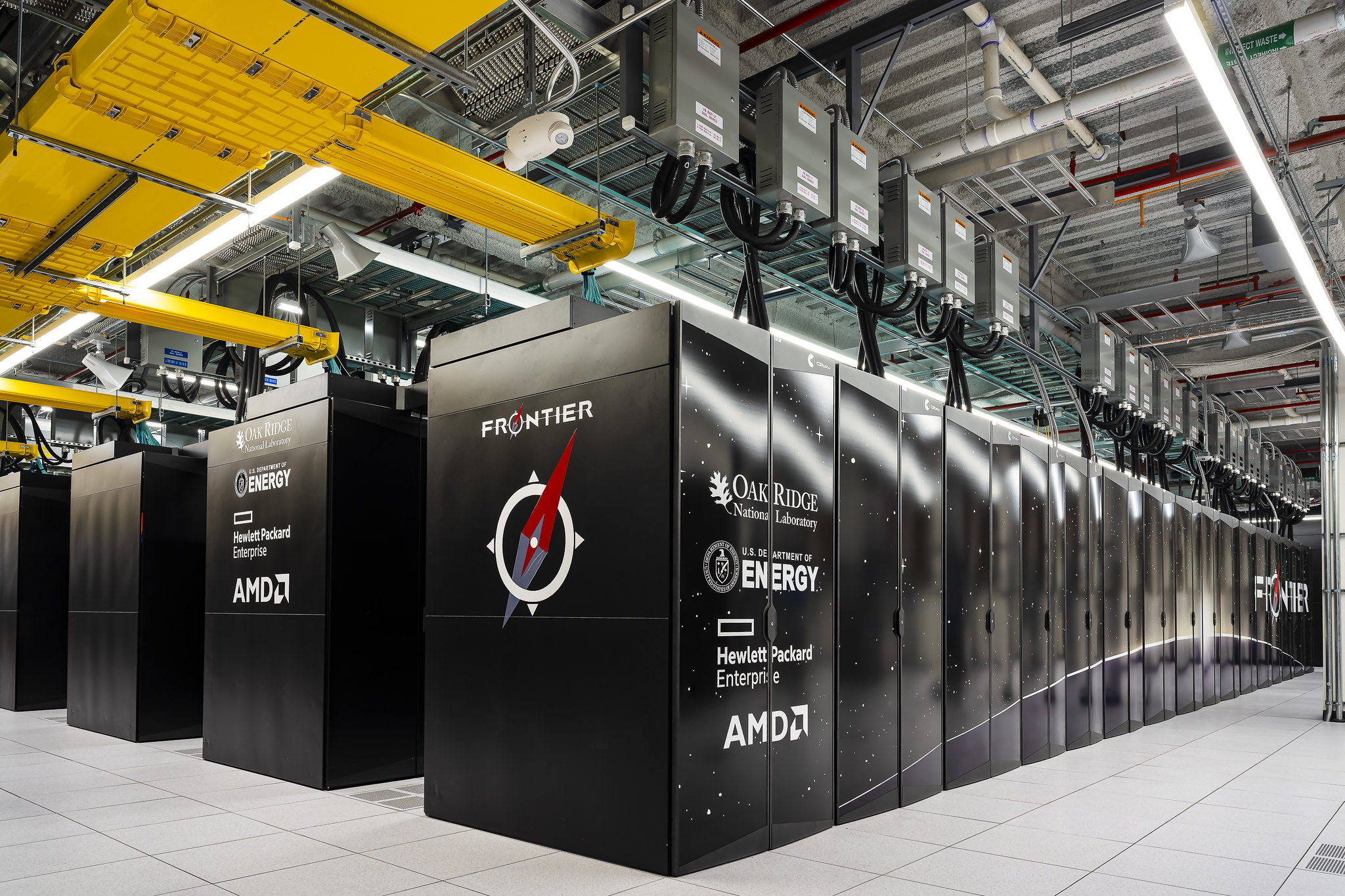
A cloud can be surprisingly difficult to move. Consider Frontier, the HPE Cray EX supercomputer at Oak Ridge National Laboratory: cabinets, cables, processors, cooling. In 2022, it crossed the exascale threshold on the TOP500 benchmark, performing more than a quintillion calculations per second. The achievement required HPE and AMD technology working as a system. Even at this scale, computing has an address.
That physical reality helps explain Hewlett Packard Enterprise. The company sells the machinery and software beneath corporate computing: servers, storage, networks, cloud management and increasingly AI systems. Its interesting proposition is that an organization can want the convenience of cloud computing while having good reasons to keep equipment, data and operational control close.
- The proposition: cloud-style operations across infrastructure companies control.
- The big move: Juniper adds networking breadth to HPE’s AI ambitions.
- The buying test: compare the complete bill, including commitments and idle capacity.
01 The cloud that closed
There is a failed experiment behind this proposition. In October 2015, shortly before Hewlett-Packard separated, HP announced that Helion Public Cloud would close on January 31, 2016. Selling public cloud capacity had not become a durable position against the expanding providers. The business would concentrate on private and managed cloud capabilities instead.
Bill Hilf, then running HP’s cloud business, told CRN that partner growth and customer demand for hybrid computing helped drive the decision. That is the documented explanation; a sweeping conversion story would add more psychology than the evidence supports. What changed was the offer: help customers assemble and operate their computing environments, including public cloud services supplied by partners.
HPE became independent on November 1, 2015. HP Inc. kept PCs and printers. Bill Hewlett and Dave Packard founded the predecessor in 1939; the enterprise company inherited their names and engineering history. Its corporate birth was a separation, with an installed customer base, rather than two people starting again in a garage.
02 A cloud you can walk into
GreenLake makes the strategy tangible. Depending on the service, customers can operate infrastructure in their facilities or a colocation site with a cloud management experience and consumption-based payments. The location and payment model are separate decisions. Buying something “as a service” does not automatically mean shipping every byte into somebody else’s building.
The product names describe different jobs. ProLiant servers run applications. Alletra storage holds and serves data. Aruba and Juniper connect users, branches and data centers. Morpheus handles provisioning and governance across environments; OpsRamp adds operational visibility. HPE also sells support, consulting, managed services and financing. Integration is part of the product, and part of the bill.
Private Cloud AI, introduced with NVIDIA in June 2024, packages compute, storage, networking and AI software together. Its appeal is practical: fewer components for a customer to integrate before developing and running AI applications. In March 2026, HPE announced expansion racks supporting up to 128 GPUs and an air-gapped configuration for its large system.
HPE names Danfoss, the Ryder Cup and the Dallas Cowboys as users of Private Cloud AI. Research laboratories supply another kind of customer, illustrated by Frontier. Across its wider business, HPE reports working with 55,000 organizations. These buyers have different workloads; a laboratory simulation and an enterprise document assistant should not inherit the same shopping list.
Conceptual diagram; product configurations vary.
03 The $14 billion connective tissue
In January 2024, HPE agreed to acquire Juniper at an equity value of approximately $14 billion. The deal closed in July 2025. Juniper brought routing, switching, security and Mist’s AI operations technology alongside HPE’s existing Aruba portfolio. The logic is straightforward: processors cannot do useful work while waiting indefinitely for data to arrive.
The combination also carried a regulatory price. The Justice Department challenged the transaction. The settlement required divestiture of HPE’s Instant On business and licensing of specified Juniper Mist AIOps source code. That history matters when assessing a purchase advertised as greater customer choice: regulators had raised concerns about losing competition between the two companies.
HPE now competes across several overlapping markets. Dell and Lenovo are alternatives in servers and infrastructure; Cisco and Arista compete in networking segments. Public cloud providers can replace some on-premises workloads and coexist with others. HPE’s argument rests on joining these pieces around a customer’s estate, rather than winning every individual component comparison.
Quarter ended July 31; reported September 2, 2026. Values rounded. Reported growth includes Juniper.
In fiscal 2025, HPE recorded $34.3 billion in revenue. September 2026 brought a $12.2 billion quarterly result, up 34% year over year. Those figures describe a larger business, but Juniper is part of the comparison. Acquisition-driven growth should not be mistaken for evidence that existing customers suddenly bought a third more equipment.
04 The meter has a minimum
Revenue comes from equipment, software, services, support and financing, alongside consumption contracts. GreenLake makes spending resemble a utility bill, but a meter does not abolish commitment. HPE’s billing documentation describes top-up charges when actual spending falls below a contractual minimum. The details depend on the agreement.
For a buyer, the relevant cost includes software, support, power, cooling, staffing and unused capacity. Private AI also needs prepared data and a useful application. A system that simplifies deployment cannot supply either by itself. Short experiments or highly variable demand may favor public cloud; steady workloads and strict data-location requirements can make private infrastructure worth evaluating.

“The AI race is fundamentally about speed, scale, and trust.”
Antonio Neri / HPE announcement, March 2026
Running that business also requires people who can connect technical specialties. HPE describes its culture around customer focus, collaboration and unconditional inclusion, with development opportunities and flexible work in its careers material. These are the employer’s stated commitments. For customers, the consequential test is whether expertise crosses product boundaries when a deployment needs attention.
05 Start with the workload
The part a reader can copy is the order of decisions. Identify the application. Establish where its data may live and how quickly it must respond. Measure demand. Then compare infrastructure and operating models over the same period, including contract minimums and exit costs. HPE’s evolution makes this useful habit visible: start with the work, and make the cloud fit.
A useful pilot should resemble the eventual workload. Run it against representative data, record response times and measure utilization during quiet periods as well as busy ones. Ask who patches the software, restores lost data and handles a failed component. Compare that operating arrangement with the public cloud alternative. The decision becomes easier when both proposals include the same responsibilities. A low hardware price tells you little if the remaining work lands on your team.