The revealing part of Gensco’s story is what happened before anybody bought anything. The HVAC distributor had a Microsoft environment whose licensing had grown complicated as the business evolved. CompuNet began by examining the licenses Gensco held, the software it actually used, and the places where the two could be better aligned. In a business accustomed to selling the next thing, an inventory of the present thing can be surprisingly persuasive.
- The offer: IT advice, implementation, technology resale, and continuing support.
- The distinguishing claim: engineers lead the engagement, from diagnosis through delivery.
- The evidence to examine: customer accounts about licensing, ransomware recovery, and offsite backups.
- The buyer’s lesson: ask for the reasoning behind the shopping list.
Gensco’s published testimonial describes an engagement that was educational as well as strategic. The team wanted to understand Microsoft’s licensing model and make better budget decisions. CompuNet offered recommendations tied to the distributor’s needs. The attraction was partly technical knowledge and partly the relief of having someone translate a complicated purchase into a comprehensible decision.
“It didn’t feel like a sales pitch.”
Gensco IT manager / customer testimonial, July 2025
That is a useful place to begin understanding CompuNet. The company works in the middle of the technology market, between manufacturers with products to sell and organizations with work to get done. Its proposition is that the middle deserves an engineer. An impressive catalog is of limited comfort when the customer’s actual problem has been misunderstood.
Five engineers for every account manager
There is a wonderfully specific number in CompuNet’s history. In a July 2016 procurement response, it described a five-to-one ratio of engineers to account managers. The same document reported more than 180 employees, including 100 engineers. Those figures describe that moment; they should not be quietly promoted into today’s staffing statistics.
It matters because it gives a buyer something more concrete than the usual promise of expertise. A company organized around engineers has made a choice about where to put labor. The question is whether the people who can inspect the dependencies, spot the awkward configuration, and explain the tradeoffs get into the conversation early enough to influence what is sold.
Today CompuNet calls its approach an engineering-led engagement model. That remains a positioning claim, not proof that every project succeeds. The customer examples make it worth examining. They show several versions of the same sequence: look at the existing environment, decide what needs to change, then assemble the products and services around that decision.
The backup has to leave the building
Consider Tree Top, the grower-owned fruit cooperative. In an account published by 11:11 Systems in April 2023, the problem was an aging approach to data retention. Its primary infrastructure relied heavily on physical disks for backup, while offsite storage and disaster recovery needed attention. A backup sitting close to the original system can be reassuring until the trouble affects both.
Tree Top and CompuNet evaluated the market and selected Veeam for on-premises backups. They then addressed the remaining gap with 11:11 Systems. The resulting combination included Cloud DRaaS for Veeam, Cloud Backup for Veeam Cloud Connect, and Cloud Backup for Microsoft 365. The decision divided a broad worry into separate technical requirements.
This is systems integration in a form that needs no mystique. Different products serve different parts of the requirement, and somebody has to make the combination useful. The buyer’s goal is recoverable operations. The logos are ingredients.
Recovery before reassurance
For Blaine County School District, the problem had already arrived. In a testimonial published in July 2025, technology director Paul Zimmerman described a ransomware attack and CompuNet’s assistance through recovery. He said the district recovered its systems without paying the ransom and added stronger security measures afterward. This is the customer’s account, not an independently audited incident report.
“Their deep technical knowledge and calm, clear communication made all the difference.”
Paul Zimmerman / Director of Technology, Blaine County School District
The two qualities belong together. During a recovery, technical competence has to travel through decisions made by other people. Clear communication helps those people understand the next step. The district’s story makes that working relationship visible without turning an attack into a tidy moral fable.
AAA of Washington offers a different security example. Its CISO, William Lidster, described CompuNet’s Microsoft work as including security hardening, policy development, integration, and training. In his published account, the organization improved detection and response. The implementation extended beyond turning on a tool: the surrounding procedures and the people using them were part of the job.
CompuNet’s cybersecurity menu reflects that breadth. It includes framework gap assessments, zero trust readiness, penetration testing, tabletop exercises, managed detection and response, and firewall services. Buyers can engage around a diagnosis, a specific implementation, or continuing operations. Those are distinct assignments, even when they share the same security vocabulary.
The renewal that became a migration
A February 2025 CompuNet account describes an unnamed social services organization preparing to renew and expand its on-premises Splunk deployment. Joint evaluation with Splunk led to a different decision: move to Splunk Cloud. CompuNet reports time and money benefits, though it gives no numerical savings. The interesting detail is the changed destination.
A renewal can disguise itself as an administrative task. Here it became an opportunity to reconsider where the system should run. That is a useful habit to copy: before extending a contract, reopen the assumptions that made it sensible in the first place.
CompuNet’s broader cloud practice lists workload planning, dependency mapping, landing zones, infrastructure as code, and cost reviews. Its data center practice includes storage, virtualization, data protection, and hybrid environments. Together these offerings leave room for different architectures. The work begins with the workload and its constraints, rather than the elegance of a cloud slogan.
A room, a door, a network
The portfolio has an amusingly physical edge. CompuNet deals with meeting-room audio, video, and controls, as well as video surveillance and access control. A company’s digital experience includes the conference room where nobody can hear the remote participant and the door whose permissions must be managed. Both become engineering problems when enough people depend on them.
Its enterprise networking work supplies another layer: network design, wireless implementation, access policies, and observability. The digital workspace practice covers calling, contact centers, messaging, and collaboration. The business applications offering reaches into automation, CRM, and business intelligence. These categories are easier to understand as connected workplace needs than as a procession of acronyms.
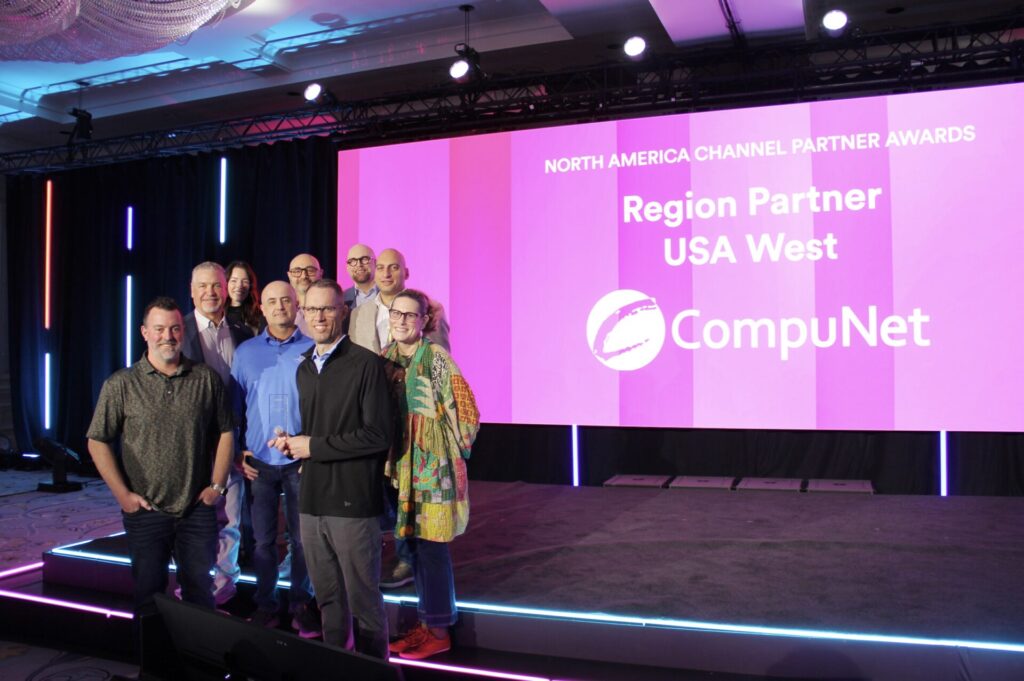
The partner roster helps explain how CompuNet covers that territory. Its public partner page lists Cisco, Palo Alto Networks, Microsoft, storage and infrastructure vendors, and physical security suppliers. In April 2025, CompuNet announced its sixth Microsoft Solutions Partner designation, adding Business Applications to the other five areas and qualifying for the Microsoft Cloud designation. Breadth of certification supports its positioning; the customer’s deployment remains the more practical test.
The purchase begins with a diagnosis
CompuNet is a value-added reseller and managed service provider. It earns its place through a combination of technology purchasing, professional services, and ongoing support. That puts it alongside national integrators, regional providers, specialist consultancies, and the customer’s own IT department as possible ways to get a project done.
The fit depends on how much coordination the work requires. A standardized, modest installation may need little outside architecture. A business combining legacy infrastructure, Microsoft applications, security policies, and multiple locations has more decisions to reconcile. Outside expertise also needs an internal owner who can set priorities and accept the result. Hiring engineers does not outsource the business’s judgment.

Growth provides another test of the model. CompuNet’s September 2024 Denver announcement named both a director of sales and a director of engineering to lead the new market, with a dedicated team to follow. The pairing gives its expansion a recognizable shape: commercial relationships and technical delivery are represented together.
The lesson a buyer can borrow is pleasantly ordinary. Inventory what you have. Name the operational problem. Make recovery a requirement, not an afterthought. Ask who will engineer the solution and who will own it afterward. CompuNet’s most persuasive stories concern those questions. The shopping list can wait until someone has answered them.