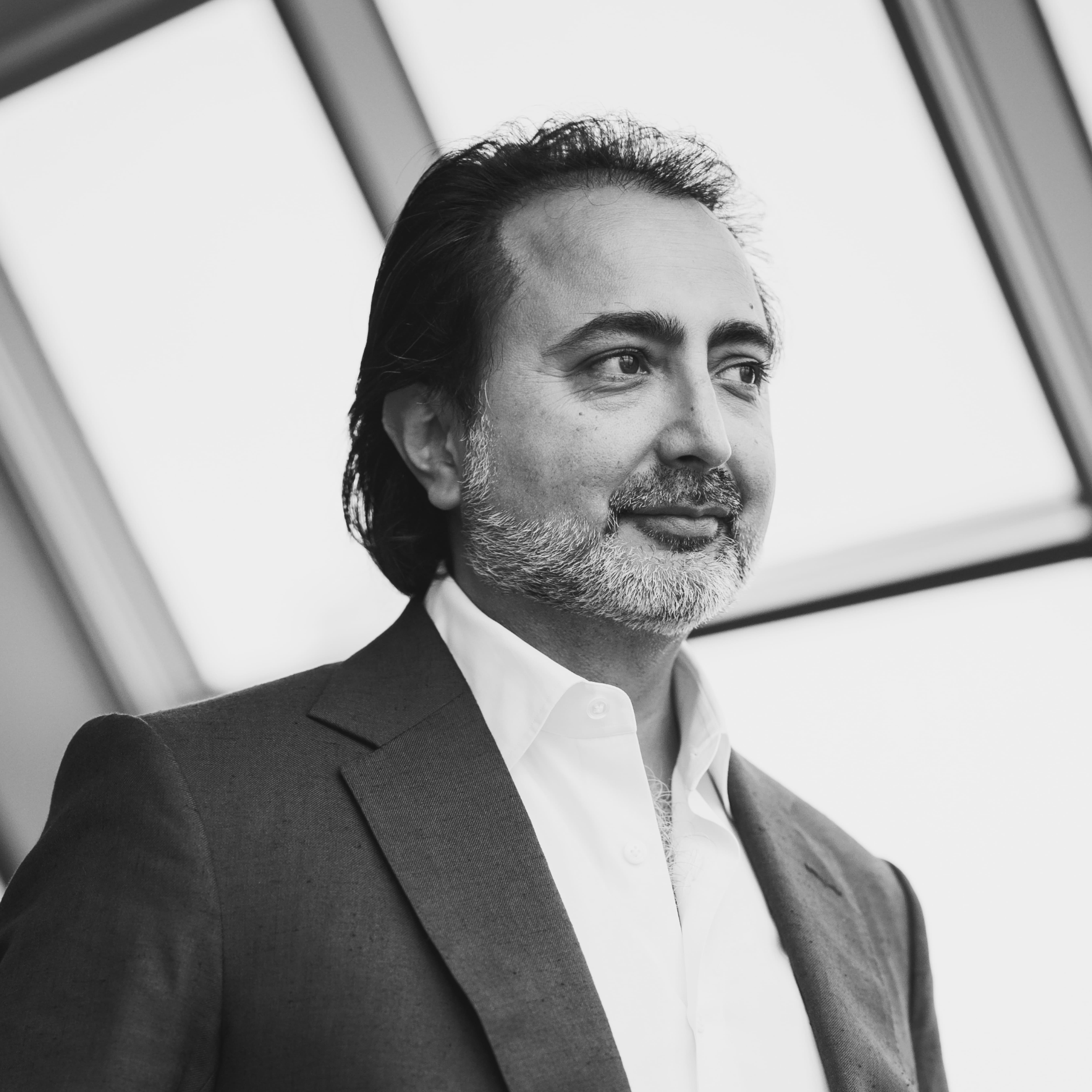
In 2024, Hemant Taneja - CEO of General Catalyst - did something that made the venture capital industry rub its eyes and look again. He bought a hospital. Not metaphorically. A real hospital system in Akron, Ohio: Summa Health, three hospitals, thousands of patients, all the complications that come with actually delivering care. General Catalyst created HATCo - the Health Assurance Transformation Corporation - specifically to run it. No VC firm had done anything like this before. The industry called it audacious. Some called it baffling. Taneja called it the only logical next step.
This is the thing about Taneja: he follows the logic wherever it leads, even when it leads somewhere nobody else has gone. He grew up in a low-income household in Delhi, India. Came to America for high school in Boston. Enrolled at MIT intending to become an educator. Left with five degrees across biology, mathematics, electrical engineering, computer science, and operations research. Somewhere in those five disciplines he found the connecting thread - that all of society's biggest problems are systems problems, and that technology, applied carefully, can fix systems.
"We've literally taken every one of these important services in society and scaled them to the breaking point."
- Hemant Taneja
The Man Behind the Machine
Taneja joined General Catalyst in 2002 as an Entrepreneur-in-Residence, after founding and selling a mobile software company. He rose through the firm over two decades, becoming Managing Director and eventually CEO in 2021. What he inherited was already a top-quartile fund. What he has built since is something that doesn't have a clean category: part investment firm, part operating company, part research institution, part healthcare provider.
Under his leadership, GC has grown to more than $40 billion in assets under management. Its 2024 fund raise of $8 billion - structured as $4.5 billion in core VC, $1.5 billion for an AI "creation" strategy, and $2 billion in separately managed accounts - was its largest ever. The firm has backed Stripe across 14 rounds and more than $5 billion invested, one of the most committed single-company relationships in venture history. It was an early backer of Snap, Anduril, Applied Intuition, Gusto, Samsara, Grammarly, Canva, and Anthropic.
But the investments that define Taneja's thinking aren't the headline names. They're the ones he co-founded himself. In 2014, he co-founded Livongo Health - a digital health company focused on chronic disease management using continuous data. Livongo went public in 2019 and was acquired by Teladoc in 2020 for $18.5 billion, the largest digital health merger ever recorded. He also co-founded Commure (now merged with Athelas), Hippocratic AI, and Transcarent - building, not just betting.
A Soul Outlives the Body
Ask Taneja why certain founders succeed where others fail, and he reaches for Vedic philosophy. "I grew up in India with Vedic philosophy: Your soul outlives your body," he has said. "I look at that and say, is a founder going to build a company that's going to outlive them? If they're really building with that kind of mindset, it's not about them; they're actually building an institution." It's not a metaphor he deploys casually. It's the frame he uses to evaluate everything - whether a company has enough soul to outlast its founding moment.
This is why the hospital acquisition makes a certain kind of sense. Taneja has spent years arguing that healthcare needs to shift from treating illness reactively to assuring health proactively. He helped develop the intellectual framework in his 2020 book "UnHealthcare," co-written with Dr. Stephen Klasko and Kevin Maney. But writing about it wasn't enough. Investing in startups that were trying to do it wasn't enough. To actually prove the thesis, he concluded, you have to run a health system yourself and demonstrate the transformation from the inside.
"I grew up in India with Vedic philosophy: Your soul outlives your body. I look at that and say, is a founder going to build a company that's going to outlive them? If they're really building with that kind of mindset, it's not about them; they're actually building an institution."
- Hemant Taneja
The Unscaled Thesis
Taneja's 2018 book "Unscaled," also with Kevin Maney, laid out the investment philosophy that has guided General Catalyst's portfolio decisions for nearly a decade. The argument: traditional economies of scale - build big, spread fixed costs, dominate through distribution - are being inverted by AI and cloud infrastructure. Small companies can now rent the capabilities that used to require massive organizations to own. They can hyper-personalize for narrow markets and outperform the incumbents who scaled themselves into rigidity.
It was a framework that aged well. Stripe, Gusto, Canva, Grammarly - all of these companies grew large without the bloat that characterized the prior generation of enterprise software. The pattern held across healthcare, energy, financial services, and media. Taneja identified it early enough to build a portfolio around it.
His 2022 book "Intended Consequences," a Wall Street Journal bestseller co-written with Kevin Maney and with a foreword by Kenneth Chenault, took the argument further: responsible innovation isn't a constraint on building market-leading companies, it's a source of competitive advantage. Founders who embed ethics and accountability from day one build more durable institutions than those who optimize for growth and retrofit responsibility later.
The Critic Inside the Cathedral
What sets Taneja apart from most people managing $40 billion is his willingness to criticize the system that made him rich. In a notable letter to General Catalyst's limited partners - the institutional investors who back the fund - he argued that venture capital had "not risen to the occasion" during one of the greatest periods of innovation and investment in history. The industry had generated enormous returns while contributing to declining social trust, widening inequality, and unsustainable environmental practices.
He didn't write that letter to signal virtue. He wrote it to announce a change in strategy: General Catalyst would organize itself explicitly around societal transformation, not just financial returns. The five sectors it focuses on - healthcare, defense and government, industrials and manufacturing, energy and infrastructure, and financial services - are chosen because they matter most to how society functions, not because they offer the easiest returns. The hospital acquisition was the most dramatic demonstration of that commitment.
On AI, he is bullish without being naive. "Bubbles are good because they mobilize capital and talent into new vectors of innovation," he told an Israeli tech conference in 2024. He acknowledges that hype cycles are real and that not every company riding the AI wave will survive it. But he believes the underlying capabilities are genuine and the transformation of his five sectors is not optional - it's happening, and the only question is who builds it responsibly.
Beyond the Portfolio
Taneja and his wife Jessica signed the Giving Pledge in 2024, committing to donate the majority of their wealth. Their Taneja Family Foundation has made substantial gifts, including to Tampa General Hospital. He donated to fund the Shiv and Santosh Taneja Innovation Alcove at MIT.nano - named after his parents - a gesture that connects his trajectory from Delhi to Cambridge back to where it began. He serves on the Stanford School of Medicine Board of Fellows and as a trustee of Northeastern University. In 2023, he co-founded Responsible Innovation Labs, a nonprofit focused on ethical AI governance.
His wife Jessica, meanwhile, runs Dhyana Grove Farm and Winery - a 90-acre property in the Colorado Rocky Mountains. She is also a professional mosaic artist working in modern abstract forms. The contrast with her husband's world is almost theatrical: he acquires hospital systems while she makes mosaics on a mountain farm. Both, presumably, with patience.
In September 2025, Taneja published his fourth book, "The Transformation Principles," again with Kevin Maney. It became a national bestseller and was named to Bloomberg's Top Books of 2025. Forbes estimated his net worth at $3.6 billion the same year. He is the rare billionaire who writes books about giving his money away while simultaneously figuring out more ambitious ways to deploy it.
"This is peak ambiguity. We don't really know the capabilities of this technology as it develops, and geopolitics is changing business in a material way. In times like this, think deeply about your values because that's going to be your guiding light."
- Hemant Taneja, 2025
The through-line in everything Taneja does is long-termism of a very specific kind - not patience about returns, but seriousness about consequences. He built Livongo over years before it became a $18.5 billion exit. He has backed Stripe through 14 rounds. He writes books with the same co-author across a decade. He names a lab after his parents rather than himself. He buys a hospital to prove a thesis rather than just tweet about it. These are not the moves of someone optimizing for the next quarter. They're the moves of someone who intends to be around long enough to see if he was right.
The five MIT degrees weren't about collecting credentials. They were about learning to see systems whole - to understand the biology and the mathematics and the engineering and the operations research as one connected thing, rather than separate disciplines. That habit of mind, carried from Cambridge to Sand Hill Road, is what makes Taneja something rarer than a successful venture capitalist. It makes him a genuine theorist of how technology and society interact - one who insists on proving his theories by doing, not just writing about them.