The origin story comes with no kombucha tap, no softly glowing skin-care wall, no refrigerated acreage of organic kale. In 1995, Ayoob Dadabhoy began with a small kiosk in a strip mall on Toronto’s Danforth Avenue, selling bulk food alongside his family. His son Asif established The Healthy Planet at Scarborough’s Parkway Mall in 1998. It was a modest format aimed at a customer who wanted something mainstream retail did not yet serve particularly well: natural products, useful guidance and a price that did not turn wellness into a luxury costume.
Three decades later, the private, family-owned company operates 45 stores across Ontario and a national e-commerce business. The modern Healthy Planet carries vitamins, supplements, sports nutrition, organic produce, pantry goods, natural beauty, baby and pet products, and environmentally minded household supplies. Larger stores add Healthy Planet Kitchen, a prepared-food counter serving bowls, wraps, salads, pizza, smoothies and juices. Imagine a vitamin shop and a small organic supermarket agreeing to split the rent, then inviting a lunch counter to join them.
The ceiling arrived disguised as an aisle
The company’s first act was supplements. Its second was realizing supplements are usually an occasional mission, not a weekly habit. By 2018, food made up 20 percent or less of the assortment in many Healthy Planet locations. Monica Walker, who had run her own Toronto organic shop and worked with Healthy Planet from the supplier side, joined with an unusually concrete assignment: get food beyond half of the business in each store.
That mandate changed the company’s centre of gravity. Produce appeared as a staple in newer stores. Frozen, refrigerated and pantry ranges widened. The buying rule stayed narrow enough to preserve a point of view: natural or organic where appropriate, local when possible, with taste as a veto. Walker has been blunt about that last test. A virtuous cracker that eats like ceiling tile is still a bad grocery product.
“The products need to taste good, because we want to be seen as a grocery store first and foremost.”Monica Walker, head of food and grocery
This was the first thing that failed, in the useful strategic sense: the original supplement-heavy format could not capture enough of the customer’s ordinary week. Healthy Planet did not discard its expertise. It built grocery around it. The result solves several jobs in one trip - finding a specialist protein powder, asking a nutritionist about an ingredient, picking up organic produce and grabbing dinner. Competitors can match one aisle. Fewer can match the combined errand.
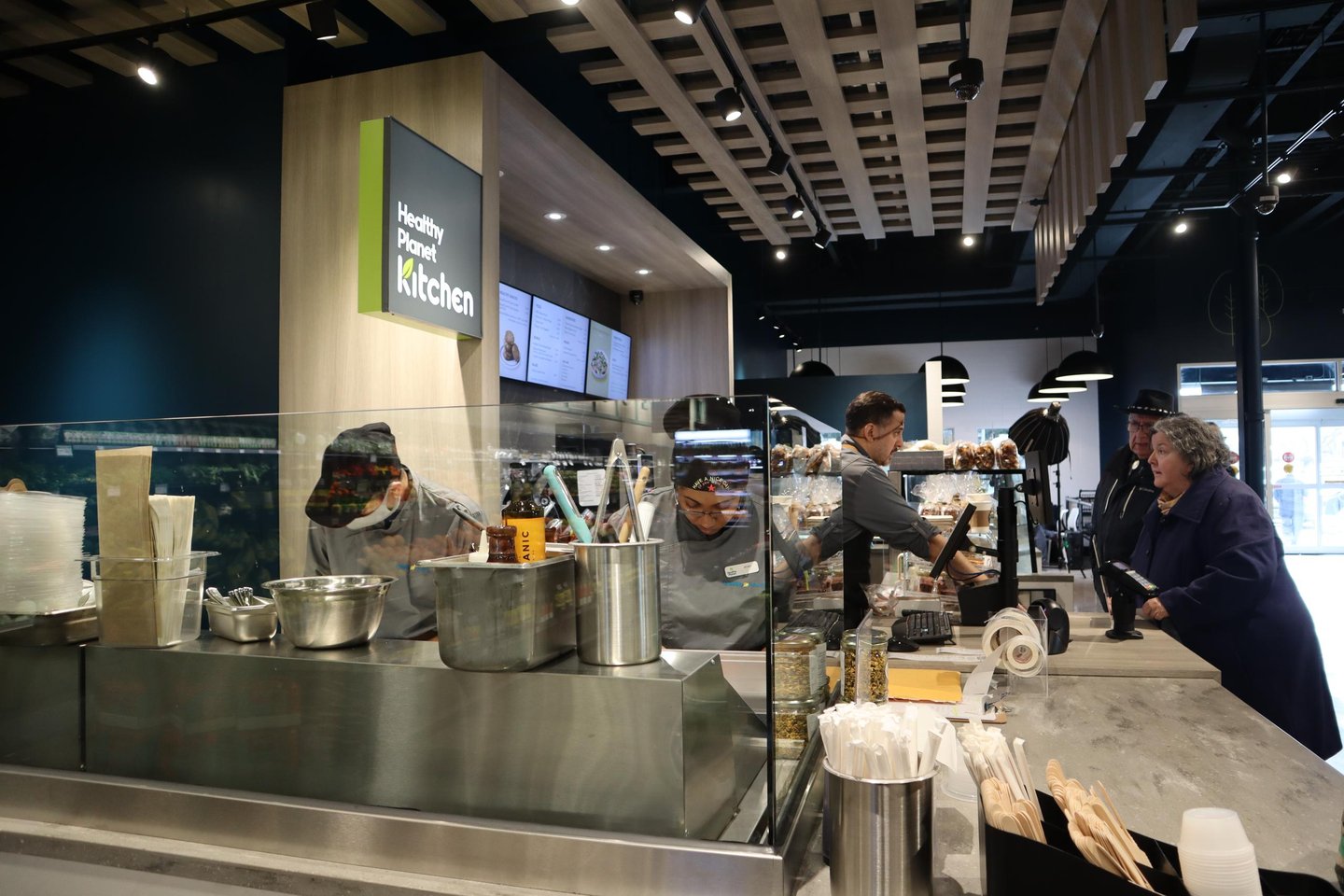
A kitchen, but not everywhere
The next adjacency was prepared food. Healthy Planet opened its first Kitchen in a 12,000-square-foot Ajax store in 2023 and hired chef Maria Mancuso to develop the menu. This matters. It was not a lonely panini press dropped beside checkout. Soups, salads, sandwiches, wraps, bowls, pizzas, baked goods, juices and smoothies created a small foodservice operation inside retail, with all the labour, freshness and waste questions that implies.
Management’s restraint is as informative as the experiment. The company has said Kitchens will go only where space permits. The cost lives in the format - more square footage, specialized staff, equipment, food-safety systems and daily production. Healthy Planet is treating the counter as a location-dependent layer, not a chain-wide decoration.
The 18,000-square-foot Etobicoke flagship, opened in March 2024, shows the idea at full size. It combines produce, natural grocery, supplements, beauty, household goods, seating and a Kitchen. The location can meet the planned stock-up, the expert question and the impulsive lunch. A smaller shop may have the demand but not the back-of-house geometry. Retail concepts often break when enthusiasm outruns plumbing.
From specialist shop to weekly basket
The first two bars describe the grocery team’s 2018 mandate. The third reflects the company’s trailing 12-month in-store sales mix to June 2026.
The assortment is the business model
Healthy Planet makes money the old-fashioned way: it buys goods, sells them through company-operated stores and online, and tries to earn repeat visits. Promotions and Healthy Points add a retention loop. Eligible shoppers earn one point per dollar; 500 points redeem for $5. Online, the company also identifies sponsored supplier placements. The machinery is not novel. The selection is.
A typical store has roughly 15,000 SKUs; the two-storey Yonge and Dundas location was reported at more than 20,000. Range is useful in supplements, where goals, formats and formulations produce a bewildering decision tree. It is dangerous in grocery, where inventory can expire. Healthy Planet’s answer is human and procedural: nutritionists in stores, product training through an online portal and brand-led sessions, plus buyers who use distributors and brokers as listening posts.
Its 2026 Organic, Natural & Proudly Canadian Index turns another part of that process into evidence. Across 44 stores, about 66 percent of in-store dollars went to brands the company classified as Canadian-owned, made in Canada or a Product of Canada. The share held for 15 months. In supplements it reached 84.7 percent; Canadian food brands grew 31 percent in the trailing year. The company also identified roughly 600 qualifying brands and cross-checked 13,331 SKUs for origin or production attributes.
This does not prove why shoppers chose anything, and the company says so. But it gives local sourcing a job beyond sentiment. Origin becomes a filter on the website, a sign in the aisle and a reason to discover a brand before it reaches a mass grocer. For small suppliers, Healthy Planet can be an early stage between the farmers’ market and a national listing. The catch is distribution. A charming local product is not chain-ready if it cannot arrive intact, on time and in volume.
The moat wears a name badge
Whole Foods can offer a broader premium grocery trip. Nature’s Emporium and The Big Carrot carry deep natural assortments. Popeye’s can be sharper in sports supplements. Amazon and Well.ca remove the drive. Healthy Planet’s difference is the bundle: specialist depth, organic groceries, aggressively promoted prices, local discovery and staff guidance, with prepared food in selected stores.
That last piece matters because health retail is crowded with claims. A shopper facing six shelves of magnesium does not merely need availability; they need orientation. Healthy Planet says each store has at least one nutritionist, with several in some larger locations. Staff also receive hands-on and online product training. The service cannot substitute for a clinician, but it can reduce the friction between “I should do something” and choosing a product that fits a preference, diet or budget.
Affordability is the other half of the positioning. The company’s stated ambition is not to be the fanciest health shop. It wants to be the best-priced. That tension is productive: standards narrow the shelf, while price broadens the audience. The customer is not only the committed vegan with a favourite adaptogen. Ashish Khera, the company’s marketing chief, described the audience as anyone interested in living healthier and buying quality food at the right price.
What changed their minds - and what to steal
Healthy Planet’s evolution was pushed by observable behaviour. Customers wanted organic grocery alongside supplements. They wanted alternatives to conventional fast food. Inflation made value more urgent. Local products offered distinction, but their makers needed distribution help. Each signal widened the format while leaving the original promise intact: make healthier choices easier to find, understand and afford.
Earn permission
Build authority in one difficult category before stretching into adjacent routines.
Chase the weekly job
Supplements brought expertise. Grocery brought ordinary, repeat traffic.
Add an operator
The food push came with a category leader and a measurable mix target.
Respect the floor plan
Kitchens belong where space, labour and demand support them, not everywhere.
The copyable play is not “sell turmeric, then pizza.” It is to map the customer’s full mission. Which purchase happens before yours? What happens after? Which adjacent need increases visit frequency without confusing your reason to exist? Then hire someone who understands the new category’s ugly details. Food has spoilage. Prepared food has labour peaks. Local sourcing has logistics. Adjacency works when the company adopts the operating discipline, not just the merchandise.
When the playbook stops working
- The original brand has no trust to lend the adjacent category.
- The store lacks enough traffic, space or cold-chain capacity for fresh food.
- Assortment breadth grows faster than staff knowledge and inventory control.
- “Local” becomes a label without reliable supply, clear standards or competitive value.
- Expert guidance drifts into medical advice instead of product education.
A specialty retailer learns to be ordinary
Healthy Planet’s achievement is not that it made wellness exotic. It made the wellness store more ordinary. Produce needs replenishing. Lunch happens again tomorrow. Loyalty points are arithmetic, not aspiration. Those mundane rhythms can support a larger business than an occasional bottle of vitamins, while the specialist shelf keeps the company recognizable.
There is still execution risk in a 45-store climb. Fresh departments are harder than capsules. Kitchens multiply complexity. A 15,000-item assortment can become clutter. Expansion outside familiar Ontario markets would test distribution and brand awareness. The economics of the format have to work store by store; the store count alone cannot answer that question.
Yet the direction is legible. Healthy Planet began by helping a niche customer find products that conventional retail overlooked. It grew by noticing that the niche customer still eats breakfast, buys shampoo, feeds a pet and occasionally needs lunch in five minutes. The company did not abandon the health store. It taught the health store to participate in the rest of the day.