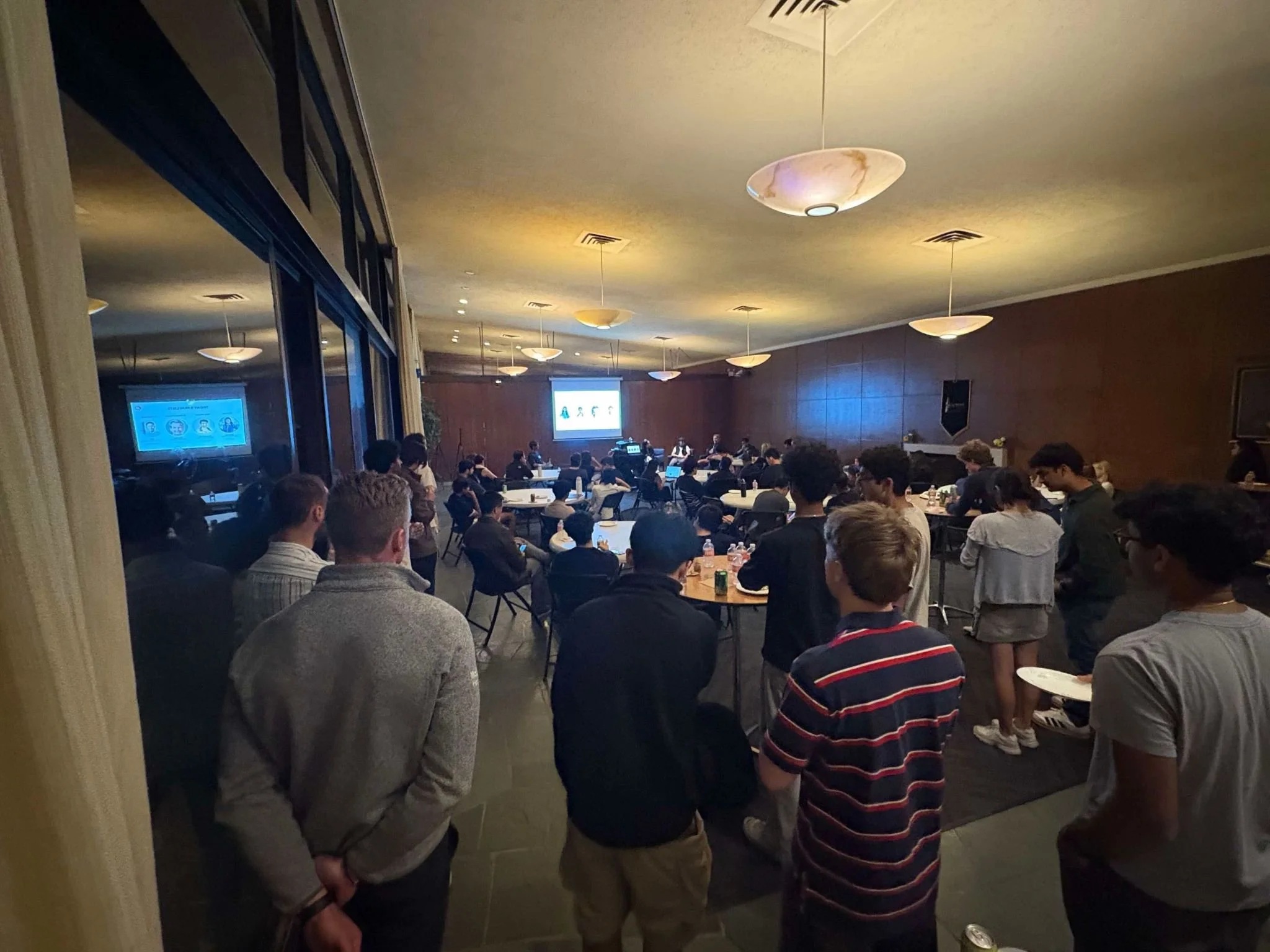
Before Health Engine had a cohort, it had a room to fill. In May 2021, the Berkeley students behind it put on a demo day called Ready, Set, Health! SOMPO Digital Lab supplied a $25,000 cash prize. Twenty startups, thirty venture firms, and nine judges attended, according to the founders’ account. The experiment asked a sensible question: would people come?
- Free, non-dilutive, and remote-first.
- Three months of founder support, ending in Demo Day.
- Open beyond Berkeley; built around healthcare problems.
That order matters. An accelerator can announce a mission before it has anything useful to offer. Health Engine began with a transaction everyone could understand: founders needed an audience; investors wanted to meet founders. Only afterward came the harder job of making the relationship useful between pitch events.
The rehearsal came first
The idea grew out of Phoenix Consulting Group, a student organization doing healthcare consulting. Christopher Zou and Mohak Jain were among the founders. Zou has credited the Korean drama Start-Up with helping inspire the idea. A television accelerator supplied the spark; an existing network supplied something more practical.
By fall 2021, four startups joined the first cohort. The founders soon encountered a positioning problem. Helping healthcare companies was too broad a proposition. Berkeley already had startup support. Health Engine needed a reason for a founder to choose this particular group of students.
The useful distinction was specialization: conversations shaped by healthcare’s buyers, institutions, and operating constraints. A founder selling into a hospital has questions that another healthcare founder may recognize immediately. Repeated contact gives those questions somewhere to go.
Zero dollars. Three months. Actual homework.
The present offer is a free, three-month cohort. Berkeley’s entrepreneurship directory describes it as remote-first and non-dilutive. Founders keep their equity. Its users are early-stage healthcare companies, with no Berkeley affiliation required. This is founder support rather than a software subscription sold to hospitals.
For a founder comparing programs, the choice is partly about which conversations are missing. Berkeley’s broader ecosystem includes SkyDeck, CITRIS Foundry, and Nucleate. Health Engine occupies a narrower position inside that landscape: a student-organized healthcare community with a fixed cohort rhythm. Its expertise is assembled through people, from the consulting network to clinical contacts and visiting founders. That makes the fit depend on the problem a startup brings. A team seeking feedback on a healthcare sales process has a different assignment from one needing a laboratory.
The program combines workshops, clinical connections, investor introductions, recruitment help, and a designated team contact. Partner grants are conditional: Health Engine looks for alignment with a sponsor’s mission and arranges conversations. Admission does not mean a cheque arrives.
Its service menu makes an important distinction between access and delivery. An introduction can put a founder in front of a physician-scientist. It cannot establish that the product works. Meeting an investor starts a conversation; it does not settle a financing round. Founders still have to make the case.
A schematic of the support offered, not a promise of outcomes.
The customer liked the problem. Then what?
An account of alumnus Adentris, posted by Health Engine, gets at the commercial problem underneath the mentoring language. The company initially sold compliance software. According to the spotlight, compliance created little urgency unless a clinic faced an audit. The offer addressed a real concern without reliably triggering a purchase.
Adentris moved toward revenue cycle management, combining compliance with services tied to getting paid. The account describes tracking demo conversions, proposal timing, and closed business, then concentrating on substance use disorder rehabilitation providers. It reports tenfold revenue growth and four additional clients after the cohort. Those are reported company results, not proof of what the accelerator caused.
There is a useful question here for anyone selling a complicated product: what event makes the buyer act now? Adentris’s current Y Combinator profile describes documentation, coding, authorization, appeals, and billing services. The product follows the customer’s workflow all the way to payment.
“We like to keep things small, intimate, and personalized.”
Rachel Ryu, then managing director, July 2024
The students have homework, too
A student-run accelerator has an obvious test of credibility. Why should experienced healthcare founders take its advice? In a 2024 interview, then managing director Rachel Ryu identified healthcare knowledge and member training as areas needing improvement. She also described recruiting beyond Phoenix and seeking students who took initiative.
That candor helps explain the model. Students can organize, research, recruit, and connect people while learning from the founders they support. The relationship becomes useful when a team recognizes the question it cannot answer and knows who might. The current leadership page names Prithvi Dixit and Aakash Suresh as managing directors.

A hundred companies is a different assignment
The tenth cohort’s May 2026 Demo Day advertised thirteen startups and three-minute pitches, followed by networking. Its event page counted 101 companies supported, including that cohort. The current homepage reports more than $370 million raised by alumni and a portfolio valuation above $1 billion.
Those totals describe the companies passing through the community. They do not establish how much progress happened because of it. More revealing is the continuing effort to assemble useful rooms: an October 2026 Tech Week listing paired Health Engine with Techstars and Wavemaker 360 for founder talks and technical networking.
For founders considering the program, the practical test is the next blocked decision. Bring a specific buyer question, a recruitment need, or a clinical assumption that needs examining. A three-month community is useful when its people can help move that question forward. It cannot substitute for clinical validation, regulatory clearance, or customers willing to pay.
The part worth copying is available before admission: convene a small group, name the problem, make a concrete ask, and return with what happened. Health Engine began by testing whether people would show up. Its ongoing assignment is to give them a reason to come back.