The most revealing detail in Harold Ryan's career is not the billions in revenue attached to games he helped lead. It is a smaller catastrophe: roughly 40 hours of testing, completed at Microsoft, made obsolete when somebody decided to produce a new build. Ryan was entry-level then. The work had to be done again. A choice that sounded simple in one room became a lost week in another.
He still tells that story because it contains his operating philosophy in miniature. Games are elaborate chains of consequence. An executive adjusts a milestone. A designer revises a system. A tester repeats a week. Ryan went from the far end of that chain to its top, eventually running Bungie during the years when Halo and Destiny turned launches into civic events for people with headsets. His second act has been an attempt to redesign the chain itself.
ProbablyMonsters, founded in 2016, began with a generous and expensive idea. Build game studios around people rather than projects. Give creative teams the dull but necessary machinery of finance, recruiting, human resources, facilities, and publisher relations. Make compensation legible, schedules predictable, leaders approachable. Let the artists make worlds while a parent company keeps the lights from flickering.
“Game development ... it's a career for people. This is their life.”Harold Ryan, 2019
It was a founder's pitch with the moral vocabulary unusually close to the balance sheet. Ryan argued that respect required runway. A company should have enough capital to honor the commitment implicit in a full-time offer. Bigger AAA projects, backed by substantial publishing deals, appeared to provide that runway. For a while, scale looked like safety.
01 / The early buildA programmer's son enters through quality assurance
Ryan says he was programming games at 10 or 11 on his father's computer. His father had worked with machines as far back as punch cards, giving the young Ryan a domestic preview of computing before software became ambient. Ryan worked in engineering and consulting, then entered Microsoft's games operation as a tester on the 1996 Windows title Hellbender. The title sounds like a forecast. The job was methodical, vulnerable to revision, and close enough to every mistake to teach respect for invisible labor.
His route ran through Microsoft, Ensemble Studios, FASA Studios, and Bungie. At Bungie, where he spent roughly 16 years, Ryan rose from production leadership to studio manager, president, and CEO. The period encompassed the Halo era, Bungie's separation from Microsoft, and the arrival of Destiny. ProbablyMonsters now says franchises associated with his career generated more than $5 billion. The useful fact beneath the large number is range: Ryan saw blockbuster development as tester, producer, manager, and chief executive.
After leaving Bungie in early 2016, he did not rush into another visible job. He has described spending about a year reviewing what two decades of success should have taught him. His conclusion was personal. His real enthusiasm was assembling teams, developing new intellectual property, and helping creative leaders turn a conviction into something playable.
ProbablyMonsters stayed quiet for nearly three years. When it emerged in 2019, the company was designed less like a conventional studio than an incubator with house rules. Separate teams could develop distinct games and cultures. Central services would absorb the administrative weather. The company announced an $18.8 million Series A round; in 2021, it announced a much larger $200 million Series A investment. The architecture finally had money behind it.
02 / Culture as equipmentThe words on the wall had a job to do
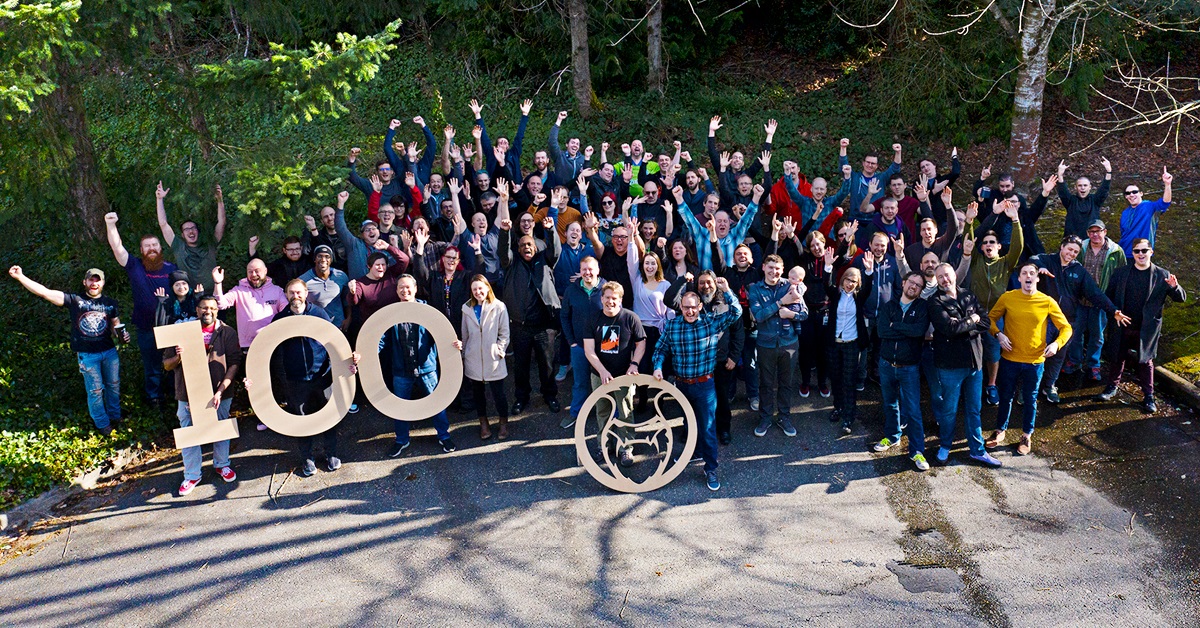
Ryan's three cultural pillars were concise: trust and be trusted; respect and be respected; lead approachably and accountably. They appeared on metal near the office entrance. This was not subtle interior decoration. He wanted values encountered, discussed, and challenged. The company backed the language with transparent compensation, a common vacation plan, executive coaching, and an ombud role. In one 2022 interview, Ryan also described setting a minimum salary around the cost of living within 20 miles of the Bellevue office.
His emphasis on approachable leadership came from scale's social cost. Large teams can turn colleagues into functions. Ryan preferred studios small enough that leaders knew who was having a difficult week and employees knew who could hear them. During the abrupt move to remote work in 2020, he noticed that the missing commute and coffee walk removed natural pauses. Leadership began placing breaks back into schedules. The observation is almost comically ordinary, which is why it feels true: humane management sometimes begins by noticing that nobody has stood up.
A cultural promise only becomes durable when staffing, project scope, capital, and schedules are built to carry it.
There was also a neat division of labor in the original model. A studio could protect its creative identity while the parent handled recruiting, legal work, finance, and partners. Firewalk and Cauldron were early examples. Firewalk's path eventually led outside the family: Sony Interactive Entertainment acquired it in 2023. That exit showed the model could create a team another company valued. It did not settle whether the parent structure could repeatedly produce stable studios of its own.
“My true passion for this was to build teams, to build new IPs, and then help the creative talent ... bring their vision to life.”Harold Ryan, speaking to GeekWire
03 / The market edits backWhen scale stopped looking safe
The elegant diagram met an inelegant market. Publishers reduced third-party commitments. Large projects required levels of outside funding that became harder to secure. ProbablyMonsters eliminated central-services roles in 2023 and went through further cancellations, closures, and layoffs across 2024 and 2025. Cauldron, Hidden Grove, and Battle Barge were among the units shut down. The company built around career stability could not provide it to everyone.
Former employees later gave Game Developer accounts of shifting direction, poor communication, and management behavior they believed contradicted the company's public ideals. Those allegations matter because Ryan made culture part of the product. A furniture company can be judged by its chairs. A people-first studio invites judgment by people's experience.
Ryan's public response to the broader strategic problem was unusually plain. Game developers deserved stability and respect, he said, but an unsustainable business model could not provide a job. He acknowledged that layoffs and cancellations put “heavy marks on the board” against the company's claim. The sentence does not tidy the damage. It does identify the test: a mission survives only if the operating system beneath it can pay for the promise.
The revision was structural. ProbablyMonsters moved away from a hub-and-spoke collection of AAA studios toward smaller teams integrated with central support. Instead of one standard production path, it began balancing short-, mid-, and long-term games. Some teams were asked a clarifying question: if they had to ship a new game within 18 months, what would they make?
This was more than trimming a budget. Ryan had once treated larger publishing commitments as a means to reliable employment. Now the size of those commitments made the company dependent on a class of deal that was disappearing. The same feature that had promised stability created fragility. Smaller work could move sooner, meet an audience earlier, and expose less of the company to a single decision elsewhere.
04 / The first receiptsNine years later, the games arrive
In August 2025, ProbablyMonsters finally unveiled its first releases. Storm Lancers was a brisk co-op roguelite with the color and momentum of an after-school cartoon. Ire: A Prologue offered psychological horror aboard a vessel caught in the Bermuda Triangle. One invited a friend onto the couch. The other placed a teenager inside looping memories with a monster. Neither resembled the vast AAA monuments around which the company had originally organized itself.
Storm Lancers reached Nintendo Switch in September and later arrived on PC and Switch 2. Ire: A Prologue followed on PC in October. The launches were modest beside Halo or Destiny, but their importance inside Ryan's story is operational. After years of plans, capital, studios, canceled projects, and revisions, ProbablyMonsters had products in players' hands. A release is an argument with a download button.
The next evidence is already dated. ProbablyMonsters has set Crimson Moon, a gothic action RPG, for September 2026 and Nekome: Nazi Hunter, a single-player action game, for early 2027. Their genres differ, but both fit the newer promise: AA-sized projects with the finish expected from veterans of much larger productions.
The revised strategy also clarified what Ryan was unwilling to discard. Original intellectual property remained central. So did the belief that experienced developers could preserve polish without inflating every idea to blockbuster size. The company described its new territory as focused games made with AAA sensibilities. The phrase contains a practical compromise: keep the craft, question the acreage.
For founders outside games, the transferable lesson is almost impolite. The cherished business model is not the mission. ProbablyMonsters began by linking respect to scale because scale appeared to buy predictable funding. When the link broke, preserving the mission required abandoning the original diagram. Many companies do the opposite. They protect the diagram and slowly convert the mission into wall art.
05 / The unfinished levelA career built around consequences
Ryan's public personality is that of an engineer who wandered into organizational design and found another system to debug. He talks about culture in root causes, inputs, and repeatable structures. Yet his most persuasive examples remain human-scale: the tester redoing a week, the worker who needs a break, the studio leader who should know a colleague well enough to notice.
There is no clean victory lap here. ProbablyMonsters' layoffs and former employees' criticism complicate its ideals. Its early releases do not by themselves prove that the revised model can provide the long careers Ryan imagined. They prove something narrower and still meaningful: the company adapted enough to ship, and it did so without pretending the market of 2025 was the market of 2019.
The games business adores sequels, but a founder rarely gets to call a strategic reset one. It is usually described with bloodless nouns: realignment, focus, efficiency. Ryan's better frame is sustainability. The word obliges him to keep both sides of the ledger visible. A workplace should respect its people. A business must endure long enough to employ them. Neither statement excuses failure in the other.
That makes Harold Ryan's latest chapter more interesting than a biography of famous franchises. He already knows how enormous games get made. He is still learning, in public and at cost, how a company can keep making them in different sizes without treating people as disposable pieces of production. The answer will not be written on metal by the door. It will appear in shipped work, retained teams, and the number of promises that survive the next new build.