Three days before this profile was published, Guofeng Cheng acquired a fresh problem. AusperBio, the company he co-founded in 2019, closed a $120 million Series C. The announcement moved the company’s reported capital raised since 2024 to $360 million and gave its lead program more runway through Phase 3 work and preparations for a possible commercial launch. Money removed one uncertainty. It enlarged everything else.
Late-stage biotech has a cruel sense of progression. Each successful experiment earns a more expensive question. Each regulatory step invites an operational one. The founder who once argued for a molecule must eventually coordinate trials, manufacturing, partnerships, capital and a company capable of surviving its own ambition. Cheng’s career looks almost designed for that widening frame.
The apprenticeship was longer than the startup
Cheng trained as a microbiologist and immunologist at the University of Illinois Chicago, where he completed his doctorate between 1997 and 2003. He then moved to The Scripps Research Institute for a postdoctoral fellowship under virologist Frank Chisari. Those dates matter because they put his founder story on the proper clock. AusperBio is seven years old. Cheng’s preparation for it stretches back nearly three decades.
In 2007, he joined Gilead Sciences in Foster City. He remained there until 2019, rising to Senior Director of Antiviral R&D. AusperBio’s official biography credits him with a pivotal role in the discovery and early development of Harvoni, Epclusa and Vosevi, three antiviral medicines that later reached the market. It also says he led hepatitis B research initiatives involving cccDNA inhibitors, HBsAg inhibitors and gene-editing collaborations.
The important word is early. Early drug research is full of elegant ideas that cannot survive contact with the next department. A scientist who spends twelve years inside a large development organization sees where they fail: potency may not translate, chemistry may resist scale, a trial may answer the wrong question, or a promising program may arrive without a practical route forward. Cheng did not leave Gilead with one clever insight. He left having watched the relay.
Build the molecule, then build the machine
AusperBio began with Med-Oligo, its proprietary platform for antisense oligonucleotides, or ASOs. These short synthetic strands are designed to bind genetic messages and alter what follows. The company’s thesis was that better ASO design, paired with targeted delivery, could produce more useful medicines. Its first clinical expression became AHB-137, an unconjugated ASO and the program around which much of the young company would organize.
By March 2023, AusperBio had announced first-in-human dosing. Cheng marked the period in the spare, exclamation-heavy language of a scientist learning public company narration: pride in the team, gratitude to supporters, another milestone completed. “Continue to strive for making a difference to CHB patient life,” he wrote in one post. The sentence is awkward and sincere. It also contains his favorite verb: strive. Biotech offers few clean victories, so he writes in motion.
“Continue to strive for making a difference to CHB patient life.”Guofeng Cheng, writing publicly in 2023
The movement accelerated. AHB-137 advanced through Phase 1 and multiple Phase 2 studies. In 2025, China’s Center for Drug Evaluation cleared a Phase 3 trial. By December, AusperBio said enrollment was complete with 577 participants. The company had crossed from a platform pitch into late-stage development, a transformation Cheng celebrated by crediting investigators, clinical staff, patients, partners and his own team.
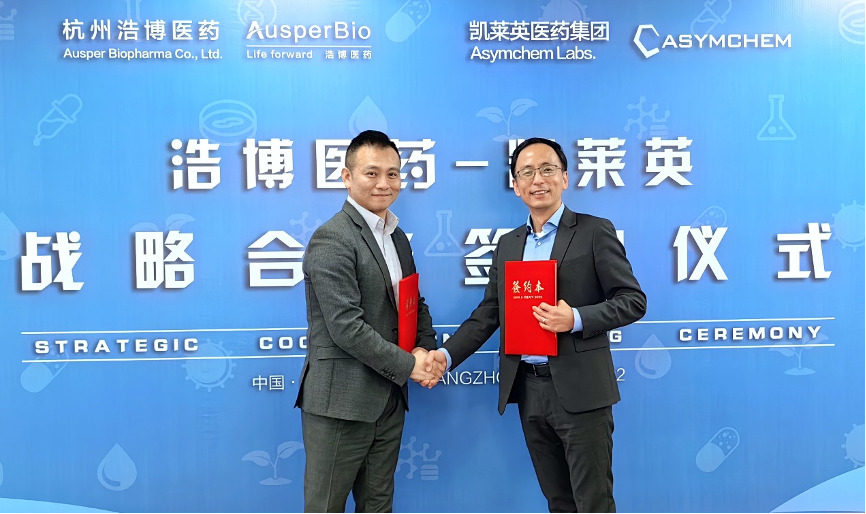
That 2023 partnership ceremony offers a more revealing founder portrait than a podium shot. Cheng stands on the right, holding a red agreement folder, across from an Asymchem executive. The announced relationship covered the unphotogenic necessities of drug development: process and formulation work, clinical samples, toxicology support, project management and regulatory consulting. A platform becomes a medicine through such nouns. A CEO learns to love them or learns expensively.
Capital arrives in chapters, not as an ending
The financing followed the technical progress. AusperBio announced a $37 million Series A in July 2024, then $73 million in December. A $50 million Series B+ arrived in May 2025 and a $63 million Series B2 that September. The newest $120 million Series C is the largest disclosed round. Publicly announced round amounts add to $343 million; the company reports $360 million raised since 2024, a figure that may include capital outside those headline amounts.
Bars scale to the largest disclosed round. USD millions.
Cheng’s comments after each round rarely dwell on the size of the cheque. He converts money into verbs: accelerate, expand, strengthen, advance. After the Series C, he called the financing “an important inflection point” and immediately paired commercialization readiness for AHB-137 with the development of next-generation programs. Cash, in his telling, is scheduled work.
The investor list also shows the company’s cross-border construction. Qiming Venture Partners, HanKang Capital, Sherpa Capital, YuanBio Venture Capital, CDH Investments and InnoPinnacle Fund have returned across rounds. RA Capital joined the Series C. AusperBio operates in both the United States and China, with Cheng’s public profile in San Mateo and a company presence in Hangzhou. The geography gives the company access to different clinical, capital and operating networks. It also creates a permanent coordination tax.
The second program is the company test
One candidate can prove a molecule. A second begins to test whether the organization has built a repeatable engine. In August 2026, AusperBio announced the first patient dosed with AHB-171, its second clinical-stage candidate. Unlike the ASO program, AHB-171 is an siRNA candidate developed with Au-HALO, the company’s liver-targeting delivery technology. Cheng described the moment as evidence of the team’s ability to translate proprietary platform work into clinical assets.
This is the less obvious meaning of a second act. Cheng’s first act was scientific depth: doctorate, postdoc, large-company antiviral research, approved medicines and programs that taught him the choreography of development. His second is institutional. Can he turn what he knows into a system other people can run, improve and eventually extend beyond him?
His public personality is hard to separate from the job because he publishes little outside it. The available posts are short, earnest and almost comically fond of exclamation points. Yet their pattern is consistent. Cheng names the milestone, names the people who enabled it, and points toward the next piece of work. After two Phase 2 enrollment completions and new financing in 2025, he thanked the team and partners, then ended with “GO AUSPERBIO!!!” The punctuation has escaped peer review.
There is discipline underneath the enthusiasm. He does not present the company as finished. Even the August 2026 financing announcement describes possible commercialization, not a guaranteed arrival. AHB-137 and AHB-171 remain investigational. Phase 3 is not a finish line. It is an examination in public, followed, if the evidence allows, by the different examination of making and distributing a product reliably.
A founder’s expertise gets the company moving. The real test is whether the company can keep moving as the founder’s job changes.
What the next passage asks of Cheng
AusperBio’s stated ambition is a functional cure strategy for chronic hepatitis B, with a broader future across oligonucleotide technologies. The 2026 round gives Cheng resources to pursue that ambition through late-stage development, commercial preparation, AHB-171 and combination approaches. It does not settle any of them. Science retains the final vote, while regulators, manufacturing and markets each keep a ballot.
For Cheng, the aspiration now carries a managerial paradox. The company needs the scientific judgement formed during his long apprenticeship, but success requires him to build beyond personal judgement. More programs mean more leaders. Commercial preparation means capabilities that research organizations do not naturally possess. Cross-border work means decisions must travel without losing their meaning. The organization must become both more specialized and more coherent.
This is why the newest $120 million is best understood as an invitation to seriousness. Seven years after founding AusperBio, Cheng has moved his company far enough that the original platform thesis is no longer the only question. The questions now concern repetition, scale and endurance. He spent his first career watching medicines move through a mature machine. In his second, he is trying to construct one while it is already moving.
The yellow folders have become trial records, financing documents and manufacturing plans. The lab bench has accumulated a boardroom around it. Cheng still writes like a scientist delighted by the next result. He now has to operate like the person responsible for every consequence that follows.