At Spartanburg Regional Healthcare System, the invoices were still arriving. More than 10,000 a month, payable to as many as 15,000 vendors. But the archival software holding their images was being retired by its developer. The hospital system needed to replace a piece of infrastructure that was easy to overlook until someone announced its approaching disappearance.
The obvious answer was another system installed on site. Then came the implementation costs. According to GRM’s account of the project, those costs made the decision makers reconsider. GRM and DDR Technologies moved the legacy images into a cloud-based repository, connected a viewer, and established a new scanning and indexing process. The conversion took 30 days. Training took one webinar.
- GRM stores physical records and turns paper into searchable digital information.
- Its work extends into hospital laboratories, employee onboarding and invoice processing.
- The useful idea: fix a specific information bottleneck before attempting a wholesale digital overhaul.
The invoice is the interesting part
The cost comparison is revealing. GRM’s published case study says the entire solution cost less than the annual maintenance expense of an on-premises system. That is a vendor-reported comparison for one project, rather than a universal price promise. Still, it explains what changed the hospital’s mind: preserving access to old information did not necessarily require buying another expensive home for it.
This is a useful way into GRM Information Management Services. Its business sits at the awkward junction between information that must be preserved and work that must keep moving. A box can be perfectly safe while the document inside it remains inconveniently unavailable. A scanned invoice can be perfectly legible while its approval process remains painfully slow.
Spartanburg project figures, as reported in GRM’s customer case study.
A warehouse with a second act
Moishe Mana founded GRM in 1987. Today, its services range from offsite document storage and secure destruction to scanning, healthcare release of information and specialized pathology storage. It operates in the United States and maintains facilities in Brazil, Colombia and Peru. Hospitals, government agencies, law firms, finance departments and human resources teams all appear in its market.
The digital work runs through VisualVault, which current company announcements describe as GRM’s sister company under common executive management. Its cloud platform organizes documents, captures data and routes work between people and systems. The connection matters: a customer can begin with boxes and eventually buy a workflow, without having to arrange every handoff between storage, scanning and software suppliers.
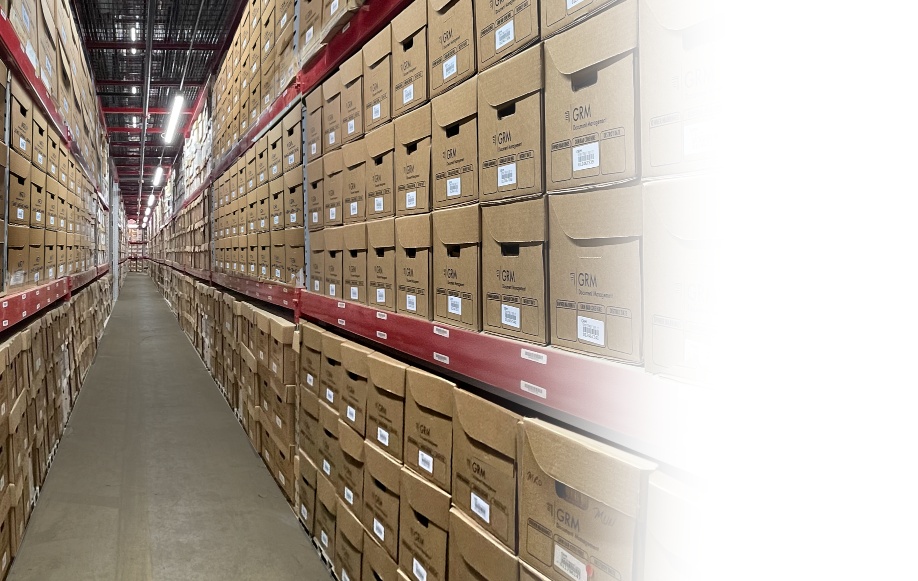
Iron Mountain and Access occupy overlapping territory in records management. GRM’s proposition is the combination of physical custody, conversion and process software, supported by industry knowledge. That combination is a reason to consider it; buyers still need to compare retrieval service, migration work, security controls and contract terms against their own requirements.
Keep the people who know the boxes
GRM’s own reinvention involved a choice about expertise. When Avner Schneur became chief executive in 2011, he saw a business heavily focused on physical documents. Advisers suggested replacing much of the sales force with people who understood software. Schneur instead retained the existing team and hired digital specialists to help train it.
The old salespeople knew their customers, records retention and governance. Those were useful assets when the medium changed. In a retrospective published by GRM, Schneur described the decision simply: “invest in our team.” Workshops paired that customer knowledge with digital skills. The lesson is unusually practical: identify which expertise survives the technology change before deciding whose job has become obsolete.
“So we decided on another route: invest in our team.”Avner Schneur, on GRM’s move into digital services
Let the specimen travel. Free the paperwork.
One GRM pathology case describes a laboratory serving a 22-hospital system and performing roughly 500 anatomic pathology tests daily. Paper requisitions accompanied specimens between departments and buildings. Other functions, including billing and customer service, needed the paperwork too. Their work could end up waiting for the courier.
GRM introduced scanning and digital retrieval through VisualVault, using accession numbers to connect requisitions with specimens. Authorized staff could reach the document without waiting for its physical arrival. The specimen still had a journey to make. Its information could become available independently. GRM’s analysis projected annual savings in the hundreds of thousands of dollars; that figure describes an estimate, not a published independent audit.
Store→02
Capture→03
Route
The working idea: connect custody, searchable information and the next task.
Physical pathology storage requires another kind of precision. GRM offers temperature and humidity-controlled space for blocks and slides, with barcodes, inventory tools and retrieval requests through eAccess. HistoWiz became both a partner and a storage customer in 2024. Here, a digital interface supports a very tangible obligation: returning the right material when someone needs it.
Start with the next person waiting
The same logic appears outside healthcare. JetBlue’s personnel and benefits conversion had a six-week deadline tied to a headquarters move. GRM reports linking its repository to SAP and connecting physical records with scanned images. Smart & Final’s HR deployment took approximately 14 weeks, bringing document storage, onboarding and signature workflows into an integrated process.
GRM sells a combination of ongoing storage and management services, digitization projects and software implementation. Its blended offering lets customers retain paper and scan selected files on request. That gives an organization a narrower starting point than converting every historical box. In July and August 2026, GRM announced acquisitions of FileVault and Storage Quarters, extending the customer base for these services.
For a reader, the repeatable move is to find the person waiting for information, then trace what blocks access. Check document ownership, permissions, indexing and integration requirements before automating. A badly identified record remains troublesome after scanning. A small organization with simple shared files may need much less infrastructure. GRM becomes interesting when custody and access are complicated enough that bringing them together changes the work.
Follow the paper trail
GRM website · Company blog · News
YouTube videos · Pathology solution demonstration · Product video library