Greg Shea likes a good correction. The correction may involve a person placed in the wrong client-facing role, an unconventional promotion that makes colleagues nervous, or a blazer-and-shirt combination he later decides deserves public ridicule. He does not package these moments as immaculate wisdom. When a former rival from the NASCAR garage recorded a conversation with him in 2025, Shea called it a catch-up lunch that had been preserved for anyone willing to wade in. His disclaimer was better than most introductions: he offered no thought leadership, merely “thought, and a lot of it.”
The joke reveals the operating system. Shea, managing partner and chief executive officer of Campbell Marketing & Communications, has spent more than three decades at the Dearborn agency. He has accumulated authority without developing much appetite for the performance of omniscience. In public, he returns to curiosity, transparent decisions and the usefulness of people who disagree. He talks about errors as things to examine rather than airbrush. For an executive whose agency helps other organizations shape public stories, he is strikingly willing to leave the seams showing.
The long apprenticeship
Staying put without standing still
Shea joined Campbell in January 1995, brought aboard by Kevin Kennedy. The agency had been founded in 1982 and built a reputation in integrated marketing, automotive work and motorsports. By 2015, Shea was its chief operating officer. In 2023, a leadership transition named him chief executive officer as well as COO, with David Losek becoming president and CFO and David Scheinberg becoming chairman. Shea now serves as managing partner and CEO.
A thirty-year run can sound like an argument for constancy. Campbell’s actual work argues for recombination. Public relations sits beside research. Creative meets digital. Product launches meet training, social channels, data and live events. At a race track, a display is never only a display: it is logistics, brand education, media, hospitality, fan emotion and follow-up data occurring at once, usually against a clock that regards excuses as a form of comedy.
Shea’s longevity makes sense in that setting. He did not choose a narrow trade and guard it. He stayed inside a business that kept asking its disciplines to learn one another’s language. At Petit Le Mans, he praised a Campbell program that joined digital, social, creative, public relations, experiential work and research for Ford Racing and Mustang. The list is not decoration. It is the job: make specialists behave like one organization while thousands of spectators, clients and machines move around them.
How an activation becomes a system
The family argument
A warmer word is not always a more honest one
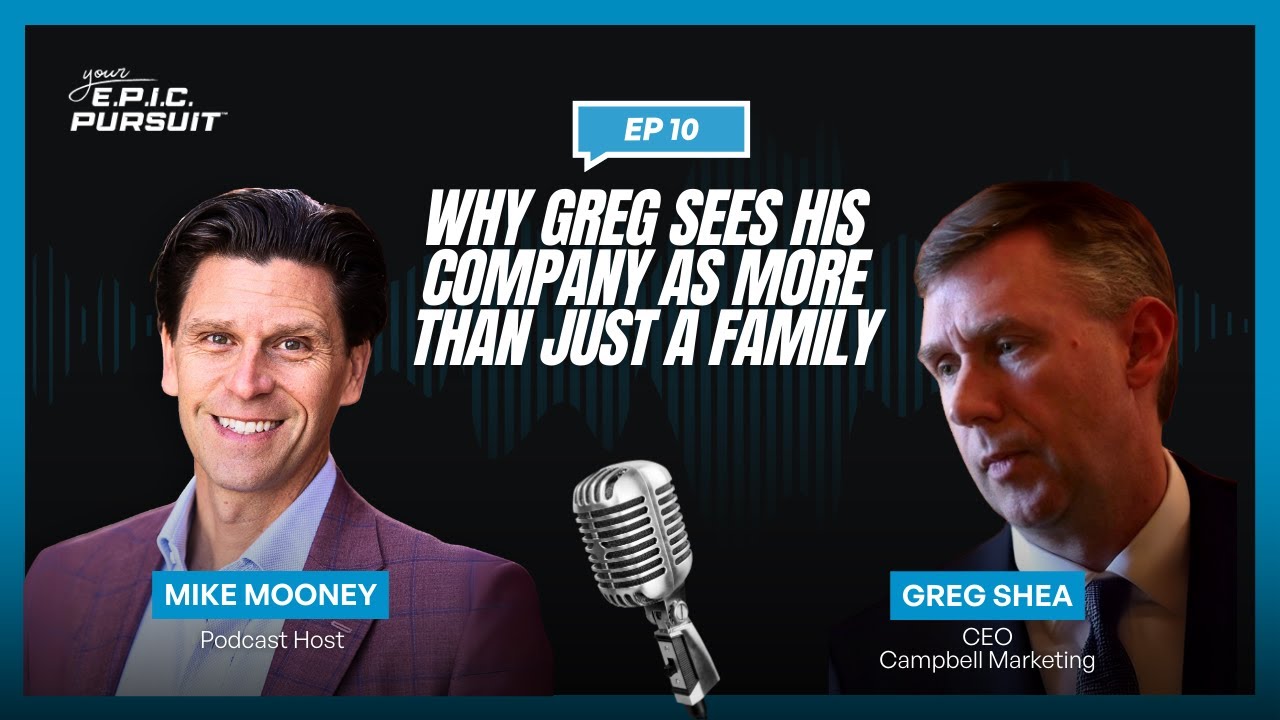
The most distinctive part of Shea’s leadership vocabulary is a refusal. He does not like describing a company as a family. The 2025 conversation on Your E.P.I.C. Pursuit made the distinction central: he prefers the professional clarity of a team. A team can care deeply about its people while acknowledging roles, standards, selection and consequence. It does not need to borrow the unconditional language of kinship to prove that the relationships matter.
“If you want to go far, go together.”Greg Shea, marking 30 years at Campbell
That may sound sterner than the usual office slogan. In Shea’s telling, it creates room for trust because expectations are less disguised. People can support one another’s growth and still be answerable for the work. A leader can make a difficult call without pretending it is parental love. A colleague can challenge the boss without staging a family rebellion. The team metaphor also gives credit its proper plural. When Shea marked 30 years and two days at Campbell, he named the people who hired, partnered with and succeeded alongside him. His borrowed line about going far together worked because the post read like a relay handoff, not a trophy speech.
His examples make the philosophy more interesting. Shea has spoken about putting a vocal contrarian in charge and watching the decision reshape culture. Most leaders say they welcome dissent. Fewer attach budget, authority and responsibility to the dissenter. That transfer converts disagreement from theater into stewardship. It asks the critic to build, and it asks everyone else to discover whether the discomfort was a warning or merely a preference.
Trust, for Shea, is therefore less a mood than a sequence of choices. Someone is recognized, given a demanding assignment, told what the standard requires and allowed to carry it. The leader remains accountable for the bet. The colleague becomes accountable for the result. Transparency connects the two: people can accept an unexpected decision more readily when they understand the thinking behind it. This is where the team metaphor earns its keep. A team is not harmonious every minute, and it does not confuse affection with agreement. It can argue about the play, revise the lineup and preserve respect. The point is not comfort. The point is enough trust to keep the argument attached to the work.
He has also discussed assigning the wrong person to a client-facing role. The useful part is not the error; every executive has a warehouse of those. It is the response. Curiosity let him revisit the fit rather than defend the original placement. Humility, in this context, is not softness. It is an efficiency tool. The sooner a leader becomes interested in being wrong, the sooner the organization can stop paying for the mistake.
Beyond the garage
Detroit widens the field of view
Motorsports remains one of the clearest threads in Shea’s public career. Campbell’s practice includes sponsorship management, enthusiast programs, trackside activations, product launches and global programs. Shea also serves among the board members supporting the Rod Campbell Award, which helps young people pursuing automotive or motorsports journalism, public relations, marketing, sales, business development or sponsorship. The award extends a mentor’s legacy by giving the next generation a door into an industry that often runs on relationships invisible from the grandstand.
Yet Shea’s recent attention has moved outward from the circuit. In September 2025, the Detroit Regional Chamber selected him for Leadership Detroit Class 46, a nine-month program of 76 executives drawn from business, labor, government, education, media, civic groups and community organizations. Shea later described 12 days spent across nine months with people working on social services, housing, energy, transportation, the arts, education, neighborhood development, banking, philanthropy and government.
The impressive part was not that a veteran executive entered another room full of executives. It was that he emerged sounding less settled. After 40 years in business and 35 in leadership, he wrote, he still craved inspiration and was thrilled when he found it. He found it in younger leaders asking “what if?” and “why not?”, turning questions into plans and expecting progress.
“After 40 years in business and 35 in leadership, I still crave inspiration and am thrilled when I find it.”Greg Shea, after Leadership Detroit Class 46
There is a useful symmetry here. The agency leader who wants a contrarian in the room entered a regional program designed to put incompatible professions beside one another. Housing meets transportation. Education meets business. Philanthropy meets neighborhood development. Communications sits among them, listening for the point where separate vocabularies describe the same problem. Shea’s career has been built on integration at the scale of a campaign. Leadership Detroit offered integration at the scale of a city.
The next lap
No victory speech, just another green flag
Shea’s public voice carries a racer’s dislike of lingering too long over the photograph. After Campbell’s 2025 holiday gathering, he allowed himself a pleased look at the team’s smiles, admitted the year had been demanding, told everyone to take a breath, and then pointed them toward 2026. Even his gratitude has forward motion.
The risk of a long tenure is that memory becomes authority’s favorite weapon: we tried that, we know this, we have always done it this way. Shea’s better instinct is to treat memory as track data. It matters because it helps the next decision, not because it settles every argument. The self-mockery helps. So does the willingness to speak about a bad assignment, an unpopular appointment or a room that changed his mind.
Thirty years at Campbell have given Shea a rare view of institutional change. Public relations merged with marketing disciplines. Live experience learned to travel through social media. Research and data moved closer to creative judgment. Motorsports remained a spectacle but became an increasingly precise platform for customer engagement. Through it all, the durable unit was not a channel or campaign. It was the team capable of learning the next combination.
That is the quiet ambition beneath Shea’s leadership language. Trust people with real work. Explain consequential choices. Correct the role when the fit is wrong. Give the challenger something to run. Look outside the building for fresh questions. Then, when the celebration is finished, take a breath and get after it again. The long race rewards speed. It rewards repair even more.