Ron Perine arrived at an advertising agency by the side door. No portfolio under his arm. No reel of television spots. No carefully rehearsed sermon about the sacred power of the big idea. He came carrying a working knowledge of accounting and information technology, two disciplines whose natural habitat is usually several doors down from the creative department.
That was 1994. Mintz + Hoke, the Avon, Connecticut agency founded by Alan Mintz and Joe Hoke in 1971, hired him into IT. Within a few years he was running both technology and finance. In 2012 he became chief operating officer, adding account service to a brief that already included finance, technology and a seat on the board. Today he is the agency’s managing principal and CEO.
It is a pleasingly uncinematic ascent. An agency makes its living by arranging attention, but Perine’s career has been built on the apparatus behind the spectacle: the systems that work, the bills that get paid, the costs that do not wander, the people who can do their best work because the enterprise beneath them is steady.
The useful life of an outsider
Creative businesses tend to romanticize the spark and ignore the wiring. Perine knows the wiring. His degree is a Bachelor of Science in Accounting from Quinnipiac University’s School of Business. Before Mintz + Hoke, he was accounting manager at another Connecticut agency, Keiler & Company. Even earlier came retail management. The sequence gave him three useful views of commerce: the customer at the counter, the numbers in the ledger and the machinery inside the agency.
His timing mattered. The 2021 announcement of his induction into the Ad Club CT Hall of Fame credited Perine with helping Mintz + Hoke move into digital advertising. His fluency in finance and technology made him an unlikely but logical bridge as an old-line agency met a new medium. He was not asked to choose between creative instinct and operating discipline. He made the two coexist.
“The nuggets are often hidden in the gray area, and that is where you will find the hidden gems.”Ron Perine on the agency’s core values
Gray is not a color accountants are famous for loving. Yet Perine talks about it with the appetite of a strategist. Clients pay an agency to enter the ambiguity, he argues, because that is where a fact turns into an insight. His job is to keep senior leaders changing vantage points, to “delve deep and leave no stone unturned.” The language is not ornamental. It describes an operator teaching himself to be useful in a room full of people whose answers cannot always be audited.
A 1971 idea, still wearing good shoes
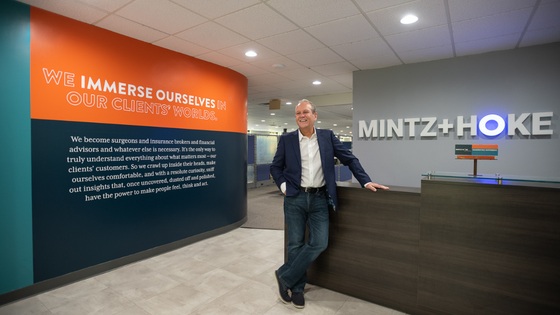
Mintz + Hoke began with what its founders called street smarts. They went out and spoke to customers: Why did you buy? Why did you stay? Why did you walk away? Five decades later, the agency calls the practice “Immersively Different,” but Perine sees the same thread. The point is to get close enough to a customer’s life that the tidy brief becomes usefully untidy.
Longevity can sound like a polite word for standing still. Perine’s version is more muscular. During his tenure the agency crossed into digital, endured 9/11, the early-2000s banking crisis and the pandemic, and marked its fiftieth year with a refreshed identity. He has described the durable attitude as “we’ve got this” instead of “what are we going to do?” One phrase starts from agency. The other starts from alarm.
The milestones do not turn him solemn. Ask what he does and Perine says he has “the best job ever,” leading a pack of smart people through varied and intriguing work. The pack metaphor may be occupationally convenient, because dogs occupy a large part of his life. His first hours belong to letting them out, feeding them, watering the plants, exercising, meditating, drinking coffee and reading local and world news. Then the dogs decide it is playtime. They rule the roost, he admits.
There is a small leadership theory hiding in the routine: tend what depends on you, clear your head, look beyond yourself and leave room for play. Perine says meditation helps him concentrate on what matters and release what lies outside his control. For a chief executive, this may be less wellness ritual than traffic management.
Culture leaves fingerprints
Perine’s public advice arrives as verbs. Be curious. Ask questions. Offer support. Lend a hand. Do not be reactionary. Own mistakes. “Once you own it,” he says, “you can learn from it, grow from it, and become better because of it.” These are not the thrilling words on the wall of an agency lobby. They are better: instructions that can survive contact with Tuesday afternoon.
Perine’s pocket guide to a workable room
- Look in the gray area before reaching for the easy answer.
- Bring clients more value than the transaction strictly requires.
- Consider what another person may be carrying.
- Own the mistake, then make the lesson useful.
In 2019, when Mintz + Hoke received another Hartford Courant and FOX61 Top Workplace recognition, Perine drew a line between culture and organizational health. Perks are pleasant; meaning is structural. People want to feel valued and to know that their contribution counts. It is the language of a finance leader who understands that the human column is not an off-balance-sheet asset.
His 2022 C-Suite honor produced a characteristic deflection. “For me, this nomination is an agency nomination,” he said, crediting the team and the leaders who guided him. One can be cynical about executive modesty, but Perine’s record repeatedly distributes the credit. His description of leadership is crowded with colleagues, mentors, clients and family.
His mother, Alice Neef Perine, is prominent among them. She graduated from Middlebury College in 1947 and taught English for decades, including Shakespeare and college-prep classes at the high school her children attended. Perine remembers her as an early feminist who believed women should have access to education and work beyond the narrow roles then prescribed for them. He and his siblings also had the peculiar privilege of meeting her in class. His two daughters, he says, keep him up to date, challenge him and keep him grounded.
Make the role real
The clearest expression of Perine’s ideas about belonging began over lunch. A conversation with Angela Martin, then marketing director of a favorite local restaurant, led Mintz + Hoke to consider creating a job for a person with an intellectual disability. The agency worked with Favarh and hired Cate Alix as an office assistant. She went through the interview process used for other employees. It was a real role, not a ceremonial one.
Perine later called Alix one of the agency’s best hires. The experience turned into advocacy. At an AllWorkCT Inclusive Employment Forum in 2024, the two told the story together. His advice to employers was unusually blunt for a subject that attracts acres of careful corporate prose: stop overthinking it and do it.
A real role. A real interview. A real colleague. Inclusion became concrete when somebody got a job.
AllWorkCT lists Perine as a founding member. The collaboration links businesses with public and nonprofit partners that support competitive, inclusive employment for people with intellectual and developmental disabilities. Its work begins in the Farmington Valley, close to the place where the first decision changed an office.
Perine also served as the inaugural board chair of Connecticut Creative Academy, conceived as a tuition-free portfolio school. The problem was plain: agencies often recruit from expensive portfolio programs, so the path into creative work tends to reproduce the means of those who can afford the path. The academy’s ambition was to recruit for desire and ability while reducing the financial gate.
These efforts fit the larger pattern of his career. Perine notices infrastructure. Sometimes it is a server. Sometimes it is a balance sheet. Sometimes it is the invisible arrangement that decides who gets a chance. He has spent three decades tending the systems around creative work, then asking whether those systems admit enough kinds of people.
The operator as host
There is a temptation to make an agency CEO into either a numbers person or an ideas person, the adult in the room or the child with the crayons. Perine’s career is more interesting because it refuses the casting. The accountant learned to value uncertainty. The technologist helped an established shop cross into digital. The operator treats empathy as a business practice. The executive still takes inspiration from people-watching, animals and daughters willing to tell him when the world has moved on.
He calls himself the leader of the pack. The phrase works if leadership means going first into the gray, keeping the enterprise steady and making space for other people to arrive. It works even better because, before coffee and clients and the daily arithmetic of an agency, the actual pack has already reminded him who is in charge.