The easiest way to misunderstand Chris Heaton is to begin with the color. CRIMSON is bright, declarative and difficult to ignore. The career behind it has been slower and more deliberate: a quarter-century spent learning one communications business from the inside, moving through finance and operations, joining three colleagues to buy it, and only then changing the name above the door.
There is a charming bit of misdirection in that sequence. Rebrands are sold as bursts of invention. Heaton's was earned through institutional memory. Before CRIMSON arrived in 2023, the firm was Mort Crim Communications, named for the Detroit broadcaster who founded it with journalist Terry Oprea in 1993. Heaton knew the inheritance well. By his own account, he had worked with the agency and its predecessor for more than 25 years.
He did not treat history as a museum exhibit. He treated it as raw material. Integrity and excellence would remain; the agency's organizing language would change. CRIMSON would advocate for the purpose of brands, which is executive-speak until Heaton reaches for hot sauce. Then the idea becomes almost suspiciously clear: decide whether the recipe should be fiery or mild, choose the peppers, understand what each ingredient contributes, and blend it for the people who will actually taste it.
“Our commitment to integrity remains unwavering, but our focus on ‘why we do what we do,’ our purpose, is evolving to meet the demands of the present.”Chris Heaton, writing about the CRIMSON rebrand
The long apprenticeship
Heaton is a Wayne State University graduate whose route to the chief executive's chair ran through the unfashionably useful rooms of agency life. He served as chief operating officer and chief financial officer before becoming CEO. His published biography emphasizes team leadership, creative ideation and finance - three functions that usually arrive in separate people and occasionally refuse to share an elevator.
In January 2020, they had to cooperate. Oprea sold the agency to four senior executives: Heaton, Richard Donley, Todd Haight and Jennette Smith Kotila. Heaton became CEO; the others took leadership posts across the business. Oprea described the deal as the culmination of years of planning. Terms were private, but the intention was public: continuity without complacency.
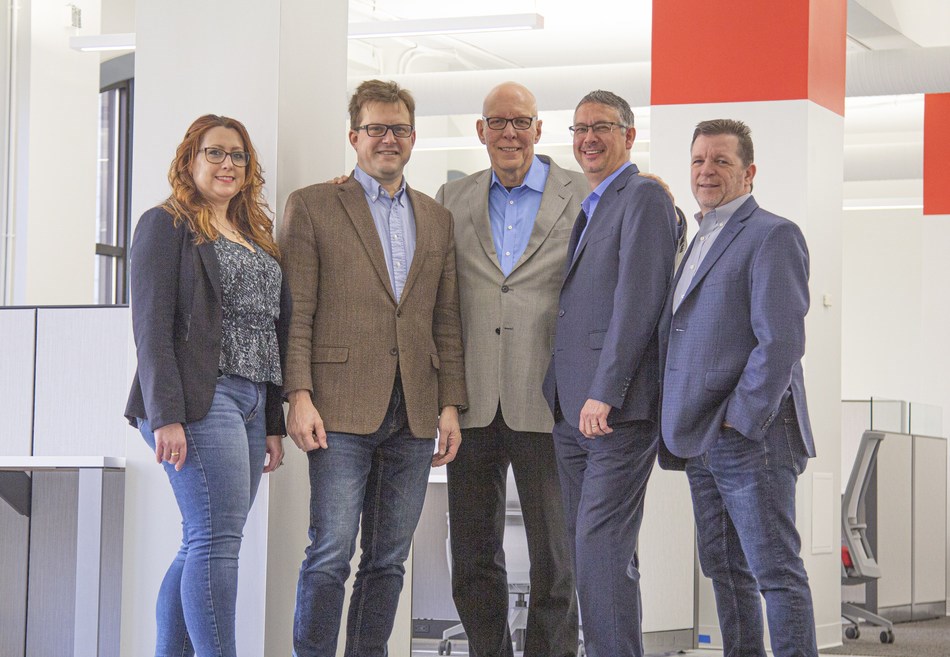
The new owners kept the headquarters in Detroit's Murphy-Telegraph Building and announced another 4,000 square feet of office space. At the time, the firm had more than 40 clients across automotive, supply chain, manufacturing, government, education, healthcare, real estate, professional services and nonprofits. The portfolio mattered, but so did the address. The agency had moved downtown in 2014. Heaton and his partners chose to deepen the commitment.
Begins the long tenure that he later described as 25 years with MCCI and its predecessor.
Joins a four-person executive buyout and moves from COO and CFO to CEO.
Mort Crim Communications becomes CRIMSON, built around “brand advocacy.”
Six promotions spread formal authority across a larger leadership team.
A name with a memory
The eventual rebrand performed a neat trick. CRIMSON echoed Crim without remaining trapped inside a founder's proper name. It could nod to the past while sounding like a present-tense instruction. The visual world became spicy, animal-filled and a little odd. The team page assigns people alter egos; Heaton is the resident raven, prone to taking “Quoth the Raven, Nevermore” rather seriously. An agency promising personality had found some of its own.
Heaton's version of brand advocacy begins before advertising. First comes the identity: why the organization exists, what it hopes to accomplish and how it should behave. Only then come public relations, marketing, web design, social media, content and video. This sounds obvious in print. In practice, the advertising business often starts with the deliverable because the deliverable is what appears on the invoice.
A conceptual rendering of Heaton's stated sequence, not a performance score.
His client experience crosses the tidy lines agencies draw around specialties. Public records and company materials connect his work with General Motors, the National Oceanic and Atmospheric Administration, the U.S. Department of Energy, the Environmental Protection Agency, Oakland County, Detroit Water and Sewerage Department and Landaal Packaging Systems. He has also singled out startups and nonprofits, including the Michigan Nonprofit Association, Michigan Municipal League and Children's Center of Wayne County.
The range explains why his language stays deliberately broader than advertising. A government department, a packaging manufacturer and a children's nonprofit do not share a sales funnel, but each has to reconcile what it says with what it does. Heaton's preferred word, advocacy, asks the agency to make that case across disciplines instead of treating every assignment as a disconnected artifact. The same premise can lead to a visual identity, a press strategy, a website or a film. The medium changes after the argument becomes clear. In a business forever tempted to sell the latest channel, that order of operations is a quiet form of restraint.
The city outside the elevator
Detroit is not a decorative word in Heaton's biography. When the NFL Draft was preparing to occupy downtown in 2024, his response carried the two halves of an operator's brain. Yes, parking would be difficult and traffic plans would matter. But the crowd was also an opportunity to advocate for Detroit. He wanted staff who came into the office to step outside, enjoy the spectacle and become “in-person ambassadors for our great city.”
That mixture of logistics and affection is more revealing than a civic slogan. Heaton notices the obstruction and the occasion. On LinkedIn, he has written about Detroit's creative business community and its diversity. In another post, an elevator filled with the smell of seafood turned out not to signal calamity but the impending opening of a restaurant downstairs. He recommended the oysters and reported, with relief, that the ventilation had been fixed.
The jokes do useful work. Brand purpose can become terribly solemn, especially in the hands of people paid by the workshop. Heaton's public persona is happier with ravens, hot sauce and an implausibly broad playlist. The official company biography identifies him as a committed metal fan - Tool, Opeth and Katatonia - who can also be caught listening to Rihanna and Ariana Grande. The range feels less like a confession than a job qualification. Integrated marketing is largely the art of making different instruments share a tempo.
“You need to know and understand your real audience, and how that audience thinks and behaves. Engage it, the rest is a distraction.”Chris Heaton on expertise in the age of AI
Giving the titles away
The clearest picture of Heaton's leadership may be an announcement centered on everybody else. In early 2025, CRIMSON promoted six people. Smith Kotila became president. Four colleagues became vice presidents across strategic communications, account services, web and digital experience, and creative direction. A long-serving producer took an expanded executive and account role.
Heaton said the changes recognized that excellence comes from empowering talented people to do what they do best. More pointedly, he observed that several of the titles merely formalized roles the leaders had already been filling. That is the sort of sentence an organization can print only after admitting the org chart was late to its own meeting.
It also fits his own career. Heaton spent years acquiring responsibility before the ownership papers caught up. His path was gradual, collaborative and bound to the fortunes of a single institution. He learned the accounts, understood the money, watched the firm move downtown, helped buy it, and then gave it room to become something its founders could recognize without mistaking it for 1993.
The result is not a clean break, and that is the point. CRIMSON still carries the sound of Crim. It still sells communications work. It still invokes integrity. But it now speaks in a voice made by the people operating it today, with a new president beside Heaton and a broader set of leaders beneath neither of them so much as around them.
The operating idea
Heaton's aspirations are visible in the verbs he repeats: evolve, advocate, understand, engage. He is interested in new tools and measurable outcomes, but skeptical that technology can rescue work without judgment. In a reflection on artificial intelligence, he invoked the old computing warning “Garbage In, Garbage Out” and argued that expertise remains a human advantage. Know the audience. Master the craft. Ignore the distraction.
For an agency chief, this is both philosophy and sales proposition. CRIMSON offers many services, but Heaton wants the client to see one logic beneath them. Purpose determines identity. Identity guides the story. The audience judges whether the mixture works. The tactical menu can change; the sequence should not.
There are noisier ways to run a creative company. Heaton's is built on patient transfer: from founder to operators, from inherited name to chosen identity, from informal work to formal authority. The crimson color catches the eye. The more interesting achievement is everything that happened before anyone opened the paint.