Greg Sewitz’s first food business required customers to reconsider their relationship with insects. His second asked them to remember watching cartoons. Between those two sales pitches lies a useful piece of his biography: a founder learning how much explanation a breakfast can bear. With Exo, the explanation came before the appetite. With Magic Spoon, he and his business partner could begin with something their customers already wanted to eat.
Two roommates and an unusually noisy ingredient
The partnership began at Brown University. Sewitz and Gabi Lewis met as freshmen in 2009 and became roommates. Sewitz studied cognitive neuroscience and English, an academic combination that leaves several respectable careers open and offers little warning that one might spend the next few years discussing cricket flour. He had imagined becoming a writer, a scientist, or a science writer. Food manufacturing supplied an unexpected fourth option.
Lewis was making his own protein bars. Sewitz had become interested in insects as a food source, including their potential to use fewer agricultural resources. During their final year at Brown, the two interests met in a kitchen. They experimented with turning crickets into an ingredient that could disappear into a familiar bar. The business that followed would be called Exo, after the exoskeleton. Even the name kept a little of the insect.
In an early account of the experiments, Sewitz described prototypes sitting in the refrigerator when friends visited. People ate the bars before learning what was in them. The taste was acceptable; the disclosure was the surprise. It gave the founders a small, rather informal demonstration of the distance between enjoying a food and approving of its ingredients. A kitchen can produce evidence. It rarely produces a representative sample.
The California-roll theory of a snack bar
Sewitz was interested in how unfamiliar foods become ordinary. In 2016, he explained that he had written a blog post comparing insect eating with the American adoption of sushi. The California roll, in his telling, offered a way to approach something people initially found unappealing. His point was about presentation: give a strange ingredient a format that people recognize, and the first bite becomes easier to arrange.
That approach needed a good recipe. Exo worked with Kyle Connaughton, the former head of research and development at The Fat Duck, to develop its flavors. Sewitz described a practical process: the chef made options, the team tasted them, customers gave feedback, and the recipes narrowed. His own favorite changed with repetition. At the time of that interview he was eating Blueberry Vanilla. Even a founder can get bored with lunch.
Exo launched in 2013, raised money through Kickstarter, and attracted investors. Sewitz and Lewis were included in Forbes’ 2016 30 Under 30 Food & Drink list. Recognition helped make the idea visible. It could not make the underlying work simple. The founders were asking people to buy a new product while also helping build the infrastructure required to produce its central ingredient.
By 2018, they had spent five years on the business. They sold Exo to Aspire Food Group that March. The sale closed one chapter without ending the partnership. They still wanted to work in food, but their next company would need a different starting point. Curiosity had got Sewitz into the kitchen. Experience was beginning to influence what he chose to cook there.
- 2009Meet at Brown
- 2013Launch Exo
- 2019Launch Magic Spoon
A smaller leap for the customer
“With [crickets] we tried to do a lot,” Sewitz said in 2019. The problem included supply as well as demand: the founders had had to develop a supply chain around an ingredient with little established American market. He could now describe the complication plainly. There was no need to turn every difficult experience into a ceremonial triumph before using what it had taught him.
For their next venture, Sewitz and Lewis chose cereal. They had both grown up eating it, and they wanted the new brand to recover the pleasure of those childhood bowls. The idea allowed them to retain food development, customer feedback, and online selling while approaching buyers through a familiar ritual. Nobody opening a box needed an introduction to the concept of breakfast cereal.
Magic Spoon launched in April 2019 after more than a year of experimentation, according to the company’s account. The packaging used playful characters and bright colors. Early flavors included Fruity, Cinnamon, Frosted, and Cocoa. The visual language mattered: an adult customer was being invited back to a childhood pleasure. A cereal box could look as though it belonged beside the television on a Saturday morning.
The change of category also changed the conversation. Exo had to establish whether a customer was willing to eat the ingredient at all. Magic Spoon could ask which flavor the customer preferred. Sewitz favored Fruity in an early interview. It is a modest detail, but an illuminating one. The person who had explained cricket flour could now have the sort of cereal argument that has occupied kitchen tables for decades.
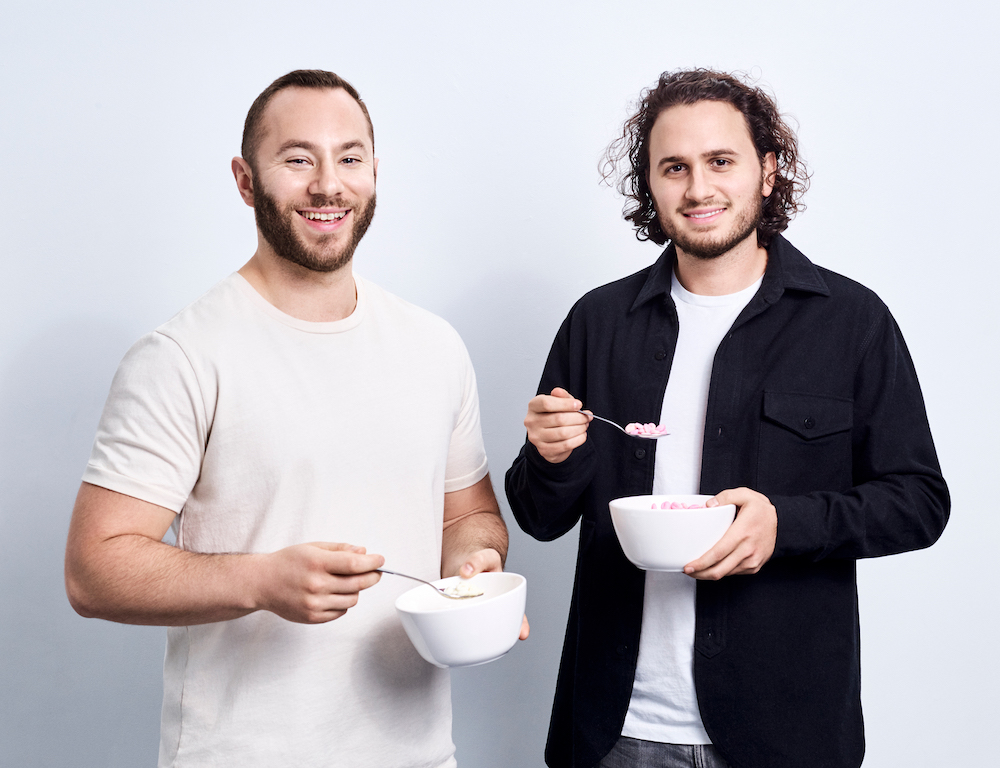
“We wanted to bring back the fun.”Greg Sewitz and Gabi Lewis, 2019
The price of a familiar pleasure
Familiarity brought its own difficulty. People already had a price in mind for a box of cereal, and Magic Spoon cost more. In a joint 2019 interview, the founders identified that price expectation as their largest challenge. A recognizable category saves a business some explaining. It also gives every shopper a ready-made comparison, usually sitting a few inches away on the shelf.
Selling through their own website gave Sewitz and Lewis room to explain the product and hear directly from buyers. It also gave them a way to introduce flavors and change the offering in response to feedback. Their initial direct relationship with customers was a deliberate choice. Before asking a retailer for space, they could learn what made someone order a box, then come back for another.
The founders raised a $5.5 million seed round in 2019 led by Lightspeed Venture Partners. Participants included founders associated with Allbirds, Harry’s, and Warby Parker, along with people from music and investing. The interesting connection was their experience selling a brand as well as a product. A cereal business needed manufacturing; this one was also being built around a website, a relationship, and a recognizable voice.
Some knowledge crossed over directly from Exo. Influencer marketing had been useful there, the founders said, and they intended to use it again. Starting over did not mean treating every previous choice as a mistake. Sewitz and Lewis could change the product’s premise while retaining methods that had helped them find customers. Their second company carried a selective memory of the first.
The cereal arrives by ear
Podcasts became part of Magic Spoon’s route into people’s kitchens. The company sought hosts who actually liked the cereal, including the team behind Pod Save America. Lewis explained the approach as one tied to sales, rather than publicity alone. A host’s enthusiasm had to do some commercial work. An audience could be large and still be the wrong place to sell breakfast.
There is something pleasingly old-fashioned about this part of Sewitz’s internet business. Someone a listener knows by voice recommends a food; the listener tries it. The website handles the transaction, but the introduction resembles word of mouth. For a premium cereal, the space to describe an experience has obvious value. A shelf label has fewer opportunities to be persuasive, and almost none to be conversational.
By June 2022, Magic Spoon said it had reached more than one million customers. That month the company announced an $85 million Series B led by HighPost Capital and its first nationwide retail launch at Target. Fruity, Cocoa, and Peanut Butter were the opening selection. After three years establishing the brand online, the founders were taking it into an aisle where the comparison would be immediate.
Series B funding led by HighPost Capital, announced alongside the Target launch.
Back in the aisle, with a longer shopping list
Retail had been part of the ambition early on. In 2021, Sewitz and Lewis said they hoped eventually to see Magic Spoon everywhere cereal was sold. The sequence mattered: establish the business online, then add other ways to buy it. A customer who first heard the name through headphones could later encounter the same box while shopping for the rest of the week.
The company’s newer work has stretched beyond those original rings. Its range expanded into cereal treats, granola, toaster pastries, and oatmeal. In June 2026 it introduced oatmeal in Maple Brown Sugar, Apple Cinnamon, and Banana Bread flavors. These are different breakfast formats with recognizable names. The choice suggests how much room the founders see in applying their approach to habits that already exist.
Growth also changes the people required to run the company. In February 2026, a recruiting firm announced the placement of David Yarmoff as Magic Spoon’s chief operating officer, working with the founders on manufacturing, logistics, and the supply chain. Those responsibilities are the machinery behind the colorful boxes. At a certain size, the next useful addition to breakfast may be someone who knows how to get it delivered.
Sewitz’s smaller preferences help keep the story at human scale. Asked in 2019 for his favorite New York restaurant, he picked Ops. Asked about Exo’s flavors earlier, he admitted to rotating between them. He has spent years developing and selling foods, yet the record still contains the ordinary business of liking a meal, tiring of one flavor, and choosing another. The customer has that freedom every morning.
His path from Brown to Exo to Magic Spoon offers a less tidy story than a single inspired idea followed by applause. The same two friends stayed together while changing what they asked other people to do. Sewitz began with a proposal that required a shift in eating habits. His second act made room for habits people wanted back. This time, breakfast could start before the explanation was finished.