A company can improve its offer. A city is a more awkward negotiating partner. Around 2011, Graham Weston encountered that distinction when a man whose company Rackspace had acquired refused to relocate to San Antonio. The objection extended beyond the office: he wanted a software community, a startup network, and a neighborhood where walking the dog could lead naturally to a coffee shop.
Weston had helped build a business that could serve customers around the world. Yet the life available outside its doors could still cost it a recruit. He forwarded the email to then-mayor Julián Castro. There was work to do on the place itself.
The episode helps explain the apparently wandering second act of his career. Coworking spaces, philanthropy, university education, apartments and a proposed baseball stadium all appear in it. The connection is his interest in giving people reasons to build a life in San Antonio. It is a proposition with practical attractions, considerable expense, and neighbors entitled to ask what the changes will mean for them.
The pork sold. The sums did not.
Weston grew up on his family’s ranch in Marion, near New Braunfels, in a household where entrepreneurship was familiar. Before he had a technology company, he had pigs. As a seventh grader, he marketed organic pork with a newspaper advertisement that invited readers to “Go Hog Wild!” Whatever else one says about his subsequent ventures, the early copywriting had confidence.
The business supplied an accounting lesson. He later recalled selling plenty while charging too little to cover expenses. An enthusiastic customer could still be an expensive customer. That is an excellent discovery to make while the stakes remain small.
In high school he took photographs at livestock shows and sold them to contestants. He then attended Texas A&M, graduating in 1986 with a bachelor’s degree in agricultural economics. A successful appeal of his father’s property-tax bills suggested another opportunity. While still a student, he started Assessment Technologies, using property information to challenge assessments.
The work put him close to commercial property owners. After college, distressed real estate became the next opportunity. In 1992, he led an investor group, including family members, that bought the San Antonio office tower renamed Weston Centre. The future internet investor had arrived by way of a very tangible business: buildings with occupants and bills.
A landlord discovers the help desk
In 1998, Richard Yoo, Dirk Elmendorf and Pat Condon brought an idea that made sense to him in familiar terms. Instead of renting someone an office, rent them computing equipment. Customers could use servers without buying and operating all the hardware themselves. More demand meant buying more servers. The building analogy had room to grow.
Weston supplied seed capital. By July 1999 he was CEO, a role he held until August 2006. He was an early investor who became an operator, working alongside the technical founders rather than arriving as one of them. His original understanding of the business also required revision.
The first version expected technically capable customers to sort out their own problems. Customers, inconveniently, needed help. Rackspace changed direction and made service central to its offer, under the name Fanatical Support. The shift gave the business a reason to exist beyond supplying equipment that competitors could also supply.
There is a useful consistency here with the later San Antonio projects. In each case, the available asset needed something around it. A server needed help from people who understood it. A workspace needed colleagues. An employer needed a place recruits could imagine living.
Weston’s first CEO tenure ended when Lanham Napier took over in 2006. He remained chairman and briefly returned as CEO in 2014. Those distinctions matter: the familiar shorthand of founder, CEO and chairman compresses a long sequence of responsibilities into something that sounds like a single job.
Rackspace went public in 2008. Its $4.3 billion acquisition by Apollo-led investors closed in November 2016. By then, Weston’s work on the city around the company was already underway.
A room full of possible colleagues
Geekdom began in 2011, co-founded by Weston and Nick Longo, the entrepreneur behind CoffeeCup Software. They had visited coworking spaces elsewhere and were trying to assemble something San Antonio lacked: a place where people interested in starting companies could find one another without already having the right introductions.
The first home was the Weston Centre. That location carried a pleasing reversal. Space associated with established professional firms could house people still discovering whether they had a business at all. The address was respectable; the plans inside were permitted to be unfinished.
Early membership came with an expectation that people would share time and skills. The arrangement recognized a difficulty founders encounter before the glamorous problems of scale: they often do not know whom to ask. A nearby designer, developer or experienced operator can make the next step less mysterious.
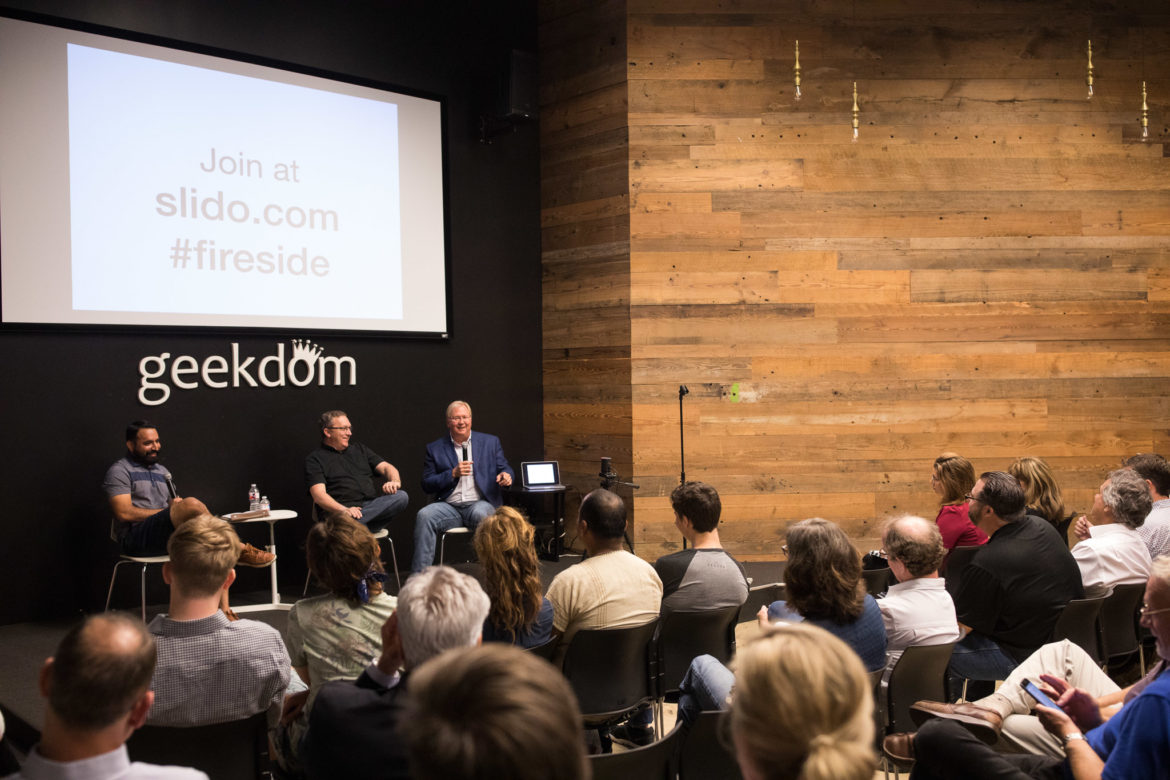
Lorenzo Gomez became another important collaborator in this community, working across Geekdom and the 80/20 Foundation. The recurring names matter. Weston’s story is crowded with partners, organizers and operators doing the daily work that a founder’s biography can too easily absorb into one person’s accomplishment.
“Once a company gets to a certain size they need to leave the nest.”
Graham Weston, speaking about Geekdom in 2018
That willingness to see companies move out gives the project a sensible test. A startup space can succeed when a tenant outgrows it. In 2018, Weston described the goal as being the place where startups begin. Keeping every promising company under the same roof would be a peculiar way to encourage growth.
Putting the neighborhood in the job description
Weston Urban, formed with Randy Smith in 2012, took the question beyond the office floor. Smith had managed Rackspace’s real estate portfolio. Their development company’s work includes Frost Tower, Legacy Park and the rehabilitation of historic downtown properties. It connects new construction with existing buildings rather than treating the city as a vacant site awaiting an idea.
The practical ambition is to make downtown useful for more of a person’s day. A workplace brings someone in for a shift. Housing, public space and things to do afterward can give that person reasons to remain nearby. For a company trying to recruit, those apparently separate decisions become part of the offer.
The philanthropic side developed alongside the property work. Established in 2013, the 80/20 Foundation supports initiatives concerned with San Antonio’s future workforce and entrepreneurs. Its name borrows the Pareto principle, expressing an interest in directing resources toward efforts capable of producing substantial effects.
In 2018, UTSA announced a $15 million gift from Weston for its proposed School of Data Science. The school’s downtown home, San Pedro I, opened in January 2023. The investment added an educational dimension to the nearby development: people learning skills that employers would need, in the district he wanted to see become busier.
Buildings make convenient milestones because they can be photographed on opening day. Training a workforce and sustaining a company take longer to assess. Weston’s projects depend on both kinds of work, even when the skyline receives more attention.
The neighbors already there
The proposed downtown home for the San Antonio Missions brings a harder set of choices into the picture. Weston is part of Designated Bidders, the group that acquired the baseball team in 2022. Weston Urban’s plans for the surrounding area include apartments and a hotel. Public financing is central to the stadium proposal.
The redevelopment also affects people whose lives were already established nearby. Residents of the lower-cost Soap Factory apartments objected to displacement as the plan advanced. Their concerns put a direct question to the language of attracting residents: what provision is made for residents who are there now?
In April 2026, county commissioners approved a revised arrangement involving a $10 million loan with 4% annual interest and parcels for a park. In July, the expected ballpark opening moved to 2029. Materials and construction schedules had lengthened the timetable. These remain plans and obligations to be delivered, with public costs and consequences that deserve attention.
The debate belongs in any account of Weston’s civic ambition. A developer can sincerely want a city to prosper while residents disagree with the means, the financing or the distribution of benefits. San Antonio’s future has more than one interested party.
The return address
For all the institutional names, Weston’s stated yardstick is personal: whether his children can be proud to call the city home. That is a different ambition from completing a property transaction. It involves jobs and housing, but also the everyday feeling of having somewhere worth returning to.
His lighter interview answers offer some relief from planning documents. In 2017 he described frequent breakfast meetings alongside a preference for getting up as late as he could manage. Asked to choose an entirely different career, he selected ventriloquism. The hypothetical second profession would at least simplify arranging a meeting with his performing partner.
His actual work keeps requiring other people with opinions of their own. Technical founders, customers, recruits, city officials and neighbors have all complicated the initial proposition. The career becomes more interesting at those points of resistance. A young seller discovers his margins. A hosting investor discovers support. An employer discovers that the neighborhood belongs in the conversation. Weston keeps returning to the places where the offer needs more work.
Keep the conversation going
Weston’s projects, public conversations, and reporting on the city around them.
- Graham Weston’s website · LinkedIn · X
- Weston Urban and its team · Geekdom
- Watch: Weston on workplace culture at TEDxSanAntonio
- Watch: Weston and Dirk Elmendorf on Fanatical Support
- Read: The Weston Way
- Read: Soap Factory residents’ concerns about the stadium plan
- Read: The revised ballpark financing agreement