Graham Weaver once wrote an investment memo declaring it mathematically impossible to lose money on a deal. The money was lost. He made the same declaration on two other occasions, with the same result. As a demonstration of the limits of mathematics, it was expensive. As material for a future business-school lecturer, it was rather useful.
Today, Weaver is the founder and CEO of Alpine Investors and a lecturer at Stanford Graduate School of Business. He has spent years working through a question that reaches beyond private equity: how do you choose work you want to keep doing? His answer involves people, patience, and a willingness to examine decisions that once seemed sensible.
He brings an engineer’s appetite for systems to a subject that resists tidy diagrams: what makes a person grow. He also brings the considerable advantage of having supplied his own cautionary tales.
The boathouse before the boardroom
Before the investment committees, there was an Ohio teenager pushing a lawn mower with a Walkman playing self-help tapes. Weaver’s interest in personal development predates his ability to put anyone on a payroll. His website’s bookshelf still makes room for biographies of Rockefeller, Walt Disney, Steve Jobs, Warren Buffett, and Sam Walton, alongside books about habits and human potential.
At Princeton, he studied engineering and graduated with highest honors. He also found rowing, initially from the wrong side of the team-selection list. In his telling, freshmen who missed a boat could remain “land warriors,” using the gym and rowing machines. He turned up early, apparently taking the invitation more literally than everyone else.
There he encountered Mike Teti, an accomplished rower who saw promise beneath his poor technique. Weaver began writing an Olympic ambition in a green notebook, together with daily actions toward it. He never tried out for the Olympics. He did become captain of a national championship lightweight crew team. The notebook had not predicted his destination exactly. It had given him somewhere to point his effort.
That distinction runs through his later teaching. A large goal can change what a person does this morning, even when the eventual result takes a different shape.
The safety of a very difficult job
His early career included Morgan Stanley Capital Partners, American Securities Capital Partners, and Oak Hill Capital Management. He earned his Stanford MBA in 1999. The respectable professional route was available to him, with a salary, a bonus, and a reasonably legible ladder.
Weaver has described choosing a large private equity firm after business school because starting his own business looked uncertain. The secure choice came with flights, late nights, and long weeks. Security, it turned out, could demand an impressive amount of inconvenience.
While at Stanford, he had already bought three companies without a committed investment fund behind him. Their early performance gave him little reason to order celebratory stationery. Yet he eventually set out to create Alpine, raising a $54 million first fund in August 2001 after more than a year of fundraising. Two individual investors helped make it possible. His cousin Danny Sanner joined as a summer intern, remembered in Weaver’s anniversary account with a puka shell necklace.
The first fund lost money. Before the financial crisis, Weaver and his partners were still trying to articulate why their firm should exist alongside all the others. Working harder at a familiar model offered little distinction. Executive coach JP Flaum helped him reconsider the business through the people running it, a relationship Weaver later credited with changing his approach.
There is something revealing about an investor learning to accept coaching. His job involves assessing other people’s judgments; progress required submitting his own to examination. The firm’s PeopleFirst language would need to survive contact with hiring decisions, operating problems, and the cost of developing someone before they had proved themselves.
A wall of sticky notes
Another coach, Tom Voccola, brought Lean manufacturing principles into Alpine during the financial crisis. The application was decidedly unromantic. Make time to examine the business. Map the work. Keep improving it. For people accustomed to evaluating companies, the awkward assignment was to evaluate their own habits.
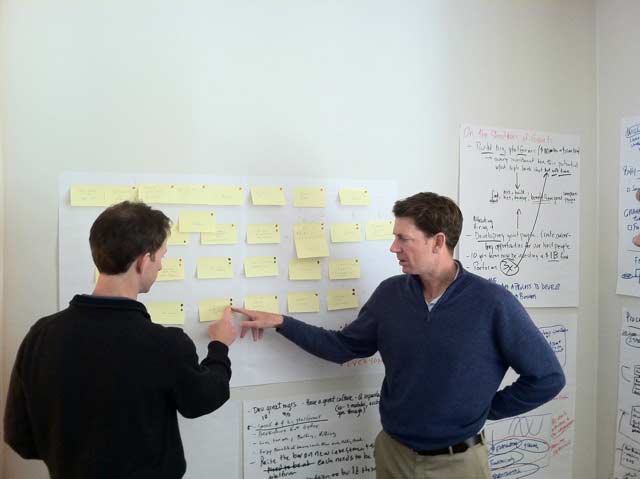
When the team mapped the steps between a possible acquisition arriving and a letter of intent, indecision appeared as an operating problem. Weaver says 80 percent of deals were getting caught in an unresolved category at the decision about visiting a company.
Alpine removed that category. The choice became passing on the deal or visiting within seven days. Weaver calls it “pass or sprint.” He reports a fivefold increase in capacity and a 90 percent reduction in time spent on deals that never closed. Those are his reported outcomes, rather than a forecast for anyone else’s business.
The human side needed experiments too. Weaver recalls initial resistance to Alpine’s CEO-in-Training program: promising MBAs could be costly, inexperienced, and impatient for promotion. Alpine eventually offered to reimburse a CEO for Laura Walsh’s salary if she did not work out. After seeing her performance, that CEO wanted more recruits like her.
The guarantee made the philosophy tangible. An institution that believes in potential has to decide who pays while potential is still potential. Weaver had benefited from early investors willing to back an unproven founder. Here was a way to carry that experience into another person’s career.
By June 2023, Alpine could close a ninth fund with $4.5 billion in commitments, twice the $2.25 billion raised for its eighth fund in 2021. In his letter about the raise, Weaver put the figure beside the less visible investment in leadership: programs for prospective CEOs, finance leaders, people officers, and investors. The money was the easily printed part of a system that depended on recruiting and developing people.
TWO FUNDRAISING MILESTONES
He described the larger fund against a difficult fundraising backdrop, with investors facing less available capital and competing demands. Scale did not erase the original question of what made Alpine different. It increased the number of people and businesses to which the answer had to apply. A recruiting philosophy becomes a more demanding proposition when it has to work repeatedly.
The case arrived before the happy ending
In 2002, Stanford’s Irv Grousbeck and Janet Feldstein wrote a case about Weaver. He suspects he supplied the curriculum’s example of failure. At 29, he had management mistakes and disappointing investments to discuss, without decades of later achievement to make the story reassuring.
His first classroom appearance went badly. “It was crickets,” he recalled. Lunch with the students proved more informative than the presentation. They wanted to understand what it had been like to fail and how he had continued. The fine points of company-building had competition from a more immediate concern: what if this happens to me?
That discovery shaped his teaching. He credits Grousbeck with helping him learn the craft and David Dodson, with whom he co-taught, with teaching him to see the classroom as something he received from. Hiring, firing, and fundraising remained on the agenda. So did the person attempting them.
“What would we do if we knew we wouldn’t fail?”
Graham Weaver
In 2024, Stanford students recognized Weaver with an MBA Distinguished Teaching Award for his elective teaching. Their testimonials emphasized his investment in their development beyond class and the rigor he brought to it. A teacher’s good intentions are one thing; students choosing to recognize the work adds a different kind of evidence.
His faculty listing now includes Engineering a Remarkable Life. It is an apt course title for someone who studied engineering and then spent much of his working life discovering how untidy the human material can be.
A longer clock, a different question
In his 2023 Last Lecture, Weaver described an asymmetric life: choosing work with room for a much larger outcome, then staying with it. His four principles ask people to do difficult things, pursue their own work, persist for decades, and write down the future they want. The investment analogy gives ambition a time horizon longer than the next promotion.
His public personality has room for lighter reference points. Speaking with Stanford’s Matt Abrahams, he named “Shake It Off” as his favorite Taylor Swift song and discussed what he admired about her persistence. He collects quotations and puts them on the classroom board. Even a concert can apparently become preparation for Monday’s lecture.
In that conversation, he also emphasized direct communication: identify the truth, make the conversation safe enough to have, and leave people clear about what is being asked. It connects the reflective writing to the everyday work of managing someone. Eventually, the thought has to become a conversation.
His March 2026 writing turned to artificial intelligence. Drawing on a keynote to Alpine’s leaders, he argued that operating businesses have useful advantages in their own data and industry knowledge. He urged experimentation and investment over a long period, while acknowledging that Alpine had started and stopped projects itself. The familiar patience had found another application.
In a 2025 letter to his younger self, Weaver offered a small daily practice: write three actions that move a larger goal forward, then do them. The advice has the same dimensions as the green rowing notebook. The ambition can be enormous; the unit of progress still has to fit inside a day. His writing repeatedly returns big questions to things a reader can put on paper.
By August, Alpine’s 25th anniversary gave him a reason to revisit the beginning. In between, his 2026 Stanford Last Lecture returned to a more domestic measure of time. He remembered traveling with three small children, keeping them occupied with books and games. Later, enjoying the quiet of first class, he found himself wanting those earlier flights back.
The story leaves him with two ambitions to keep in view. He wants to give people room to attempt work they have not yet proved they can do. He also wants them to notice the life happening while they attempt it. For an investor trained to look ahead, the seat beside him has become part of the calculation.