Graham Krizek had already launched his company. He had not yet left his job. Then came a podcast invitation, and with it a complication familiar to anyone whose side project has begun acquiring witnesses: what if the people at work heard it?
Recounting that first appearance two years later, he remembered being nervous about the overlap. Voltage was public; his commitment to it was still divided between a new business and an existing employer. In February 2021, he went full time. The interval matters. Before the financing rounds and enterprise customers, there was an engineer testing whether a problem that bothered him might bother enough other people to support a company.
The problem was the amount of work required before the interesting work could start. Krizek wanted to build applications using Bitcoin. Operating the underlying infrastructure kept getting in the way. A payment feature threatened to become a separate occupation.
His answer was Voltage. Its subsequent history offers an unusually practical view of Bitcoin entrepreneurship: upgrades, backups, customer requirements, and the recurring discovery that making something look simple creates a considerable amount of work backstage.
A hobby acquires a day job
In his telling, the interest began around 2012. He remembered the early faucet websites, where visitors could collect Bitcoin, and the attraction of experimenting with a decentralized network. Looking back in 2025, he emphasized how absorbed he had been by the technology. Imagining what the coins might someday be worth had been a secondary consideration. The tinkering was the attraction.
That curiosity developed alongside a more conventional technical career. Krizek attended Kansas State University from 2011 to 2015. His work included systems administration at Fruition, cloud architecture at Email on Acid, site reliability at NodeSource, quantitative engineering at Ikigai Asset Management, and senior software engineering at Salesforce. The recurring subject was infrastructure: the systems that other people expect to keep working.
He is based in Wichita, Kansas. When Voltage attracted a $6 million seed round in January 2022, its geography was part of the local interest. Trammell Venture Partners led the round; participants included Craft Ventures, GV, Stillmark, and Wichita’s Tenzing Capital. A cloud platform for Bitcoin could be built from Kansas. The servers were not going to object to the address.
Money gave the venture resources. The underlying proposition remained close to the frustration that had started it: developers should be able to make something useful without first reproducing the entire technical foundation.
Two minutes, and all the work behind them
Krizek’s June 2020 announcement put a concrete number on the promise: provision a dedicated Lightning node in less than two minutes. The platform opened to users that October. A node is software that participates in the network; in this setting, it gives an application a way to send and receive payments. Lightning adds a payment network on top of Bitcoin, using channels to move value between participants.
The initial Voltage service offered hosted infrastructure while leaving users in control of their funds. Voltage would handle uptime, backups, upgrades, and networking. Customers could connect their applications through programming interfaces. It was a fairly clear division of labor, although the labor on the provider’s side was substantial.
upgrades and networking
Simplified view of the launch product. A shorter setup still depends on work happening underneath.
There is a revealing modesty to the job description. Backups rarely make anyone’s vision board. Yet a backup, an upgrade, or a connection failure can determine whether a promising application becomes a working business. Krizek had found a place where the practical demands of software met the ambitions people attached to Bitcoin.
That also gave Voltage a useful test. A service designed to reduce technical overhead should make a difference to people trying to do something else. Before the enterprise turn, games and podcasts supplied particularly legible examples.
Coins for games, sats for voices
In March 2021, Krizek described how THNDR Games used Voltage for Lightning rewards. The game company had encountered node crashes under the load of thousands of daily transactions. Its developers had wanted to make games; troubleshooting payment infrastructure kept inviting itself into the schedule. Hosting the node with Voltage let them move that work elsewhere.
The distinction was easy to understand even for someone unmoved by Bitcoin. A player sees a reward. A developer sees a payout that must complete. Underneath both sits software that has to remain available. Krizek’s company occupied that last, less visible position. It could help a game without designing the characters, writing the levels, or persuading anyone to play.
The following month brought another application. Voltage teamed with Breez on a node offering for podcast hosts. Listeners could stream small Bitcoin payments as they listened, but hosts needed infrastructure that stayed online to receive them. The proposed service combined an always-available node with inbound channels supplied by Breez.
It was a specific attempt to connect a creative activity with a payment mechanism. The listener listens; the host receives sats, the small units in which Bitcoin payments are often expressed. The infrastructure needs to be ready even when the host has gone off to make the next episode. A microphone is already enough equipment to worry about.
Every other Friday belongs to curiosity
Krizek’s public code offers a glimpse of interests outside the founder biography. His GitHub profile includes a project for running Bash scripts in AWS Lambda and an IRC notification service, alongside forks of Bitcoin Core and Lightning software. These are practical tools and experiments, the sort of work that makes sense to someone who enjoys getting systems to cooperate.
In March 2022, he described an arrangement inside Voltage that gave that impulse a place on the calendar. Every other Friday, employees could work on an open-source project of their choice. They could work alone or together. Near the end of the day, the team would gather to share what they had done.
The freedom was explicit. A project did not have to serve Voltage or even involve Bitcoin. Krizek wanted people to follow their own interests while giving something back to the open-source world the company depended on. The specificity makes the idea interesting: a whole day, recurring, with the choice left to the person doing the work.
His advice to founders has a similar bias toward doing. He recommends getting products into the market early and retaining some enjoyment in the process. His preferred phrase is “Execute Relentlessly.” It sounds stern until placed beside a Friday on which the boss has deliberately declined to choose the project.
The customer behind the customer
As Voltage grew, the operational questions became larger. In a May 2023 post coauthored with Bobby Shell, Krizek outlined the company’s use of Google Cloud to expand hosting locations. Initial operations included Iowa, the Netherlands, and Singapore. Geography returned as a technical requirement: businesses needed infrastructure positioned to serve their users and fit their existing workloads.
That relationship linked his earlier cloud experience with his Bitcoin work. A network can be global in principle while a customer still has quite particular needs about where software runs. Serving that customer means dealing with those particulars. The abstraction only works when someone has attended to the details it hides.
- Announced in June.
Opened in October. - Krizek goes full time
in February. - $6 million
seed round. - Self-serve retirement
announced in July.
In July 2026, Voltage announced a more consequential decision. It would retire its self-serve product and concentrate on enterprises. The schedule stopped new infrastructure additions on July 13 and set August 31 for deprecating the self-serve infrastructure as a whole. The original route into the product was closing.
The company’s explanation was that serving exchanges, wallets, and other businesses could bring Lightning to people who would never operate their own node. That choice gives Krizek’s story a tension a tidy founder narrative might miss. Making a tool accessible to individual builders and bringing the underlying technology to a broader public can lead to different product decisions.
The early users helped establish the company. The enterprise focus required deciding where its attention would go next. For Krizek, the customer increasingly became the business between Voltage and the person making the payment.
Money arrives; the machinery recedes
The newer examples extend well beyond a developer’s dashboard. Voltage reported supporting a $1 million Lightning payment from Secure Digital Markets to Kraken in January 2026. In July, it described Vida using Voltage Credit to pay team members in Bitcoin while settling the company’s balance in dollars. The payroll arrangement addressed two preferences at once: what the worker wanted to receive and how the employer wanted to handle the accounts.
Those are distinct uses of the same broad idea. A trading firm has a settlement problem. A distributed team has a payroll problem. Neither begins by asking for a new infrastructure hobby. Krizek’s task is to make the payment technology fit the work already in progress.
By October, Voltage was announcing support for WhiteBIT’s Lightning functionality across deposits, withdrawals, and payment flows in supported countries. Krizek described the aim in terms of a technology becoming part of a customer experience people already trusted.
“Lightning becomes powerful when it disappears”
Graham Krizek · October 2026
His ambitions also extend to AI agents and machine-to-machine payments, where software could make frequent, small transactions. He has spoken about programmable access to services and the possibilities of payments built into applications. These remain areas he wants to develop. The immediate work is less speculative: make the integration usable, keep the service running, and help the customer complete the transaction.
The engineer who worried that his day-job colleagues might hear his podcast has become responsible for a company other businesses rely on. The problem he recognized has kept changing its clothes. Sometimes it looks like a game reward, sometimes a podcast payment, sometimes somebody’s pay. Krizek keeps returning to the part underneath: all the work that has to happen so another person can get on with their day.
Keep the conversation going
Watch & listen
- Building Lightning Network Infrastructure | Graham Krizek from Voltage ↗
- Will every company be a lightning company? | Stephan Livera Podcast 489 ↗
- Running a Lightning Node in the Cloud with Voltage | Connect The World ↗
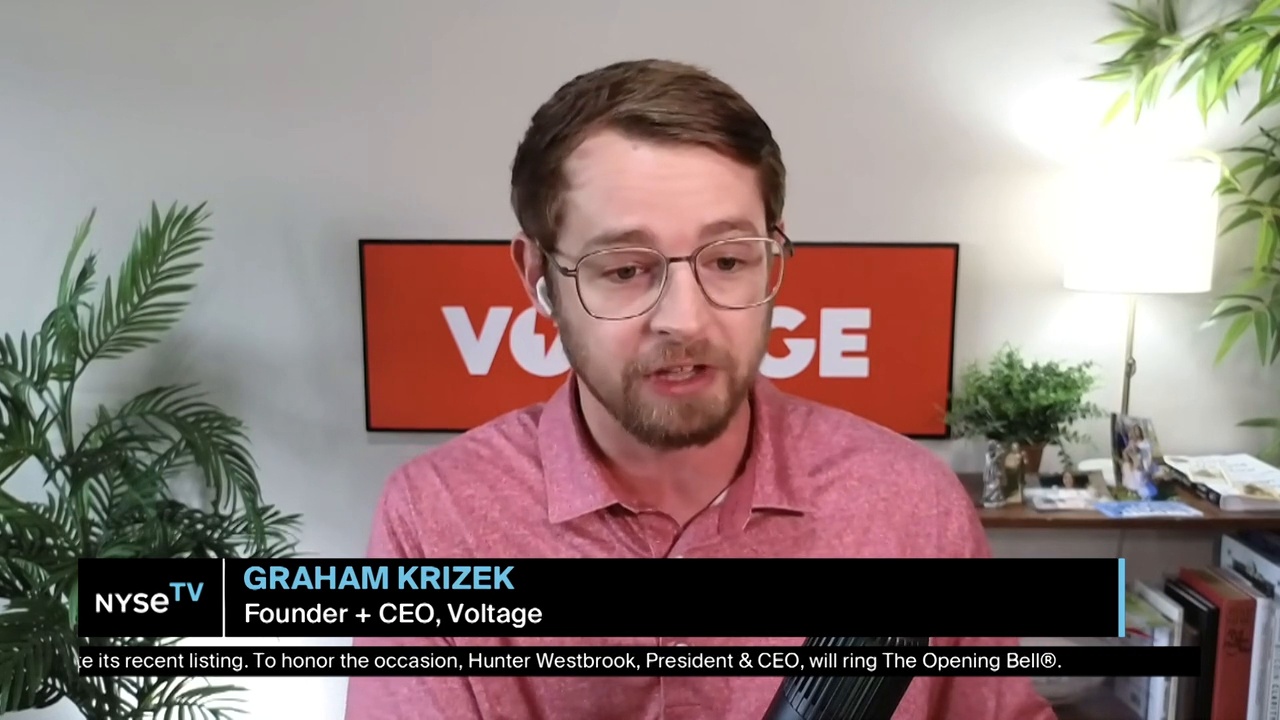
- Graham Krizek joins NYSE TV Live ↗
Further reading
- The 2020 announcement ↗
- The $6 million seed round ↗
- FOSS Fridays ↗
- Google Cloud expansion ↗
- The enterprise decision ↗
- Bitcoin payroll at Vida ↗
- WhiteBIT’s Lightning launch ↗
- The 2026 founder interview ↗
- The early gaming example ↗
- The podcast collaboration ↗
- The $1 million payment ↗
- The 2025 PayPod conversation ↗
- Krizek’s founder advice ↗