The first rule of a fast road is that somebody has to maintain it. On Bitcoin’s Lightning Network, the road is a collection of payment channels. Money can move across them quickly, often without making a separate Bitcoin transaction for every purchase. But a channel is not a bottomless pipe. Funds sit on one side or the other. A business can have a working node, a willing customer, and an awkward problem: too little capacity on the right side to receive the payment.
Lightning Labs has spent nearly a decade turning that awkwardness into software. Founded in 2016 by Elizabeth Stark and Olaoluwa Osuntokun, the San Francisco company first became known for lnd, its open-source Lightning node. It now builds tools for channel liquidity, asset issuance, node management, and payment integration. The point is not simply to make bitcoin move fast. The point is to make the system tolerable for the people who must run it.
- What it makes: lnd, Loop, Pool, Lightning Terminal, Taproot Assets, and Wavelength.
- Who uses it: node operators, wallet and app developers, merchants, and firms building payment services.
- What costs money: mainly liquidity and network services; much of the underlying code is open source.
- The live question: can these tools make self-custodial payments simple enough for builders outside Bitcoin’s specialist circle?
A node was only the beginning
In March 2018, Lightning Labs released the first bitcoin-mainnet beta of lnd. The announcement offered the thrill of real payments and the caution of real risk: experiment with only small amounts, it advised. The beta was intended for developers, technical users, and prospective routing operators. Early software needed better backups, reliability, and ways to watch channels. This was not a consumer checkout button dressed in a hoodie.
Stark had become interested in whether Bitcoin could support tiny payments at internet scale; Osuntokun supplied much of the engineering. Their product was one implementation of an open network, alongside other teams’ Lightning software. That distinction matters. Lightning Labs does not own the road. It builds a widely used kind of vehicle, a set of traffic controls, and some unusually practical roadside services.

The problem that charged a fee
Suppose a shop has received a string of Lightning payments. The balance of its channel drifts toward the shop. Receiving another payment can become difficult even though the shop appears to have plenty of bitcoin. Opening fresh channels or closing old ones costs time and on-chain fees. In 2019, Lightning Labs introduced Loop, a non-custodial swap service that moves value between Lightning and the Bitcoin chain while helping keep channels open. A Loop Out can restore room to receive; a Loop In can put funds back into Lightning.
The early version did not solve every case. In its own account of Loop’s beta, the company said some Loop In swaps had failed for users with poor inbound liquidity. That is a splendidly circular failure: the tool for fixing liquidity could itself run short of it. Lightning Labs changed the swap flow, expanded limits, and made the pricing more explicit. Its current product page lists Loop Out at 0.05 to 0.5 percent and Loop In at 0.10 to 1 percent, with quotes affected by timing and on-chain conditions. Routing and blockchain fees belong in a real comparison too.
The sequence is conceptual. All three layers still operate together.
Pool, introduced in 2020, attacks the same problem from another angle. It lets operators lease channel liquidity from other nodes. In most businesses, receiving money is free; here, the capacity to receive it can be rented. Lightning Labs serves as auctioneer in a marketplace whose design uses sealed bids and batched channel openings. The comparison for a merchant is concrete: lease inbound capacity, rebalance with Loop, make a direct arrangement with a node, or absorb the on-chain cost of opening channels. The cheapest option depends on traffic, fees, and the reliability of peers.
From bitcoin to dollars, with a few steps in between
The company’s next bet was that the same network might carry more than bitcoin. In 2022 it announced Taro, later renamed Taproot Assets, alongside a $70 million Series B. The protocol lets developers issue assets on Bitcoin and send them through Lightning channels. Asset issuance reached mainnet in 2023; Lightning transfers followed in 2024. This is the machinery behind the attractive phrase “stablecoins on Lightning,” not proof that every stablecoin is already available in every wallet.
In January 2025, Lightning Labs and Tether announced a plan to bring USDT to Bitcoin and Lightning through Taproot Assets. That was a consequential partnership announcement, and also a useful reminder to read product milestones carefully. A protocol can be running, developers can be testing, and an issuer can be integrating while ordinary users still wait for broad support. In June 2026, Taproot Assets v0.8 arrived with its first public SDK, reducing the amount of protocol bookkeeping an application developer has to manage.
The newest product is an admission
Wavelength, released in alpha in July 2026, addresses a familiar complaint: integrating Lightning often meant operating infrastructure that an app developer never wanted to learn. It offers a toolkit and API for self-custodial bitcoin payments, with stablecoin support planned. Anyone can try it on test networks; mainnet access was by invitation at launch. During its closed alpha, Lightning Labs listed a one-basis-point service fee on Lightning transactions, plus normal routing fees.
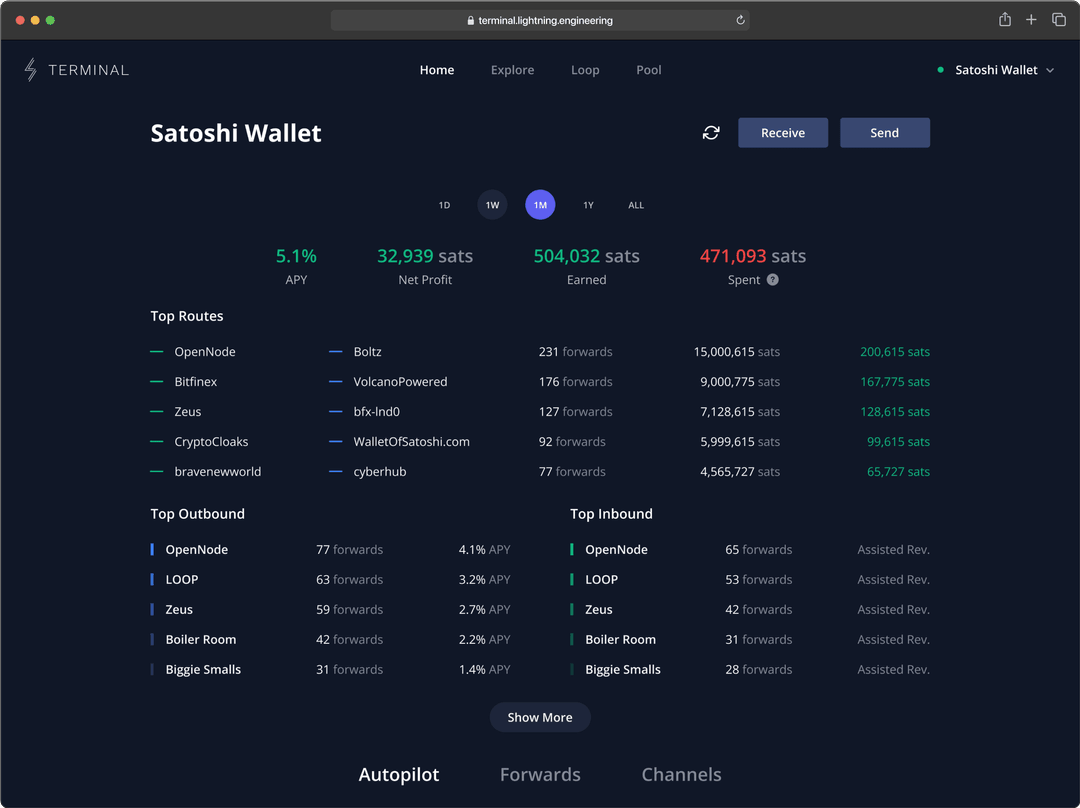
Lightning Terminal, meanwhile, presents node operations in a web interface. An August 2026 alpha added a Claude-powered assistant that can answer questions about a node’s channels and activity. The company says it transforms retrieved node data locally before sending it for processing. For now, the assistant analyzes; it does not rebalance channels or change fees on the operator’s behalf. That limit makes sense. An assistant that can describe a bottleneck is useful. One that can move money needs a different level of trust.
Lightning Labs sits between a public protocol and a private service business. Its node implementation and protocol work invite inspection and contributions; its liquidity services charge for the labor of keeping the network useful. Alternatives exist - other Lightning implementations such as Core Lightning and Eclair, direct channel arrangements, and competing infrastructure vendors. That openness is the company’s opportunity and its discipline. Developers can leave if the tools cost too much or complicate what they promised to simplify.
There is a lesson here for anyone building on a new platform. Start with the capability, then watch where competent users still get stuck. Lightning Labs’ sequence is unusually clear: ship the node, discover the receiving problem, price the maintenance, and finally wrap the rough edges in APIs. The model works best when there are enough active counterparties and transactions to justify the operating cost. It works poorly when channel liquidity is scarce, on-chain fees eat the savings, or users would rather pay a conventional provider for a simpler experience. Fast roads, after all, are valuable only when somebody can get on them.