A million dollars and change is an awkward thing to refuse. In December 2018, Roger Ver offered OpenNode $1.25 million to begin working on payment processing for Bitcoin Cash. The young company declined. Its answer was public, brief and sufficiently polite to make the refusal more conspicuous: thank you for the offer; we will keep working on Bitcoin.
Afnan Rahman was one of OpenNode’s founders. The rejection came from the company, rather than a personal declaration from him, but it supplies an unusually concrete opening to his career. Here was a business choosing which money to handle while declining money it could have used. Startup strategy rarely arrives with such convenient arithmetic.
The offer asked OpenNode to support a competing cryptocurrency. Accepting it would have altered the company’s work. Refusing it left an obligation: make the chosen system useful enough that the choice mattered beyond an argument among enthusiasts. The payment counter would eventually provide a more demanding audience.
Before the checkout button
Rahman’s work in Bitcoin preceded OpenNode. He founded Masen, a design and technology studio focused on Bitcoin, and collaborated there with João Almeida, who became OpenNode’s co-founder and chief technology officer. Their connection began before the payment company had a funding announcement to circulate.
A graduate of the University of California, Santa Barbara, Rahman also helped build Zap, the Bitcoin wallet associated with Strike. These were different ways of approaching the same practical difficulty: a monetary network still needs software people can understand and use. A wallet, a design studio and a merchant payment processor address different points in that encounter.
OpenNode was founded in 2018, with Rahman, Almeida and Brandon Lewis identified as its founders. Its place in the story was the business side of a transaction. Someone might already want to spend Bitcoin. A shop still needed a way to receive it, record it and decide what currency to keep. Enthusiasm could introduce the customer; it could hardly reconcile the accounts.
One currency, several doors
OpenNode packaged Bitcoin acceptance through a developer API, ecommerce plugins and a hosted checkout. The range of entrances mattered. A business with a development team could integrate the infrastructure into its own product. Another could use a checkout page without building the payment experience from scratch.
Fulgur Ventures invested in OpenNode and described its appeal in practical terms: make accepting Bitcoin as straightforward as accepting a credit card. That was an investor’s thesis, but it captured the test facing Rahman’s company. The novelty of the currency would not excuse a difficult purchase.
Lightning supplied a second layer of payment channels above Bitcoin. Payments could move through connected channels rather than placing every individual purchase directly on the blockchain. Bitcoin provided the underlying settlement system; Lightning made room for faster, smaller transactions. OpenNode handled the work of presenting those capabilities to businesses.
The company’s ambition therefore had an almost domestic scale alongside its international one. A button had to work. An invoice had to make sense. A merchant had to be able to get on with the rest of the day. Grand monetary theories are remarkably easy to interrupt with a troublesome checkout.
The students and the shopkeepers
In August 2019, OpenNode partnered with the Blockchain Education Network. The plan linked learning about Bitcoin and Lightning to trying the technology in surrounding communities. BEN’s network then included 2,300 students across 200 universities.
Rahman wanted students to learn how to build with Lightning and help local businesses accept Bitcoin. The proposed activities included payment integrations, merchant outreach and incentives such as conference passes. OpenNode would provide funding through its corporate social responsibility initiative. The path from classroom to shop was explicit.
Later that month, an OpenNode plugin made Lightning payments available to Shopify merchants. The platform had more than 500,000 merchants at the time; availability of the plugin gave them an option, rather than establishing that all had adopted it. Rahman emphasized the experience for both customers and businesses.
He also stated the company’s boundary plainly: “we are and always will be a Bitcoin-only platform.” The sentence gave the earlier refusal a product counterpart. More places to use the service, one currency underneath. Education and distribution were advancing together.
“we are and always will be a Bitcoin-only platform”
Afnan Rahman · August 2019
The customer could keep the dollars
By February 2020, Rahman said 5,000 merchants had registered with OpenNode. He described merchants who wanted to retain some or most of their payments in Bitcoin, including an increase in luxury businesses signing up. Their appetite created an interesting problem: the person shopping might prefer to pay with ordinary money.
OpenNode worked with Wyre on a beta feature that let customers pay through Apple Pay or debit cards while the merchant received Bitcoin. It began with fewer than a dozen merchant testers. The arrangement separated the shopper’s payment preference from the shopkeeper’s desired currency. Both parties could get the version they wanted.
In October 2020, OpenNode introduced split settlement. Businesses could keep a chosen proportion of receipts in Bitcoin and convert the rest into local currency. The company described it as one of its most requested features.
That request is revealing about the work behind adoption. A business need not make an all-or-nothing decision about every receipt. The feature put the choice into the settlement process, where a merchant could choose an amount rather than sign up to a philosophy. Even a committed Bitcoin business might have a landlord with other preferences.
Nineteen restaurants, one ordinary purchase
On September 7, 2021, OpenNode announced that McDonald’s in El Salvador accepted Bitcoin through the Lightning Network. The integration covered all 19 restaurants in the country, along with online ordering and the delivery app.
The setting gave the payment company a different kind of visibility. An ecommerce plugin offers a capability to merchants who must choose to install it. A restaurant counter puts that capability beside a familiar menu. The business can explain an unfamiliar payment method in the course of selling something entirely familiar.
The number is worth keeping at its actual size. Nineteen locations in El Salvador was a specific deployment, with specific purchasing channels. It demonstrated that the service could operate inside a recognizable business. It did not establish how frequently every customer chose Bitcoin, or promise how every other market would behave.
For Rahman’s career, this was a concrete consequence of the early focus. A company organized around Bitcoin and Lightning had helped put them into an everyday commercial setting. The distance between monetary ambition and lunch had become shorter. Lunch, for its part, remained admirably uninterested in the debate.
McDonald’s restaurants included in the announced Lightning payment integration.
The money accepted, and the money given back
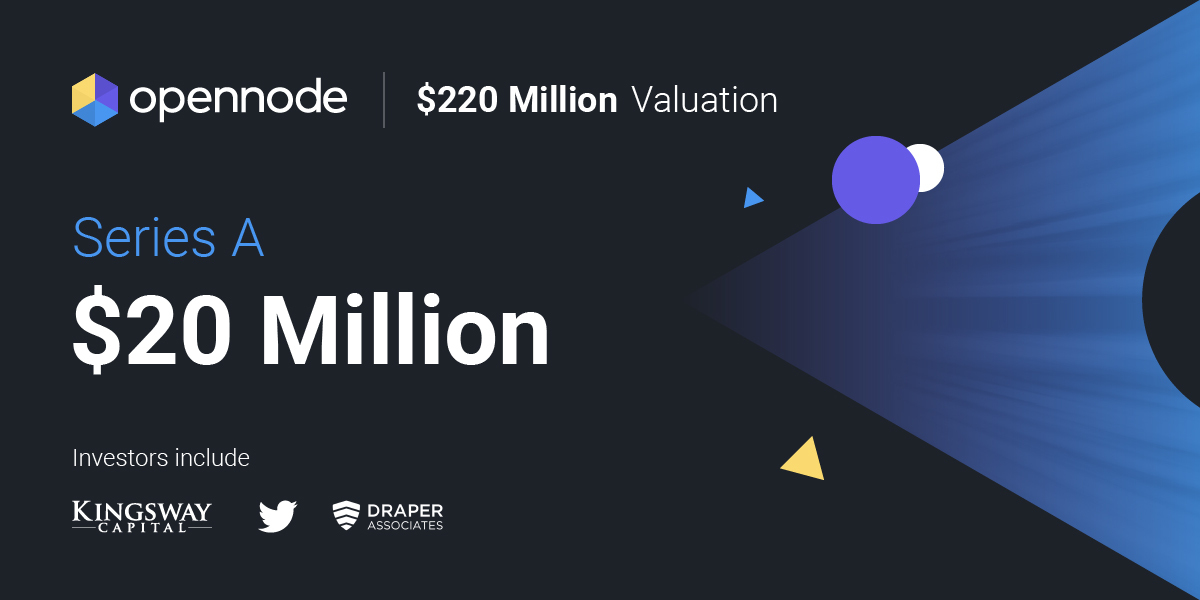
In February 2022, OpenNode announced a $20 million Series A at a $220 million valuation. Kingsway led the round, joined by Twitter, Tim Draper and Avon Ventures, a venture fund affiliated with Fidelity Investments’ parent company. The company said it would continue building Bitcoin and Lightning payment infrastructure.
The figures describe different things. Twenty million dollars was the financing round; $220 million was the company valuation attached to it. Neither figure was Rahman’s personal wealth. The announcement funded a business, with investors supporting the next stage of its development.
OpenNode also announced an endowment for independent developers and open-source projects. It initially committed one Bitcoin to the OpenNode Endowment, known as ONE. The mission statement connected the fund to strengthening the ecosystem on which the business itself depended.
There is a useful sequence here: choose a network, make commercial tools for it, then support some of the shared development beneath those tools. The company’s own ambition was expansive, extending to access and individual sovereignty. The endowment gave that language a defined starting contribution. One Bitcoin was a smaller number than the financing headline, and a different kind of commitment.
A trial, with a regulator in the room
In September 2022, OpenNode announced plans to test Bitcoin payment processing and payouts within the Central Bank of Bahrain’s regulatory sandbox. Such a sandbox provides a setting for trialling financial technology under a regulator’s framework.
Rahman called the announcement a watershed moment for Bahrain, the Middle East and the Bitcoin economy. His ambition reached beyond a single merchant integration toward countries, governments and financial institutions using the payment network.
The distinction between an announced test and a completed national rollout matters. Bahrain’s sandbox proposal was a trial of the infrastructure. It added a regulatory setting to a career already involving wallets, merchant software and education. Each introduced a different audience, with different reasons to be persuaded.
At a shop counter, a working payment is a persuasive answer. A regulator has a broader set of questions. OpenNode’s proposed trial brought the company into that conversation. Rahman’s public language remained ambitious; the form of the project was deliberately bounded. A sandbox is a modest name for a place where large ideas must learn to behave.
Build above it. Be careful beneath it.
By June 2024, Rahman was writing as co-founder and CEO of AYCE & Co. His new company broadened the work: AYCE now describes an ecosystem bringing together exchange, stablecoin and tokenization services, with Bitcoin security central to its positioning.
His argument that June concerned OP_CAT, a proposed change to Bitcoin’s scripting capabilities. He acknowledged possible uses for tokenization while arguing that pressure for new features should not rush changes to the base protocol. He favored building additional functions on other layers while protecting the underlying network.
“Why hurry to fix something that isn’t inherently broken?” he asked. The question connected his later work to OpenNode’s earlier choice of Lightning: applications could expand while the base network received more cautious treatment. It was his position in a technical debate, rather than a verdict resolving it.
AYCE’s broader product language adds an interesting turn to the trajectory. The founder who helped build a Bitcoin payment processor was working on a wider range of financial services. The question of where to build, and what to protect, stayed central.
The next question was trust
In November 2025, Rahman appeared in a discussion about crypto platforms and trust in Latin America. Working products, credible partners and evidence of safeguards occupied his attention. He stressed users’ need to research the businesses handling their money. He also treated customer support as part of security, bringing the conversation down to the person who needs help.
That emphasis gives his career a useful closing perspective. Making a transaction technically possible is one task. Making people comfortable using a service is another. Rahman’s examples increasingly included institutions, verification and accountability alongside the underlying technology.
His 2025 Advertising Week speaker profile identified him as AYCE’s co-founder, and a California corporate record refreshed in March 2026 listed him as AYCE Global’s CEO. OpenNode remains a defining chapter in that longer body of work.
The $1.25 million refusal still makes a good opening, but the later decisions give it substance. A payment business must decide what to support, how to make it usable and what evidence earns trust. Rahman’s career has brought those decisions into classrooms, online stores, restaurant counters and regulatory trials. Saying no supplied the boundary. The years afterward supplied the work.
Follow the work
Explore the companies, Rahman’s writing and conversations about his work.