A timesheet looks like a small thing. An employee records hours, a manager approves them, payroll runs. In government contracting, that ordinary sequence carries a second assignment: the hours must help explain the money charged to a particular contract. A business can pay everyone correctly and still struggle to reconstruct that explanation. This is the territory occupied by Gov-Con Solutions, an accounting and consulting company whose subject is the space between a number and the evidence behind it.
- Keep QuickBooks; add government contract accounting tools.
- Get help with cost allocation, reporting, and audit preparation.
- Choose software alone or pay for implementation and specialist support.
Its customers include small federal contractors, subcontractors, and technology businesses receiving research awards. These are companies whose technical work may be sophisticated while their accounting operation remains small. Gov-Con’s accounting practice addresses that mismatch with bookkeeping, monthly reporting, government invoicing, and labor-cost support. The underlying proposition is easy to understand: a contractor should be able to deliver the work and explain what performing it actually cost.
Keep the books. Add the machinery.
Consider the choice facing a company already using QuickBooks. Moving into federal work introduces accounting questions that ordinary commercial reporting may not answer. Which costs belong directly to a contract? Which support several projects? How should those shared expenses be allocated? Replacing the entire system is one response. Gov-Con sells an extension of the familiar setup, accompanied by people who know the questions.
Its software, GovCon Connect, works alongside QuickBooks. The company describes tools for indirect-rate calculations, labor distribution, project costing, and contract-funding visibility. QuickBooks remains part of the accounting environment. Gov-Con adds functions and helps establish the procedures around them. That combination matters because a useful report depends on choices made before anyone presses the button: account design, project codes, and the treatment of employee time.
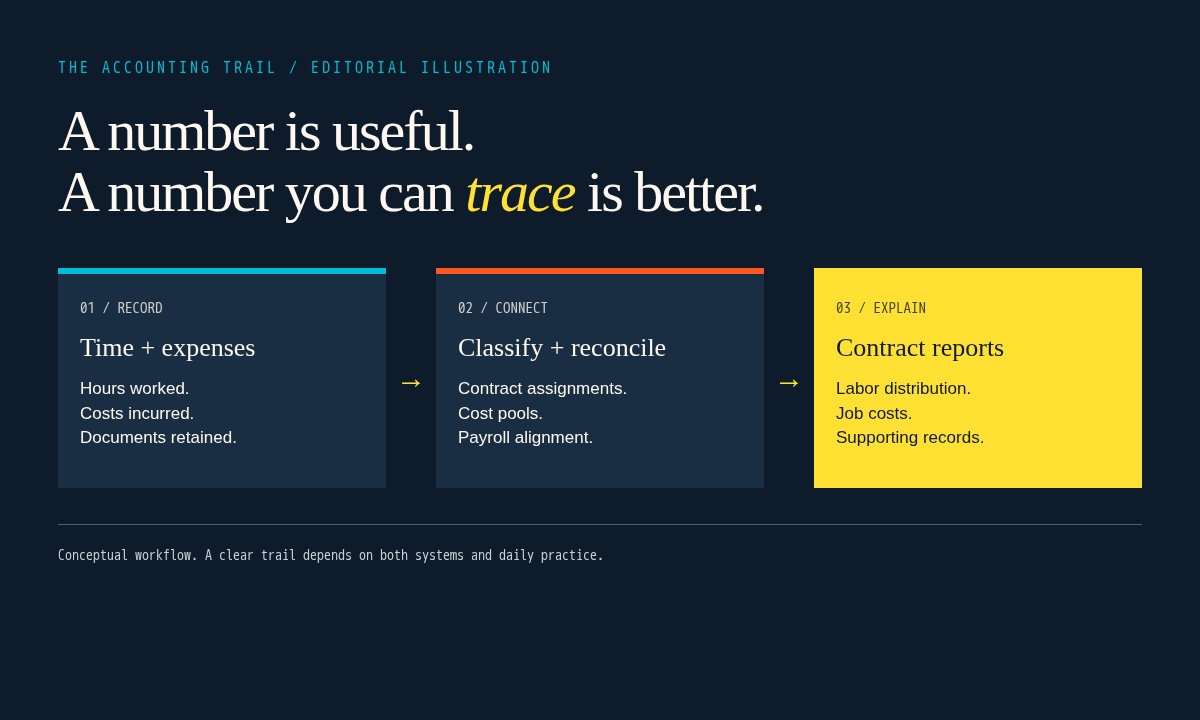
The human work is substantial. Gov-Con offers readiness assessments and audit consulting, reviewing accounting structures, policies, labor practices, and documentation. Its team can identify gaps, help correct them, and assist with an active audit’s requests. The product is therefore partly a repeatable accounting tool and partly a professional service. The balance changes with the customer’s experience and the amount of responsibility it wants to retain.
The first crack is usually a routine
Gov-Con’s published list of audit red flags is strikingly domestic. Costs get mixed together. Labor records fail to reconcile. Expenses lack project assignments. Written procedures are missing. There is no cinematic villain here. There is a transaction entered without the detail that someone will later need. The company’s advice points toward a familiar management problem: small omissions become expensive when they accumulate.
Its timekeeping guidance makes the same point at the level of daily behavior. Record actual hours promptly. Map them to the appropriate work. Preserve the explanation for corrections. Reconcile the time records with payroll and accounting. A technical connection between applications does not settle those questions. People still need a consistent way to use it.
“We passed with zero findings.”
Vincent Stango, Stango Obsidian Alliance, Inc.
Customer testimonial published by Gov-Con
That testimonial is one customer’s account of an audit outcome. The more broadly useful lesson is the preparation behind a review. Gov-Con’s services organize the records and responses that let a contractor explain its system. Buying help makes sense when internal expertise is thin; it still requires the business to supply accurate information and follow the resulting procedures.
There is a useful distinction in the company’s timekeeping guidance: recording time and distributing labor costs are connected tasks. A business needs both to line up with its accounts. For a small team, that suggests a concrete review: choose a completed pay period, compare the approved hours with payroll, and follow the resulting charges into project reports. Any unexplained difference gives the accounting team something specific to investigate. The exercise is repeatable, which is precisely its appeal.
What the $90 buys
On its main product page, Gov-Con lists an Essentials subscription at $90 a month for customers managing their own implementation. More involved packages add professional configuration, audit assistance, or support for billing-rate proposals and incurred-cost submissions. Setup and specialist work carry additional charges. A reader comparing options should treat the monthly software number as one component of a scoped accounting engagement.
Software access with self-managed implementation. Setup and specialist services add fees.
This pricing structure reveals the business model. Software supplies a recurring subscription. Implementation, consulting, accounting, and training supply additional paid work. Customers can do more themselves or buy more expertise. Gov-Con’s training offer covers government cost accounting, indirect rates, and incurred-cost reporting, extending the relationship beyond the person who operates the software. Managers and employees influence the quality of the records too.
The price of knowing your costs
Indirect rates sound like an accountant’s private hobby until a company commits to a price. Shared expenses must be understood somewhere. Gov-Con’s rate practice includes designing cost pools, developing provisional rates, supporting proposal pricing, and comparing actual results with expectations. Its guidance also addresses fixed-price contractors: even when provisional billing rates are unnecessary, understanding the full cost of delivery helps management judge profitability before committing.
For contracts requiring annual incurred-cost submissions, a different reconciliation follows. Gov-Con prepares the schedules and connects them to ledger balances, labor records, contract costs, and billings. Completing a spreadsheet is only part of the assignment. The figures must remain supportable when someone asks how they were produced.
In the wider market, Deltek Costpoint and Unanet offer purpose-built government contracting ERP systems. Gov-Con’s particular appeal is the possibility of retaining QuickBooks while buying specialized tools and assistance. A business seeking a broader integrated operating platform has a different buying decision. And Gov-Con’s own FAQ says its software does not replace independent auditors, CPAs, or legal advisers.
The habit a reader can borrow is modest: trace one labor charge from time entry to payroll to contract reporting. Then check whether shared costs follow a documented method. These are practical questions to ask before an audit date appears. Gov-Con has made a business out of helping contractors answer them.