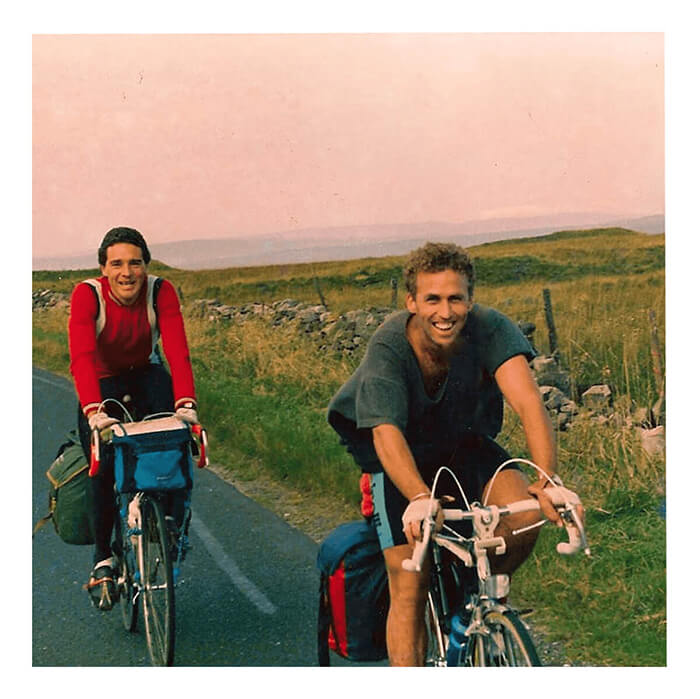
The useful thing about a bicycle is that it refuses to hurry on your behalf. Hills remain hills. Weather gets a vote. Strangers are close enough to speak to, and every object you carry eventually submits an invoice to your legs. Glen McDermott has cycled through 38 countries, and the habit seems to have followed him into business: travel light, pay attention, and decide what is worth the effort.
That is a curious operating system for a brand strategist. Branding is often sold as acceleration, a quick trip from anonymity to applause. McDermott's version begins with friction. His agency, Red Rock, starts client work with listening workshops. Its distributed team studies culture and purpose before producing the visible things. The work has the pace of someone arriving in a new town on two wheels, alert to what a windshield would hide.
McDermott grew up in Canberra, Australia's carefully planned capital, when it still felt to him like a frontier town. As a teenager he planted 30,000 eucalyptus trees in its suburbs. He says those trees now stand roughly 35 metres high, casting shade over the city. He hopes to walk beneath them with his grandson one day. It is difficult to invent a tidier parable for patient work, though at the time it was simply work with a shovel.
A retail education in desire
His first career was in retail design and marketing. Across Australia, Southeast Asia, and the United States, he learned how merchandising, words, and images could steer behaviour toward the impulse buy. He led marketing teams on three continents. The craft was persuasive. The objective eventually felt less so. Selling more things to people, in his telling, made for a hollow mission.
The exit was not a polished founder myth. McDermott has said that his retail career came crashing down after he was fired multiple times. It took him too long, he admits, to read the signs and choose a different road. This detail does useful work in his biography. Reinvention is usually edited into a clean upward arrow; his had switchbacks and bruised pride.
In 2010 he joined the coworking movement, preferring collaboration with independent people to the corporate environment he had known. A team began to gather. Clients followed. Red Rock emerged from those relationships as a creative marketing agency based in the New Haven area but designed to work virtually. The name nods toward the Australian landscape, while the structure belongs to the borderless working world McDermott had already been inhabiting for years.
“Brands are no longer storytellers; they are storymakers.” Glen McDermott
The company narrows the road
Red Rock did not begin with its present degree of focus. Like many young agencies, it learned by doing. McDermott's later formulation is more disciplined: the founder's personal story comes first, purpose grows from it, and profit follows when the first two meet a real demand. In a field full of companies eager to announce that they can do everything, he prefers the commercial clarity of exclusion.
He describes the choice with comic severity: Red Rock aims to become irrelevant to most prospects and “deeply relevant to just a few.” This is positioning without the perfume. A specific point of view repels as well as attracts. McDermott has publicly described declining prospective work when it contradicted the firm's stated mission. The refusal matters because purpose that never costs anything is merely office decoration.
His favored shorthand is “Unify, Simplify, Amplify.” The order is the argument. First decide what belongs together. Then remove the clutter. Only then reach for volume. Modern marketing often begins at the other end, amplifying a muddle and wondering why nobody remembers it. McDermott's route is slower at the start and cheaper in embarrassment later.
A founder shaped like a network
McDermott's career is less a ladder than a collection of tables at which people meet. He has chaired the Greater New Haven Chamber of Commerce Technology Council and its Big Connect event, served as a director of The Australian Community, and led the Connecticut chapter of Conscious Capitalism. That chapter's work now appears through the Conscious Business Collaborative, where he is executive director.
The Collaborative runs a Conscious Leaders Network. By late 2025, McDermott said that more than 70 business leaders had graduated from the program. It also established a relationship with Southern Connecticut State University to bring sustainability and regenerative economic ideas into the School of Business. These are not side projects stapled to a founder biography. They reveal his preferred unit of change: a cohort, a workshop, a room where business people can test a better premise together.
The civic roles also explain Red Rock's local roots. A virtual company can easily become placeless, a procession of rectangles on screens. McDermott keeps returning to New Haven's institutions, manufacturers, entrepreneurs, and convenings. In 2018, the Greater New Haven Chamber of Commerce named him Volunteer of the Year. The agency may cross time zones, but its founder has kept a chair in the community.
The bicycle test
Travel is the recurring counterweight to the screen. Red Rock's biography says McDermott has traveled through dozens of countries mainly on two wheels. In 2023 he crossed Morocco, meeting family-owned micro-enterprises while his team ran the company. He also moves between the New Haven area and Jávea, Spain, where he spends time with family. The founder's life and the firm's virtual design appear to have negotiated a practical truce.
There is adventure in this, but also management. A long bicycle trip makes abstraction difficult. Weight is felt. Distance has texture. Plans meet weather. Help often comes from strangers. McDermott has said travel builds empathy because the rider is exposed and impressions are vivid. In business language, one might call that proximity to stakeholders. On the road, it is simply the fact that you need directions and somebody is kind enough to point.
His taste in leadership books follows the same line. He cites Frank Hurley's account of Ernest Shackleton's expedition as an influence on his riding adventures and management style. The attraction is understandable: endurance, improvisation, and responsibility for a small group under uncertain conditions. Red Rock's conditions are gentler, but its flat structure also depends on trust, clear communication, and the freedom to admit an error without staging a corporate opera.
“Purpose clarifies not only what you choose to do, but also what you choose not to do.” Glen McDermott
The bright spot in the week
McDermott describes Red Rock as transparent and flat, with a regular cadence, shared information, and small experiments. The agency draws specialists who can work autonomously across cultures and time zones. He says clients have called Red Rock meetings bright spots in their day or week. For a business that sells communication, pleasant meetings are not a trivial operational detail. They are a live demonstration of the product.
He is equally plain about the limits of founder culture. His practice of openly admitting mistakes sets a precedent for colleagues to do the same, he says, but he suspects it works because the team remains small. Scale is so often treated as an unquestioned virtue that it is refreshing to hear a founder notice the conditions that make his methods possible. Some cultures can be enlarged. Others become a franchise of the original mood.
At this stage, McDermott is not trying to disguise the personal origins of the company. He argues that small businesses gain an advantage when founders make their convictions visible, provided the work supports the claims. Reputation multiplied by visibility is one of his formulas. Yet the reputation comes first. A megaphone cannot rescue an empty sentence; it can only distribute it more efficiently.
What remains after the ride
The most revealing objects in McDermott's story are not ads. They are trees. Thirty thousand saplings went into Canberra soil before he had a company, a positioning statement, or a distributed team. Decades later they form canopies. The work outlived the task, acquired users he would never know, and changed the temperature of a place. It is an appealing standard for any creative profession: make something that continues to be useful after your name falls off it.
The bicycle offers the companion lesson. Motion matters, but velocity can conceal. McDermott's career moved across continents before it found its governing idea. Once it did, his varied roles began to rhyme: founder, convener, traveler, adviser, volunteer. Each asks him to notice what people value and build a route they can recognize.
Branding at bicycle speed will not suit everyone. It asks for more listening than announcing, more selection than sprawl, and enough patience to let proof accumulate. It also leaves room for surprise. On a bicycle, the useful detour is often the one that introduces you to somebody. In McDermott's work, the road is not a metaphor pasted on afterward. It is where the strategy learned to look up.