After the fire, Glen Gunderson brought sandwiches. At YMCA Camp Northern Lights in northern Minnesota, the Orion building had burned, taking a kitchen and leadership-program lodging with it. Camp staff, contractors and colleagues were working to restore the essentials. The president and CEO of YMCA of the North arrived with something the people doing that work could use immediately: lunch.
It is a modest detail in a story full of difficult logistics. In June 2024, camp leaders had to arrange meals, reconnect utilities and find places for young participants to stay. The recovery belonged to many hands. Gunderson’s part in this particular passage was wonderfully free of executive vocabulary. Someone had to feed the crew. He helped.
That makes a useful place to begin with a leader whose job can otherwise seem very large and very abstract. His association operates across Minnesota and western Wisconsin. Its work includes child care, youth programs, camps and community partnerships. A mission broad enough to fill a board presentation still has to reach the people standing in front of you.
The job he almost declined
Gunderson joined the YMCA in June 2012. He had initially declined to enter the search for its chief executive. A mentor urged him to investigate further. He did, speaking with more than 170 people as he tried to understand the organization beyond his first impression of it.
Then came a conversation at home. His daughter was eight. He explained the choice in terms he hoped she could understand, treating it as a chance to talk about decisions. Her answer was brisk: “I think you should go to the Y. You will serve more people there.” Children can be inconveniently good at removing the decorative parts of a question.
The work became a new setting for experience he had accumulated elsewhere. He had worked in marketing and business development at Life Time, then held a chief business officer role at RedBrick. The move placed that commercial experience inside an institution with volunteers, donors and a public mission. He would have to learn its habits as well as understand its accounts.
graduating class
as president & CEO
board of directors
A useful clue to that experience sits in his relationship with Mick Johnson, a longtime YMCA volunteer. Johnson reached out early after Gunderson arrived and became a mentor and friend. In 2026, Gunderson reflected on that relationship when the association honored Johnson’s lifetime of service. Joining an established institution means inheriting people’s memories along with their expectations. Having someone willing to explain both is a considerable advantage.
Gunderson’s arrival also brought a question about who belonged on the leadership team. He valued the people already there and wanted additional colleagues who could introduce unfamiliar ideas. The board gave him room to learn and recruit. His account of the transition is less a solo entrance than an attempt to assemble the right company.
A coach gets coached
The same problem appears in a smaller room, or rather on a basketball court. Gunderson likes coaching. In a 2016 reflection, he described a youth team committed to equal playing time. During a tournament, he considered concentrating minutes among the stronger players to improve the chance of winning. An assistant reminded him of the original goal. The team kept its approach and lost the tournament.
The incident is revealing because Gunderson leaves his own temptation in the story. He does not edit himself into a coach who never looked at the score. His colleague corrected him, and he accepted it. Later in the season, the players were able to contribute meaningfully. Development required giving them the opportunity before the result was assured.
His coaching approach included several capable adults supporting one team, spreading attention across the players. The executive parallel is easy to see. Shared responsibility gives other people a chance to notice something the person in charge has missed. It also gives that person a chance to behave sensibly when reminded. A bench with room for advice is a useful piece of equipment.
“If I serve well, then my team becomes emboldened.”
Glen Gunderson, 2016
Gunderson has described learning to be comfortable with his own limits. A finance colleague should bring stronger financial skills; an operations colleague should bring stronger operational skills. Taken seriously, that belief affects hiring, authority and the atmosphere of a meeting. Expertise has to be welcome even when it complicates the chief executive’s first idea.
A mission needs a measuring stick
Service still requires choices. At the YMCA, Gunderson adopted Objectives and Key Results, a system for connecting an organization’s goals with measurable progress. He added a letter at the front: M, for mission. MOKRs made the purpose explicit for colleagues who might otherwise hear a management method borrowed from a different kind of workplace.
The distinction had practical consequences. The team initially set five objectives, then reduced them to three that integrated its work. Fewer priorities meant a clearer shared direction. A generous institution can accumulate commitments until every activity has a defender and nobody has enough time. Choosing where to focus is part of the responsibility that generosity creates.
An explanatory view of the YMCA’s adaptation of Objectives and Key Results.
One of Gunderson’s observations concerns the emotional difficulty of ending an activity. People may still rely on it, even when participation has fallen. A nonprofit has to consider those people while asking whether a different use of resources would reach more families. He has called the pull of those existing commitments a “benevolent quotient.” Kind intentions do not make the allocation decision disappear.
His longer view borrows an image from cathedral construction: workers contributing to something begun before them and completed after them. The analogy allows for slow progress without excusing inattention. In the YMCA’s approach, annual goals meet quarterly reviews. Ambitious results can be treated as stretches before becoming firmer commitments. A missed result can prompt a better question or a clearer way to measure it.
That is a demanding combination for a leader. The horizon must remain wide enough for a community’s future; the next piece of work must remain specific enough for a colleague to do. A cathedral is an arresting image. Someone still needs to know which brick comes next.
A larger circle of colleagues
Gunderson’s work extends into organizations that help the Y function. In 2024 he joined the board of Daxko, a software company serving community institutions. His stated interest was to help the company understand what YMCA organizations were trying to accomplish. Technology decisions become more useful when they begin with the people working in local programs.
He has emphasized the value of bringing information from individual Ys together, so that their decisions can draw on a broader understanding. It is an extension of the listening habit: local experience has something to tell the larger system. A software board is another place where the practical needs of a community organization can be heard.
Other relationships reach into education and youth opportunity. The Beacons Network lists him on its executive leadership advisory alongside leaders from schools and other community organizations. He also serves on Kaleidoscope’s board. These settings require working with people whose responsibilities overlap without being identical. A shared concern for young people leaves plenty of details to negotiate.
In July 2026, he participated as a presenter at the YMCA World Council in Toronto. A regional chief executive can bring local experience to that wider exchange and return with other people’s questions. The YMCA’s international connections create occasions for that kind of learning. They also provide a useful check on the assumption that one organization has exhausted the available ideas.
Leaving room for the next generation
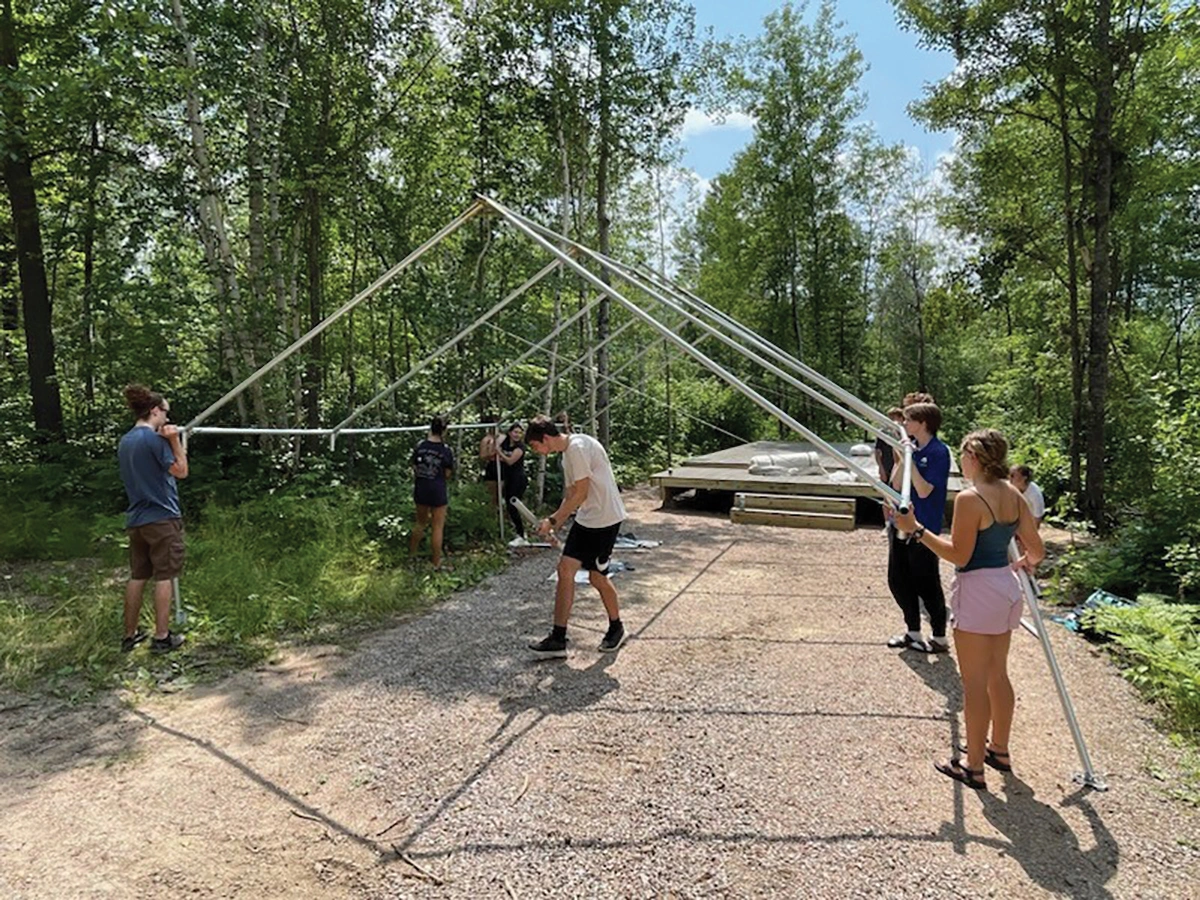
The outdoor side of Gunderson’s work gives the longer view a physical setting. Camp Northern Lights opened in 2019 on Bear Island Lake. He emphasized opportunities to step away from daily distractions and spend time in nature throughout the year. A camp offers a place where families can do something together without needing a very elaborate explanation of why.
Making those experiences available also requires money and partners. For the 2019 Prairie Burn Music Festival at Camp St. Croix, Gunderson connected fundraising with reducing barriers for campers needing financial assistance. The idea of access becomes concrete when someone can actually attend. A promising invitation needs a route through the gate.
The association identifies Gunderson himself as a legacy donor. That places him among people arranging support beyond their own working years. It fits the question of what a chief executive leaves behind: programs, capable colleagues and resources that someone else will eventually steward. An institution’s next chapter depends on people who will never have attended the current leader’s meetings.
Gunderson’s story returns, finally, to the camp crew. The kitchen was gone; the work remained. Other people brought construction skills, meals, materials and local knowledge. He brought sandwiches. The detail earns its place because it shows a leader accepting a share of a task without needing the whole task to belong to him. For a mission built around people contributing, that is a sensible place to stand.