Girish Ramachandra has a mildly inconvenient origin story for anyone hoping to film the moment inspiration struck. There was no such moment. Asked about the beginnings of Shopalyst, the company he co-founded in 2014, he described an idea that developed from a practical irritation: people could discover something they wanted inside an app, then face a separate expedition to buy it. The internet had become rather good at showing people things. Completing the transaction required more cooperation.
“There wasn't any particular single eureka moment,” he said in 2015. It is an unusually useful admission. The origin of a business can be an accumulation of observations rather than a scene with dramatic lighting. In his case, the observation concerned the small distance between interest and action. A product appears in a photograph, a video or a post. The shopper likes it. Then comes the work.
Shopalyst began with four former Infosys executives and an early platform called Shortlyst. Publishers and developers could add buying functionality to content. The ambition was straightforward enough to explain without a diagram: make the place where someone encounters a product a place where shopping can begin. A tiny button had acquired a substantial job description.
“There wasn't any particular single eureka moment.”
Girish Ramachandra · 2015
The engineer arrives with retail experience
Ramachandra came to this problem with a background in both engineering and management. He studied mechanical engineering at UVCE in Bangalore and management at the Indian Institute of Management Bangalore. The combination gives his professional story two useful reference points: how systems work and how businesses use them. His later career brought those questions together in retail technology.
At Infosys, he served as a vice president responsible for the Retail Industry Solutions business. His professional biography credits him with four patents that he helped commercialize. That last detail matters to the shape of the career: the inventions were connected to commercial use, rather than remaining an entry in a technical biography. Shopalyst followed work on products intended for actual retailers and their customers.
His Bengaluru base also anchors a business with customers beyond India. Kalaari Capital lists Shopalyst as a 2014 founding and a 2015 Series A investment. The investor's explanation centres on the gap between product discovery and purchase. It is a tidy description of the opportunity Ramachandra chose: connect two activities that people already perform, but that software often treats separately.
What has to happen behind a button
The button is the visible part. The less photogenic work concerns product information: collecting it, connecting it and making it available inside other experiences. Shopalyst describes a Product Knowledge Graph that indexes information from sites, apps and content. Its architecture uses parallel data processing and machine learning to handle the volume and changing nature of that information.
For a reader outside software, the practical meaning is simple. An app needs enough information about a product to do something useful with it. A photograph can inspire interest without supplying the details required for a purchase. A commerce service must bridge that difference. The shopper sees a convenient action; the company builds the connections that make the action possible.
Shopalyst's account of distributed commerce includes a universal Buy button and remote checkout. Its product information services can be accessed by software, allowing brands, publishers and developers to integrate shopping into their own environments. In that model, a retailer's store is one setting for a transaction, while the wider internet supplies many possible starting points. Ramachandra's career has increasingly occupied the space between them.
A shopping list and a silhouette
His early writing about artificial intelligence makes the problem more human. In an essay first published in May 2017 and republished in April 2018, he separated shopping driven by need from shopping driven by desire. Replenishing a familiar product calls for remembering preferences and taking care of the order. Discovering something new calls for a different sort of assistance.
He used the example of asking for a regular body lotion purchase. A useful system would resolve the preferred brand, size, variant and retailer without requiring the shopper to specify everything again. For fashion, he proposed visual search: finding a product without making the customer translate a shape, fabric or colour into the precise language of a search box.
Those examples give his interest in AI a specific texture. The subject is the awkward work people do to communicate with software. One customer wants a routine completed; another wants help identifying something attractive. Treating both as the same search problem misses what each person is trying to accomplish. Even the humble shopping list, in this account, has requirements.
Back at IIM Bangalore
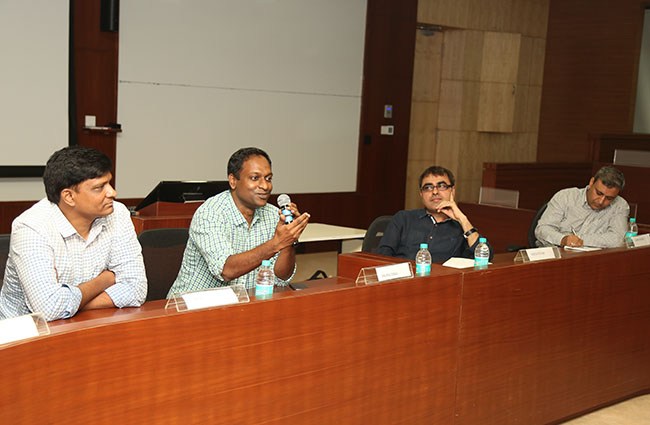
In November 2016, Ramachandra returned to IIM Bangalore for an alumni discussion about getting started in entrepreneurship. The panel included Anuraj Ennai of Mobiotics, Rajeev Pathak of Funtoot.com and startup and venture consultant Ujwal Tickoo. A photograph places him at the left of the group, in a room arranged for conversation rather than theatrical revelation.
The setting offers a useful pause in a story usually told through product releases. A former student comes back as a founder, sharing a table with other people who have taken the entrepreneurial route. The photograph records a public role that accompanies building a company: becoming someone another would-be founder might ask about the beginning.
The company outside the code
That role continued in September 2022, when he joined Hiver co-founder Niraj Ranjan Rout for Kalaari Capital's SaaS From Scratch discussion on going to market. The episode addressed starting the journey from zero to one, defining an ideal customer and running experiments. These are the questions that arrive when a product has to become a business.
The pairing is instructive without requiring the two companies to resemble each other. Software founders can face related commercial questions while serving very different needs. Who should use the product first? How do you recognise a customer worth pursuing? Which experiment would teach you something? The discussion put Ramachandra in the company of a fellow operator, talking about the work around the software.
His writing has also extended into the conditions under which marketers operate. In August 2021, he published an article on precision marketing and personalisation in a world with fewer third-party cookies. His contributions on India's Open Network for Digital Commerce consider another coordination problem: the services sellers need to participate, including catalogue management and discovery. Across these subjects, the recurring concern is how separate systems meet.
Take the shop to the shopper
By November 2023, Ramachandra was describing Shopalyst through the language of Discovery Commerce. His argument was that brands needed to bring shopping experiences to the media environments where people already spent their time. Building an attractive website alone did not settle the question of how a customer would get there, learn about a product and buy it.
He described using campaign context to find relevant audiences, building advertisements that contain useful product information, and connecting them to storefronts with retailer choices. Success was evaluated across targeting, engagement and the experience after a click. He also discussed measuring a brand's presence across search, shelves and media, alongside familiar advertising measures.
In that interview, he said more than 500 brands across 30 countries used Shopalyst. The number describes the company's reported reach at that point, rather than an independent measure of campaign performance. For the personal story, the more revealing detail is how the explanation had expanded. The early buying action had become part of a broader system for marketers, while the shopper's journey remained the organising concern.
Rocket science, marketing science and a thank-you
When Shopalyst marked ten years in 2024, Ramachandra's public reflection turned towards people. He thanked co-founders Mohan Kumar Krishnan and Sajeesh P J, along with families, teams, customers, mentors, investors, partners and friends. The list gives a different account of what sustains a technology company. Architecture has dependencies; so does a decade of building.
There was a particularly agreeable detail in his anniversary account. R Hutton from ISRO and Sanna Tandon from Unilever joined the occasion, bringing rocket science and marketing science into the same conversation. It is the sort of pairing that makes a company celebration sound worth attending. Two fields with rather different destinations had briefly shared a stage.
He described gratitude for the company he had kept and looked forward to building with those people for years ahead. There is no need to turn that into a sweeping personality diagnosis. The emphasis is plain in the statement itself: at a milestone that could have invited a solitary founder portrait, he named the people around him.
The question survives the technology
Ramachandra's contribution to the 2024 Modern Marketing Reckoner considered how generative AI changes consumer expectations. Personalisation, timely recommendations and smoother movement between touchpoints featured alongside a further expectation: people want control over how AI uses their information. The promise of convenience comes with a relationship to manage.
By October 2026, Shopalyst's website presented Symphony, an agentic AI platform for marketers, alongside Maia, its AI copilot. Its tools covered audiences, creatives, experiences, campaign management and insights. The company reported serving more than 500 brands in more than 30 countries. Those are the company's current descriptions; the product vocabulary has travelled some distance from Shortlyst.
A longer view makes the continuity easier to see. Ramachandra moved from retail solutions at Infosys to a startup connecting content with commerce, then to tools intended to help marketers manage that connection. The technologies and the buyers' working methods have changed. The original question still fits into an ordinary moment: someone has seen something they like. What, exactly, should they have to do next?