The modern athletic director keeps an absurd desk. There are buses to schedule, referees to confirm, forms to chase, parents to answer and, somewhere between a rainout and a wrestling weigh-in, an Instagram post to make. The game has not changed. The job around the game has. A school program is now expected to announce, document, celebrate and sell itself at the velocity of a professional franchise, usually without a designer in sight.
Matthew Glick noticed that mismatch from the field. As a Colgate University soccer player, he saw amateur sports organizations sitting on a daily supply of good material - athletes, rivalries, records, college commitments - while the people responsible for sharing it lacked time and design resources. He started Gipper in his dorm room and graduated in 2019. The New York company that followed did not try to teach every coach Photoshop. It turned the repeated grammar of sports into software.
Choose a game-day template. Drop in the opponent. Apply the school colors and logo. Add the sponsor. Publish now or schedule it. What used to begin with a blank canvas begins with the job already understood. That is the small, practical insight behind a company that says its tools are now trusted by more than 20,000 athletic programs, schools and districts.
01 / The product
A sports workflow wearing a design tool's jersey
The core product, Gipper Engage, combines a template editor with a brand kit, a sports-logo database, media storage, collaboration and publishing. Its library includes the usual fixtures - schedules, final scores, rosters and athlete spotlights - plus motion graphics, video, newsletters, sponsor assets, bag tags, awards, email signatures and livestream overlays. AutoBrand applies saved colors and logos with one click. Content Planner handles text, photos, video, carousels and graphics across connected Facebook, Instagram and X accounts.
That sounds like a bundle of familiar features because it is. The distinction is context. Canva offers a larger general canvas. Photoshop offers control. Social schedulers offer distribution. Box Out Sports offers a direct athletics-focused rival, including features Gipper does not emphasize, such as live-data integrations and automatic multi-format graphics. Gipper's argument is that the athletic department should not stitch these pieces together at all.
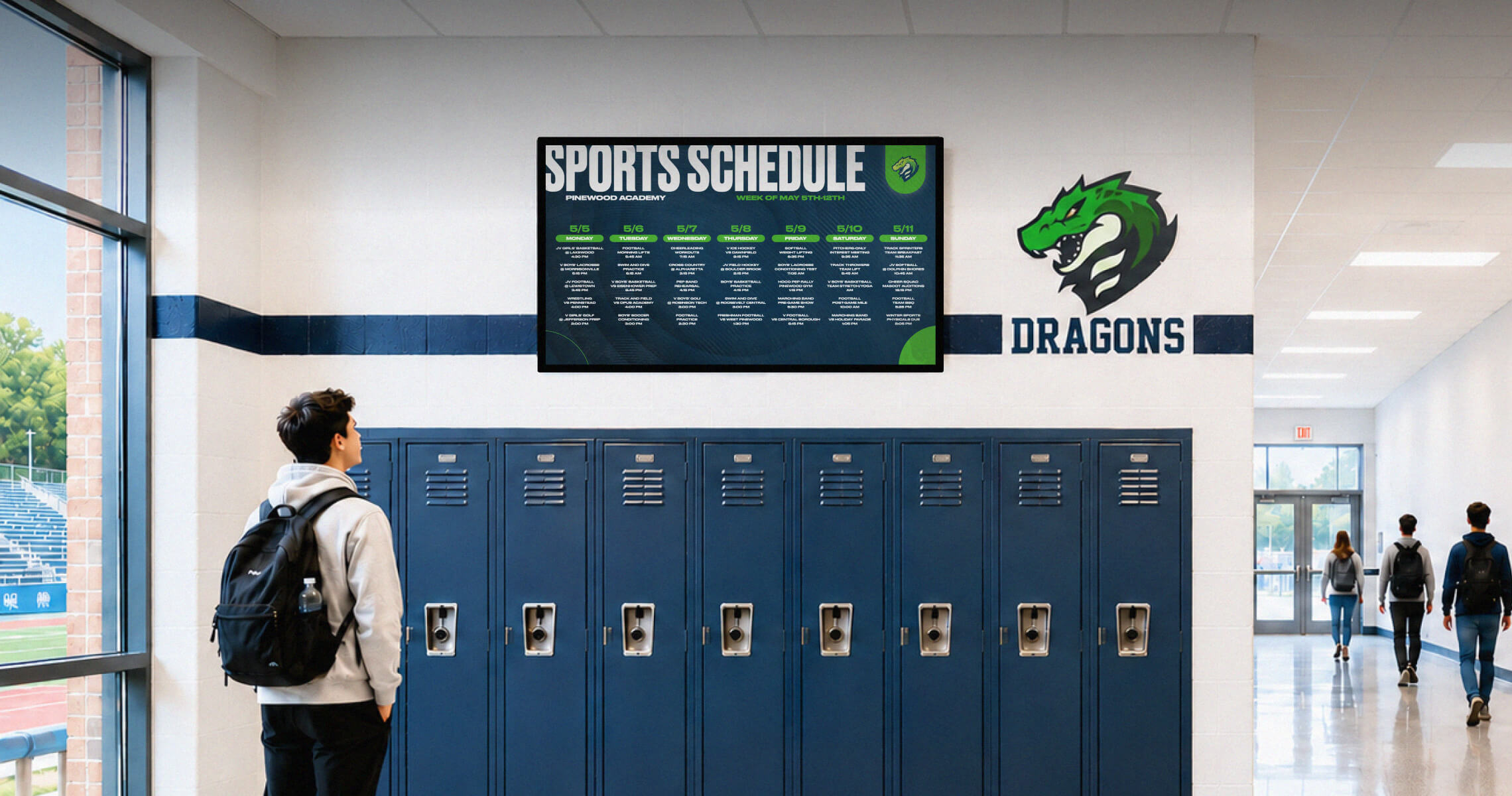
The expansion beyond graphics makes that argument stronger. Newsletters package longer updates for families and alumni. Gipper Touch turns school records, awards and history into an interactive hall of fame. Gipper Display pushes schedules, scores, announcements and event promotions to existing campus TVs. A post that once died in a feed can now appear in an inbox, a gym foyer and a hallway without being rebuilt in three other systems.
02 / The customer
The buyer is busy; the audience is everybody
The obvious user is an athletic director, coach or sports information director. The practical audience is wider: athletes who want recognition, parents tracking schedules, alumni remembering a title run, students passing a screen, sponsors buying local attention and prospective families taking a tour. This is why Gipper's niche is more interesting than “graphics for sports.” It sells a way for a school to look coherent to every constituency at once.
Green Level High School in North Carolina offers the cleanest example. Athletic director Colin Fegeley has used Engage for years, then added Touch and Display. Social content feeds a 75-inch interactive screen and other TVs. The school can give a weekly schedule a second life, direct visitors to tickets with a QR code and sell sponsor visibility across its digital real estate. Fegeley says local sponsorship income exceeds the cost of the Gipper subscription. The graphic is not merely prettier; it can become inventory.
“We bring in more in corporate sponsorship monies than our Gipper subscription costs.”Colin Fegeley, Green Level High School
The business model is annual B2B software. On a published collegiate page, Engage plans run from $625 a year for up to two people, to $1,500 for up to 30, to $3,000 for organization-wide use. Higher plans add more templates, collaboration, content requests and background-removal credits. Touch, Display and larger packages use demo-led pricing. The comparison is deliberately not “What does one graphic cost?” It is “How much staff time and tool sprawl can this replace?”
The old system's final score: time lost
03 / What broke, then changed
The first failure was not taste. It was plumbing.
Gipper's most persuasive case studies begin with systems failing in boring ways. At Dunkirk High School in New York, the old display process meant frozen screens, failed uploads and roughly three hours of work to refresh five TVs. With Display, athletic director Kyle Jarrell says the same job takes five to ten minutes. At Central City High School in Nebraska, staff moved from a separate signage platform and a weekly 30-minute update ritual to publishing in about 30 seconds.
At the Overlake School in Washington, the problem was duplication. Gipper powered social media while TouchPros powered a 42-inch screen in the gym foyer. Two systems meant two logins and two places to update. A demo of Gipper Touch changed the administrators' minds because the editor felt familiar and could reuse their existing brand assets and content. The migration did not demand a new display. Gipper replaced the mini computer, moved the material and kept the portrait screen.
That is the company's expansion thesis in miniature: do not ask a school to invent more content; remove the extra trip. The switch becomes attractive when the new product absorbs a workflow the customer already performs. It also explains why the company can move from feeds to newsletters to walls without losing the plot. The asset is the same. The destination changes.
What to copy
Pick an operator with recurring, deadline-driven jobs. Pre-build the grammar of the work, save identity once, then follow the finished asset into adjacent channels.
What not to copy
Do not bundle merely to inflate a feature list. Expansion earns its keep only when the same customer, brand assets and content genuinely travel together.
Why it wins
Speed, sports vocabulary, guardrails and support matter when the user is not a designer and cannot spend an afternoon becoming one.
Where it bends
Template convenience becomes a limit when a team needs bespoke art direction, deep analytics, live data or unusual production formats.
04 / The market
Vertical software earns its keep in the nouns
“Design platform” is broad enough to be meaningless. “Make 30 senior-night cards before Thursday” is a product brief. Gipper understands opponents, rosters, schedules, score bugs, sponsor marks and the peculiar politics of giving every sport equitable attention. Its searchable database holds more than 17,000 high-school and college logos. Workspace controls let an administrator invite coaches, staff and students while keeping the visual identity consistent.
That specificity is its defense against general tools, but it is not an automatic victory. Box Out argues for faster multi-format output, lower entry pricing and live-data features. Canva can be free and is familiar to students. A staffed Division I department may need original creative work that no template library can provide. For an occasional schedule post, the subscription is hard to justify. For a school with dozens of teams, several channels and one stretched administrator, the calculus changes quickly.
Conditions where the playbook does not work
Gipper is a poor fit when content volume is low, existing designers already own a mature workflow, a buyer needs extensive original brand work, or a competitor's specialized live-data and format automation matter more than Gipper's connected channel suite. The value also shrinks if staff will not maintain brand assets, collect photographs or publish consistently. Software can shorten the route; it cannot manufacture the habit.
The company's financing maps the progression. TIA Ventures led a $2.7 million seed round in 2021 alongside the launch of Gipper 2.0. Telescope Partners led an $8.63 million Series A closed in December 2022, with TIA Ventures following on. The NFHS moved from preferred partner in 2021 to naming Gipper its exclusive graphics solution partner in 2023. State associations and amateur sports groups added distribution into the networks where athletic administrators already gather.
Glick turns a Colgate dorm-room idea into a sports-graphics company.
A $2.7 million seed round arrives with Gipper 2.0 and an NFHS partnership.
The company closes an $8.63 million Series A and becomes the NFHS's exclusive graphics solution partner.
AutoBrand, Newsletters and Content Planner turn a design tool into a content suite.
Touch and Display carry the same stories onto interactive displays and campus TVs.
05 / The lesson
Make the amateur operation feel less improvised
Gipper's mission language is expansive: athletic departments should have the digital capabilities of professional organizations regardless of staff or resources. The actual product lesson is pleasingly modest. Start where the operator repeats a task under pressure. Remove the blank page. Lock in the brand. Make approval easy. Then let the finished thing travel.
Founders can steal the sequence. First, find a customer whose identity is obvious but whose workflow is fragmented. Second, encode domain knowledge into defaults instead of writing another help center. Third, measure value in minutes, missed posts and replaced tools. Fourth, expand along the path of the same asset. Gipper did not leap from graphics into payroll or ticketing. It followed school stories from the phone to the inbox to the wall.
The result will not make every high school look like a professional franchise, and it should not. A school is not a content farm. But recognition matters, schedules need to be seen, sponsors want visibility and a frozen screen is still a frozen screen. Gipper's business sits in that unsentimental middle: help one busy person publish the ordinary things reliably enough that the extraordinary kids do not disappear.