Giovanni Marcantoni learned early that a family game could be a rather merciless affair. Growing up in Baltimore, he played bocce with his father, uncles and grandparents after Sunday meals. The adults took their sport seriously enough to deny a child the usual diplomatic victory. “Even when I was young, no one let me win,” he recalled. There is affection in that memory, and a useful distinction: you could belong to the gathering without being allowed to conquer it.
Years later, he would build a business around inviting people into games. Volo Sports began with bocce in Baltimore in 2010. By September 2026, it was reporting operations across 17 markets. Alongside it, the Volo Kids Foundation offered children sports programs at no charge. The distance between those two moments is considerable. Yet the original attraction remains easy to recognize: a game gives people something to do together, and an excellent excuse to come back.
Sunday lunch, then a serious game
Bocce was a sensible place for Marcantoni to begin. His family played in Little Italy; the game already belonged to his experience of Baltimore. It also offered newcomers an unusually manageable introduction. Roll a ball toward a smaller target ball, then attempt to improve on everybody else’s efforts. One can explain the essentials without a whiteboard. The subtleties may occupy the rest of the afternoon.
His league took that familiar pastime to Federal Hill Park. By 2014, he was describing almost 500 annual bocce participants in Baltimore and more than 1,000 nationwide. The ages ranged from 22 to 65. Those figures belong to an early chapter, when a broader business was taking shape around a game that could accommodate people with very different sporting histories.
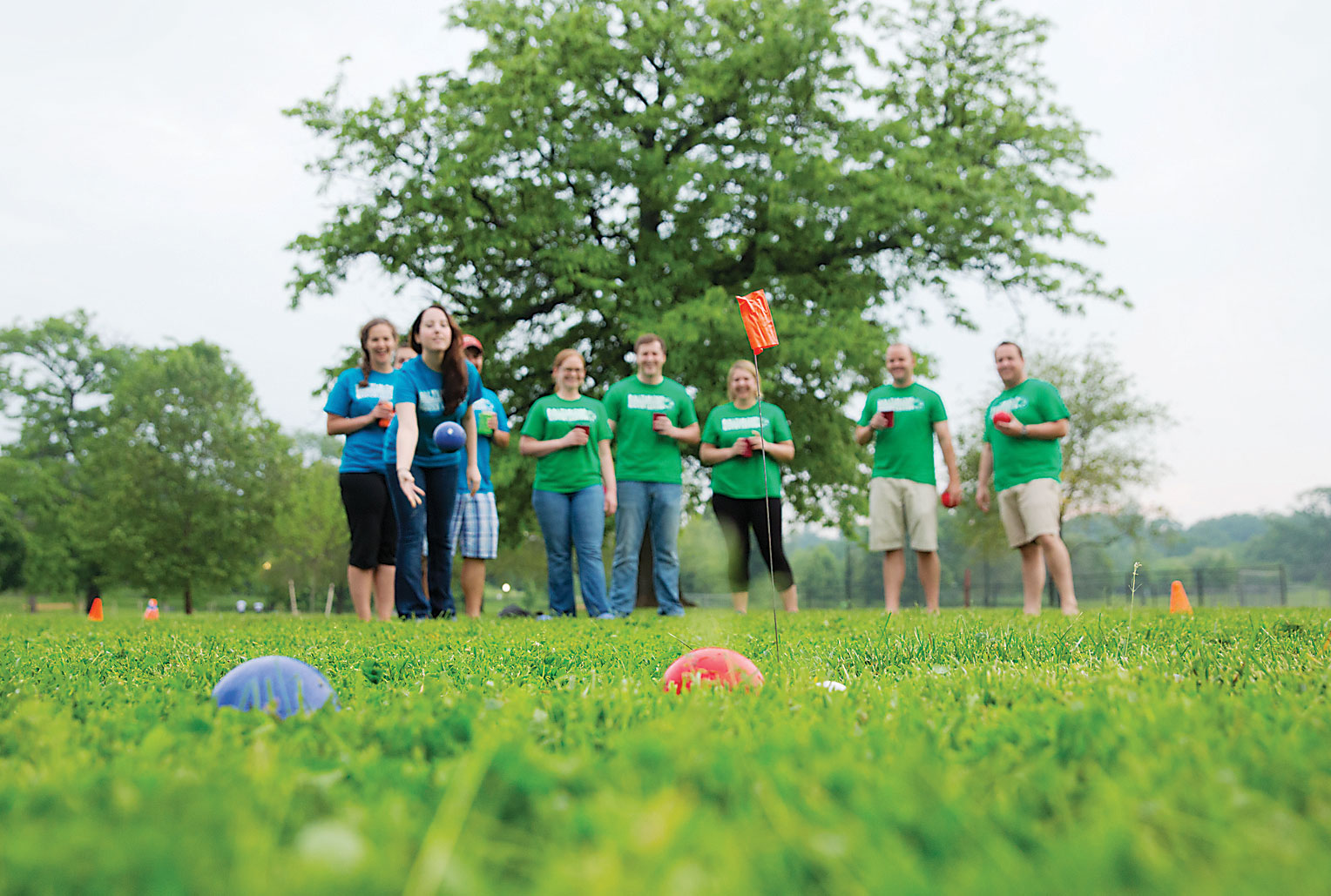
Marcantoni had played baseball and basketball growing up, and football at Calvert Hall. As an adult, he noticed something less appealing in recreational leagues: people leaving early in a season because the competition felt too intense. His alternative made room for players whose main objective was a pleasant evening. The score could still matter. It simply did not have to carry the full burden of the occasion.
The hobby acquires a balance sheet
Before sports became his occupation, Marcantoni worked in finance. He had attended the University of Delaware’s Lerner College of Business and Economics, and the league initially fitted around another career. His early commercial idea was charmingly specific: build a bocce community, then open a bar with courts. The prospective customers would already know one another. A hospitality business with its own standing invitation has certain advantages.
Skee-Ball helped expose the size of the opportunity. In New York, he found evenings attracting more than 120 people paying $75, with bar partnerships adding revenue. Multiple leagues were running each week. Eventually the side project demanded a decision about becoming the main occupation. The bar could wait; the people were already turning up. For a founder, that is a persuasive kind of interruption.
The personal returns were rather good, too. Marcantoni met his wife through bocce. In discussing that part of his life, he has described romance arriving without his setting out to find it. A league can arrange the game and the gathering afterward. The participants handle the more interesting developments themselves. His own marriage gives a human dimension to a company otherwise easily described in registrations and markets.
Baltimore also gave the young business a working community. At Betamore, the Federal Hill entrepreneurship campus, Marcantoni found reasons to commit the company to the city. After moving the office there from Harbor East, he spoke about wanting to remain in Baltimore and participate in its business community. An organizer of social gatherings had discovered the usefulness of one for himself. Even the people arranging introductions sometimes need an introduction.
The price of admission becomes zero
In 2015, the youth program began with an operational question. The adult business already had equipment, insurance, a website and people who knew how to run games. Could those resources serve children? Marcantoni wanted to use what the company had built. Baltimore councilman Brandon Scott helped turn that interest into a concrete proposition: space at Herring Run Recreation Center, provided the children could play free.
The money still had to come from somewhere. Restaurants contributed, employees volunteered their time, and the effort developed into a nonprofit. Early programming included football, soccer, kickball and sailing. At the June launch, rain sent players and volunteer coaches indoors to continue in the gym. It was an appropriately practical beginning for an idea that would depend on adapting existing resources to another group of players.
Volunteers, donations and partners help make the programs possible.
The adult operation offered more than a potential contribution. Its participants were also people who could coach. Equipment and organizational experience could be put to work again. By early 2018, the youth effort had its own executive director, and the previous year’s programming had reached more than 3,000 children in Baltimore, Washington and New York. Giving the project a separate organization made its responsibilities more explicit.
Nayla Bautista, its early executive director, helped develop that expansion. Jen Rifkin later became executive director in February 2022. Their presence matters in a founder’s story: an ambition becomes a program through the people responsible for running it. Marcantoni has publicly thanked both women, along with Scott, Todd Nagel and the colleagues who kept the early office functioning. Free admission requires a surprising amount of organized labor.

The foundation’s 2024 report recorded more than 24,000 player registrations, 476 completed programs and more than 3,950 volunteers mobilized. Those are measures of participation and delivery, rather than a count of unique children. Read together, they convey the work behind a simple offer. A family sees a chance to play. Behind that chance sit scheduling, people, equipment and a place to gather.
A national company still plays locally
As the adult leagues spread, Marcantoni faced a naming problem. Different cities had different identities. In 2017, he brought them under the Volo City banner, connecting the leagues with the affiliated youth foundation. Players moving between cities could recognize the name, while the shirts carried the explanation of what adult participation helped make possible. A business that had grown through local gatherings needed a shared introduction.
Recognition followed. In 2018, Volo City placed No. 976 on the Inc. 5000, with reported growth of 507 percent over three years. The business had traveled a fair distance from casual bocce. Marcantoni credited the people doing the work. The achievement also presented a pleasing incongruity: a company devoted to games had become the subject of a decidedly serious growth calculation.
By 2024, his conversation with the Profluence Pod covered bootstrapping, internal expansion and acquisitions. That November, Bluestone Equity Partners invested in Volo; the reported amount was $21 million. The investor described plans to strengthen operations, technology and acquisitions, and Walker Brumskine joined the board. Marcantoni was now working with institutional capital in a sector built from many local operators.
The ZogSports deal followed in June 2025. Its announcement described more than 120,000 players on that platform and an enlarged Volo footprint of 11 major U.S. cities. The transaction connected established recreational communities, including operations in New York and California. An acquisition in this business brings particular obligations: people already have teammates, familiar venues and expectations about the evening they have paid to enjoy.
Bocce begins
in Baltimore
Free youth
sports begin
Volo reports
17 markets
September 2026 added Fray and CLUBWAKA’s Miami operations. Fray brought Volo into Phoenix and Jacksonville while expanding its Washington presence. The Miami acquisition added familiar fields and an established player community in Coconut Grove. Volo also said its nonprofit partner would follow into the two new markets. Growth meant more places for adults to play and another set of local arrangements for the children’s programs.
A million invitations still to send
Marcantoni’s ambitions now extend to helping a million children play free each year. That remains a goal. In October 2026, he also discussed possibilities for national tournaments, sports festivals, a Volo Elite offering and a women’s division, without setting rollout dates. The ideas suggest a company trying to accommodate different appetites for sport while retaining the social reason people joined in the first place.
There is a practical side to his outlook that predates the larger deals. In 2016, when asked about work and personal life, he said time away from the office with family and friends often produced ideas. Walks, pingpong and music were among his ways of getting going again. The business required persistence; it also benefited from its founder occasionally leaving the desk. Recreation was allowed to be useful without becoming homework.
“Pick up the phone and call people.”
Giovanni Marcantoni, on advice he values
The scale has changed the founder’s calendar, but the useful unit of his work is still a gathering. A place has to be available. Someone has to arrange the game. Somebody arriving alone needs a way in. Marcantoni’s own life supplies the reminder that what follows can exceed the organizer’s plan. He set out to bring people together over bocce. Among the results were a company, a marriage and a growing number of children with somewhere to play.