In 1999, Aaron Hawkey was living in his business partner’s kitchen. The living room had already been claimed for an office. It was a domestic arrangement with a clear order of priorities: the company got the better room. When he met his future wife that year, the accommodation gave her a fairly efficient introduction to the profession she was marrying into.
Hawkey and Robert Angarita had met at La Salle High School in Pasadena. Hawkey tutored his friend in computer science. They went to rival universities, UCLA and USC, and started building businesses together anyway. More than two decades later, they would be running BallerTV, a company concerned with a different household problem: how to watch a child’s game when you cannot be there.
The schedule was half a mile away
At UCLA, Hawkey managed his intramural basketball team and took the assignment seriously. Finding the schedule required a walk to the recreation center. For a student at a university associated with the internet’s beginnings, the errand seemed particularly avoidable. In 1998, he and Angarita started Intramurals.com, taking the administration of campus sports online.
The service eventually reached 500 campuses. The irritation was modest; the audience for removing it was considerable. There is something appealing about a software business that begins with a student trying to save himself a walk. It also established a pattern Hawkey would return to: participate in something, notice the awkward part, build a tool.
The partners took time away from college to pursue the business, sold it to StreetZebra, then returned to finish their degrees. Hawkey studied electrical engineering. Returning students can have the timetable of an undergraduate and the social position of a visitor. The friends had trouble finding study groups after their time away. Their next company grew out of that experience.
- 1998Intramurals.com
Campus sports, online - 2002Cramster
A study community - 2016BallerTV
Youth sports on screen
A study group with room for strangers
Cramster, founded in 2002 by Hawkey, Angarita and Kaveh Golabi, assembled a community around homework help. Students could consult textbook solutions, ask questions and work through problems with others. By the time Chegg announced its acquisition in December 2010, the community counted more than a million members.
The appeal was the moment of being stuck. A textbook was available; understanding was less cooperative. Cramster gave that moment somewhere to go. Its resources included expert answers, practice problems and study groups, with both free and premium memberships. The service could accompany students beyond a classroom’s hours and beyond the people they happened to know.
Building it required less romantic work. Hawkey and Angarita initially held other jobs while developing the site. They later expanded operations in India, where the company could afford the staff it needed. A move toward a freemium model brought a revenue tradeoff in exchange for reaching more students. The business had to organize the people who supplied the help as carefully as the pages that displayed it.
Chegg was then known for textbook rentals. Bringing Cramster into the company added a different kind of relationship with students: help while they were actually studying. Hawkey stayed on Chegg’s product and marketing team until 2014. He had now seen an idea travel from a personal inconvenience into a service used far beyond his own campus.
A Bruin, a Trojan, and a working truce
The partnership survived a more traditional Southern California test: college football. In 2008, Hawkey and Angarita were publicly disputing how many national championships USC could claim under Pete Carroll. Hawkey argued for one. Angarita insisted on two. They joked that the debate consumed about five hours of their working week.
It is a useful detail in a career otherwise easy to describe through acquisitions and job titles. These were friends with an established supply of arguments, working in Pasadena, carrying a school rivalry into their company. Agreeing to build a business together apparently did not require agreeing on the record book.
Pasadena also supplied a deeper connection. Hawkey was born in Ohio and moved to California at 13, spending a summer in Caltech housing and time in its gym. Years later, five Caltech engineers would be part of BallerTV’s ten-person founding team. His connection to the campus continued through basketball, including courtside visits with his two sons. A gym could be a place to spend an afternoon and, over time, part of the geography of a career.
The audience was someone else’s family
The return to sports took some experimentation. Hawkey and Angarita initially tried streaming their own recreational soccer games. Hawkey’s retrospective review was economical: “not even us.” Even the participants were an unpromising audience. The more useful discovery came from families who wanted to watch young athletes.
BallerTV began in 2016, with Sandeep Hingorani helping bring connections in grassroots basketball. The service offered live games, replays and highlights. Its audience could include a parent away for work, a grandparent elsewhere, a coach evaluating a player or an athlete watching a game again. Each had a different reason to care about footage a conventional broadcaster might never commission.
By 2018, the company had broadcast 100,000 events. Its expansion depended on freelance videographers across the country, turning a software product into an exercise in getting people and equipment to the right courts. A subscription service still needed someone who could find the gym, set up and keep the action in frame.
That practical requirement helps explain the shape of Hawkey’s work. The public-facing product was a video player. Behind it sat a dispersed production operation. Basketball, volleyball, softball and other amateur sports brought different venues and schedules. A weekend’s coverage required many small assignments to go right at once.
“We started Cramster to help students get unstuck when they need help most”
Aaron Hawkey, December 2010
From a sideline job to a camera problem
In September 2019, BallerTV acquired FieldVision, founded by Kav Ohiomoba and Andy Kittler. FieldVision brought technology for filming sports autonomously, combining player tracking, ball tracking and an understanding of game context. BallerTV brought an operation already covering games at scale. The fit was unusually literal: one business had developed the means to automate work the other was arranging across the country.
Hawkey’s explanation at the time centered on keeping technology abreast of the number of broadcasts. The acquisition announcement reported more than 250,000 games covered since 2017 and weekends with as many as 17,000 live games. At that volume, adding coverage meant confronting the limits of a system dependent on manual camera work.
The original setup could be remarkably simple: an iPad, a tripod and an operator panning from the sideline. Simplicity made it possible to deploy widely. It also made the next question obvious. Could the software follow play? In 2025, Hawkey described autonomous capture as necessary for covering sports at a larger scale, crediting the FieldVision acquisition with helping the technical development.
The progression gives his engineering background a visible place in the story. A sports network needs an audience and rights to show games. For this particular network, its future also depended on what happened inside the camera.
The phone gets the sideline assignment
BallerCam launched in July 2025 after nearly two years of development and testing. It pairs an iPhone with an ultra-wide-angle lens attachment. Computer vision and machine learning select the view, following action through cropping, panning and zooming. The product records, streams and archives games, moving capture equipment into the hands of families and teams.
The distinction matters. The attachment captures a broad field of view, while software chooses the portion that becomes the broadcast. A person no longer has to spend the match physically steering the camera. At launch, the product supported soccer, volleyball and basketball. Viewers receiving a shared BallerCam stream did not need a paid subscription of their own.
Alex Morgan joined as an investor and brand ambassador alongside the launch. Dwyane Wade had already joined the company in 2019. Those relationships placed recognizable athletes beside a product whose everyday purpose remained domestic: letting people see a game they cared about. Fame could help introduce it. Families would decide whether it belonged in the weekend bag.
By that launch, BallerTV said its underlying technology had powered coverage of more than two million youth sports games. The figure describes accumulated use, rather than a promise about a future audience. It also marks the distance from those early recreational soccer streams, whose viewers had proved so elusive.
Still building for the next game
On October 13, 2026, a US patent for fisheye lens structure, housing, image capture and image processing named Aaron Francis Hawkey among six inventors. Assigned to Baller, Inc., it describes methods for turning a distorted wide-angle image into a selected view. Behind the familiar movement of a sports broadcast sits a fairly demanding geometry problem.
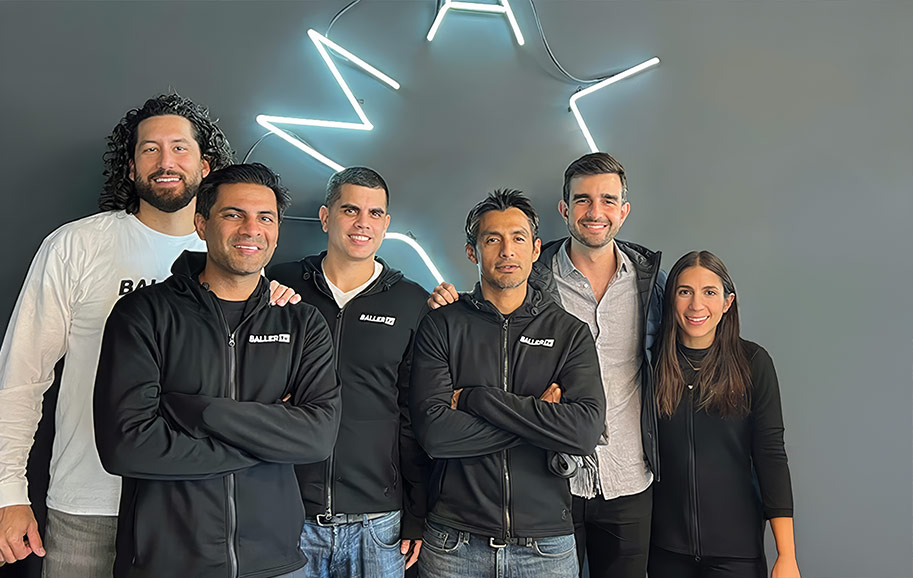
Hawkey remains BallerTV’s co-founder, co-CEO and a board member, sharing leadership with Angarita. The work has changed from campus schedules to study communities to cameras following a ball. The partnership has stayed recognizable. One friend once needed computer science tutoring; both went on to make a long occupation out of building things together.
BallerTV’s stated ambition is to make more games available, connect families and give athletes footage that can help them learn and be seen. For Hawkey, a basketball regular and father, the subject has always been close at hand. The kitchen office belongs to an earlier chapter. The question of where work ends and family begins is still somewhere near the court.
Keep the game going
Interviews, reporting & further reading
- The founders in conversation (2019)
- Hawkey’s startup interview (2021)
- Pasadena roots (2019)
- The Cramster years (2010)
- A campus rivalry (2008)
- Chegg acquires Cramster (2010)
- BallerTV’s early broadcasts (2018)
- Building a broadcast operation (2019)
- The FieldVision acquisition (2019)
- The BallerCam announcement (2025)
- BallerCam’s design (2025)
- US patent 12,762,673 B2 (2026)