He helped invent how a generation of creators got paid. Now he is rebuilding the movie studio from the ground up - for an era where the camera is sometimes a prompt.
In a Venice living room, three men sat for a portrait instead of standing in a glass tower. That is the first tell about Promise, the company George Strompolos co-founded and runs as CEO. It is an entertainment studio built, in his words, from the ground up - which is a polite way of saying it carries no back catalog, no legacy lot, and no incentive to protect the old way of making films.
Promise produces films and series for the generative-AI era. Not AI as a gimmick bolted onto a marketing deck, but AI threaded through the entire creative pipeline. The engine of that idea is MUSE, a production workflow platform the company describes as its operating system - software meant to move an idea from concept to screen faster by making a sprawl of generative tools actually work together. Anyone can list a dozen AI tools. The hard part, as Strompolos's investors put it, is making them cohere. MUSE is the bet that the integration is the product.
He did not arrive here by accident. Strompolos has a habit of showing up to the party before the band finishes setting up. He was inside Google for roughly six years, back when YouTube was an experiment rather than an empire. He co-founded a company that defined the creator economy. And he sold it near the top. Promise is the third act of a career spent betting that the way people make and watch video is about to change - again.
His co-founders complete the wager. Jamie Byrne, now President and COO, spent years leading creator partnerships at YouTube. Dave Clark, the Chief Creative Officer, is an award-winning filmmaker who built a reputation making cinema with AI. One operator, one platform whisperer, one artist. The team is the thesis.
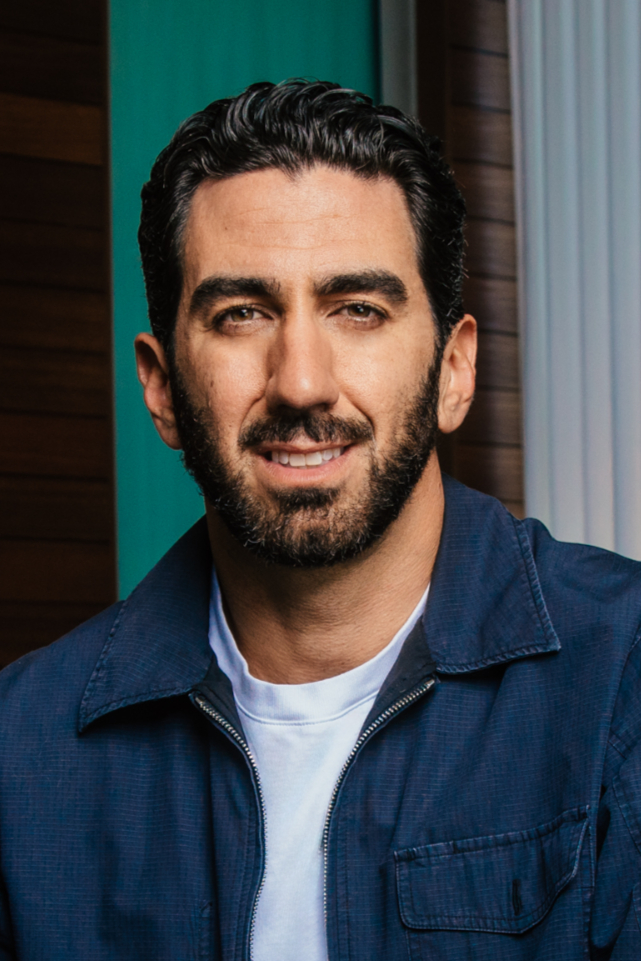
We believe this is a transformational moment in entertainment and a studio must be built from the ground up.
Strompolos did not start in Hollywood. He started in media's nervous system - business development roles at WIRED Magazine and CNET Networks, the kind of jobs where you learn how attention turns into money. Then he joined Google, and from there, YouTube, in the years when nobody was sure the site would survive its own bandwidth bills.
In 2007 he co-created the YouTube Partner Program, the mechanism that turned uploading videos into a job. It is easy to underrate now, when teenagers casually announce they want to be YouTubers. At the time, paying ordinary people to make video was a genuinely strange idea. He was one of only eight people named as inventors on Google's patent for monetizing user-created video - a paper trail proving he was in the room when the rules were written, not just reacting to them afterward.
The industry noticed. The Hollywood Reporter put him on its list of top executives under 35 in 2008. Advertising Age named him to its 40 Under 40 in 2013. But lists are lagging indicators. By the time the trophies arrive, the early bet has usually already paid off.
He kept showing up early - WIRED, CNET, YouTube, the creator economy, and now generative-AI film.
In 2011, Strompolos left YouTube to start Fullscreen - a media and technology company built to help creators grow audiences and turn talent into careers. He had spent years building the rails inside the platform. Now he built the company that helped creators ride them.
Fullscreen became one of the defining names of the multi-channel-network boom, a force in a corner of media that the legacy studios spent years pretending was a fad. In 2018, AT&T and WarnerMedia acquired it - through Otter Media - in a deal reported at $845M. Strompolos stepped down as CEO that September. Among his early believers: Peter Chernin, the former News Corp president whose investment vehicle backed Fullscreen. The same Peter Chernin would later back Promise. When an investor bets on you twice, across two eras, that is its own kind of resume.
Promise launched in November 2024. The pitch is unusually disciplined for a field drowning in hype. Four principles anchor it: champion original storytelling through visionary artists; empower both emerging and established filmmakers; use generative AI to enhance rather than replace the artistry of filmmaking; and protect creative integrity and artists' rights. In an industry that spent 2023 striking over exactly these fears, that last line is not boilerplate. It is the whole argument.
The company moved fast. In early 2025 it acquired Curious Refuge, an AI film school that reaches more than 170 countries - a way to find the next generation of AI-native storytellers, not just license the tools. By May 2025, Promise had widened its cap table with a strategic investment from Google's AI Futures Fund, alongside Crossbeam, Kivu Ventures, and Saga Ventures, and deepened a partnership folding Google's AI models into MUSE.
Around the studio sit two more pieces: The Generation Company, a production-services arm delivering high-end AI visual effects, and a slate that includes projects blending traditional cinematography, motion capture, VFX, and generative AI. The aim is not to prove a robot can make a movie. It is to hand filmmakers a faster, stranger, larger set of brushes.
Business-development roles at WIRED Magazine and CNET Networks.
Joins Google / YouTube in strategic partnerships.
Co-creates the YouTube Partner Program; named on Google's video-monetization patent.
The Hollywood Reporter, Top 35 Executives Under 35.
Founds Fullscreen; serves as CEO.
Advertising Age, 40 Under 40.
Fullscreen acquired by AT&T / WarnerMedia (reported $845M); steps down as CEO.
Launches Promise as Co-Founder & CEO.
Promise acquires Curious Refuge; adds Google's AI Futures Fund and other investors.
“We use generative AI to enhance, not replace, the artistry of filmmaking.”
“A studio must be built from the ground up.”
The former News Corp president backed both Fullscreen and Promise - the same investor wagering on Strompolos across two eras of media.
Led by partner Andrew Chen, a16z calls Promise “uniquely positioned to lead” the convergence of technology and storytelling.
A strategic investment plus a partnership integrating Google's AI products into the MUSE platform, with Crossbeam, Kivu, and Saga alongside.
Being one of eight named inventors on Google's video-monetization patent is rarer than any award. It is documentary evidence he was building the creator economy, not narrating it.
Promise's founder portraits were shot in a Venice home by photographer Jeff Lorch. A studio that chose intimacy over a glass-tower power pose.
Peter Chernin backed Fullscreen and then Promise. Few founders get a repeat customer among investors who have already seen how the story ends.