At a wedding, Geoffrey Karas brought up a car wash. There are more conventional subjects for the occasion, but this one had consequences. His future business partner, Justin Landau, remembers Karas pointing him toward a company in Miami. Both were working in finance in New York. They began investigating, raised backing and discovered that their investors had a condition: the pair would have to run the business themselves.
The original idea had allowed for hiring a management team. The eventual arrangement required a move to Florida. In 2019, Karas and Landau took over four El Car Wash locations and became responsible for an unfamiliar daily operation. A conversation about an investment had turned into a change of address, occupation and responsibility. The wedding guests could presumably return to their usual work on Monday. These two had acquired rather more homework.
A career with an unexpected exit
Karas, usually called Geoff, came to the opportunity with experience on the financial side of businesses. He studied at Colgate University from 2006 to 2010, graduating summa cum laude. His professional history includes investment banking at Barclays Capital, private equity at KarpReilly and investment analysis at Silver Rock Financial. The sequence helps explain his familiarity with evaluating companies before he became occupied with operating one.
He and Landau also co-founded Audrose Partners, an investment company focused on businesses that require substantial operating work. In February 2019, Audrose, Wafra and Fireside Investments announced National Express Wash and its acquisition of El Car Wash. Karas was initially its president; Landau was CEO. The plan combined acquisitions and development, with attention to the underlying real estate. Even in the earliest announcement, the land and the operating business appeared together.
The chronology matters. El Car Wash was an existing Miami brand, founded in 2011. Karas and Landau built the current platform after acquiring it. Their story begins with four working sites and the decision to take responsibility for what those sites could become.
Learning to stand at the entrance
During the first year, the partners effectively acted as regional managers. Neither arrived knowing how to operate a car wash. They spent time learning the industry’s practical work and relationships, while shaping the experience customers would encounter at each site. Finance had given them experience with consumer businesses across multiple locations. Running the washes required another kind of attention.
Karas’s references for the brand included Starbucks, Chick-fil-A, Raising Cane’s and Wawa. Those comparisons reveal the ambition more clearly than a picture of washing equipment would. A familiar name should give a customer some confidence about the next encounter. Consistent service has to justify that confidence each time. A striking sign can introduce a business; it cannot wash the car.
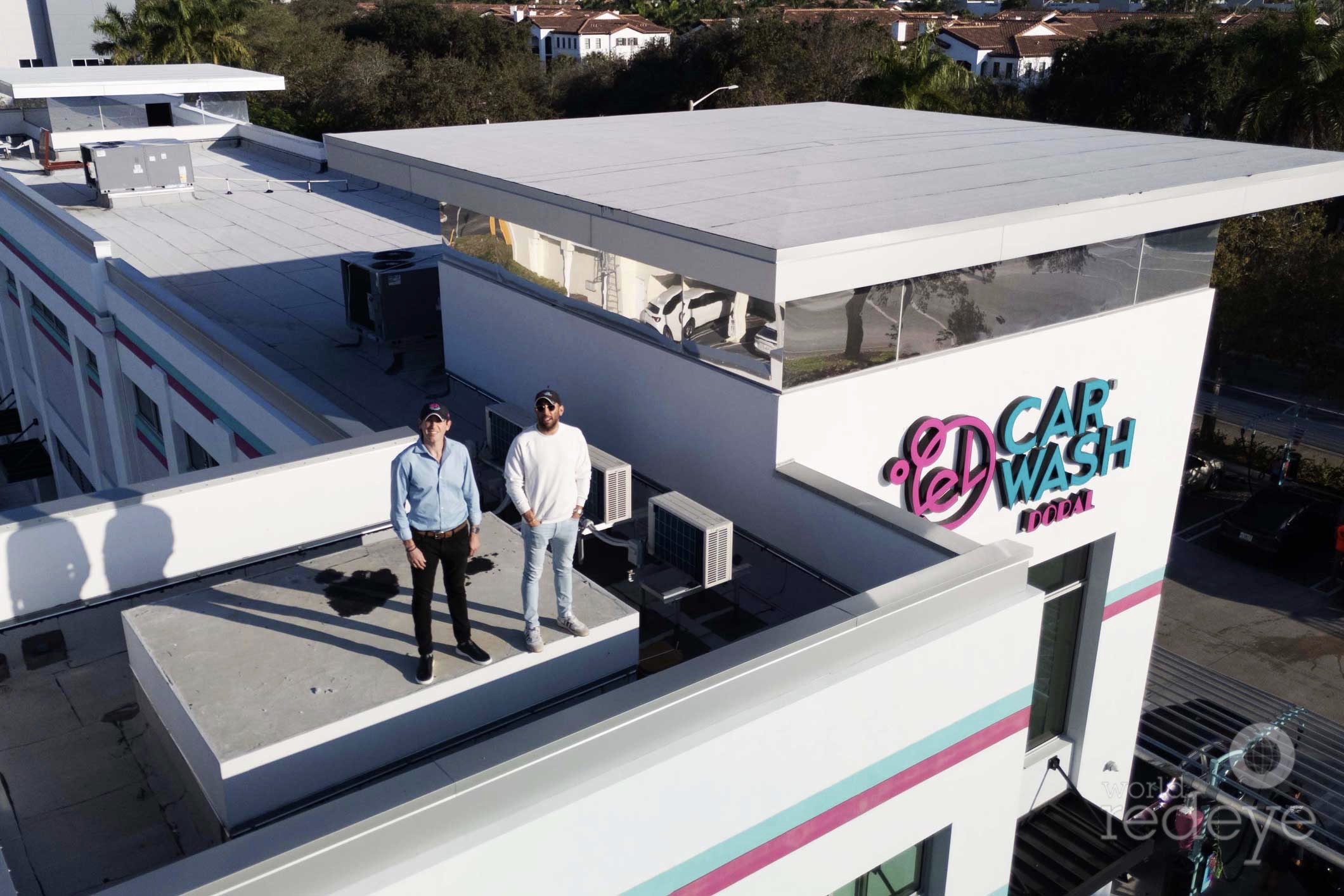
The pink and teal drew on Miami Beach’s Art Deco colors. That choice gave an everyday errand a recognizable setting. It also made the business visibly attached to the place where the partners were learning to run it. Their new occupation came with quite a lot of fluorescent pink.
The second visit changes the arithmetic
A membership asks a different question from a single wash. Instead of deciding whether today’s dirt deserves today’s payment, a driver has already bought access for the month. The next visit becomes easier to justify. For the operator, that recurring relationship shifts attention toward whether the customer continues to find the service useful.
Landau has described the financial focus as gross profit per member. The company’s approach accommodates frequent visitors: across a membership base, different patterns of use can balance out. That is the business logic behind welcoming someone who returns often. A busy tunnel alone offers an incomplete picture; the continuing relationship matters too.
For Karas, making that relationship convenient has involved building a network. The North Miami opening in 2021 explained the reasoning particularly clearly. He and Landau wanted locations on the main routes and within the shopping areas their members used. An additional wash could give an existing customer another useful stop. The network’s value depended on where the next site stood.
Acquisitions could extend that convenience. When El Car Wash bought three Motor City locations in Palm Beach County in 2021, the plan included joining the membership programs. It also included investment in the acquired tunnels and bringing Motor City employees into the company. More sites meant more work integrating equipment, people and the offer made to customers.
An office above the wash
In January 2024, El Car Wash opened its Doral headquarters in a building that also housed a working wash. The site exceeded 7,000 square feet. The company said it had worked with city officials and local homeowners’ associations on the appearance. There was a practical audience for the aesthetic beyond the driver approaching the entrance: the people who would see the building every day.
Having an office above the product is a pleasingly literal arrangement. Corporate growth can sound abstract when described through markets and pipelines. Downstairs, the service has a beginning and an end. Someone arrives with a vehicle and expects it to leave clean. The headquarters puts those two scales of the business at the same address.
Landau has described the typical customer as someone who lives within a few miles or passes a location while commuting, shopping or collecting children. Location selection therefore competes with other uses for desirable roadside land. He has also explained the decision to forgo a shop selling drinks and air fresheners: attention to satisfaction and retention took priority over those small additional sales. The choices are mundane, which is why they are useful. A daily service is assembled from them.
“Our business, by its nature, is very local.”
Geoffrey Karas · January 2025
Karas’s observation survives the growing store count. Customers and employees generally live near the sites. A company can operate across several states while each visit remains attached to a particular neighborhood. The larger ambition still has to fit comfortably into someone else’s Tuesday.
The capital, then the wider map
Warburg Pincus acquired El Car Wash in 2022 from affiliates of Wafra, Audrose Partners and Fireside Investments. Financial terms were undisclosed. The announced purpose was further expansion, through both new construction and acquisitions. Karas, identified then as co-CEO, connected the investment to serving the membership base more conveniently through a wider footprint.
The acquisition supplied another capital partner for a strategy already visible in the earlier announcements. The partners had begun with a platform built to buy and develop locations. They were now bringing a larger investor into that work. By November 2023, an acquisition in Naples and Fort Myers had taken the company to forty operating locations. Its map was spreading across Florida.
Michigan required an introduction outside the home state. The first wash there opened in Brighton in September 2024, with automated member access and self-service cleaning amenities. El Car Wash entered as the official car wash of the Detroit Lions. A familiar local institution could help introduce an unfamiliar name.
Barry Sanders subsequently took an ownership stake and became a brand ambassador and spokesperson. His role included appearances and promotion as the business expanded in Michigan. Karas and Landau emphasized his ties to the state. The connection gave the company a recognizable local face, alongside the much more prosaic task of opening places to wash cars. By September 2026, the Mack Avenue location brought its Michigan total to eight.
The people at the next location
The company’s expansion also enlarged the organization Karas had to lead. El Car Wash offers employee equity alongside training and career development. Karas has linked the business’s success to the communities supplying both its customers and its workforce. That gives the local argument another dimension: the people delivering the service have a stake in how the company develops.
His public LinkedIn activity returns to recruitment and advancement. In one post, he described seeing talented people choose the company and develop their careers as a rewarding part of building it. Recent leadership announcements included both outside recruits and internal promotions. For a former investor who once helped manage the regions himself, the organization now contains many more people entrusted with making the daily operation work.
Four in Chicago, fifty on the drawing board
In May 2026, the acquisition of six operating Canton Car Wash locations took El Car Wash into the Baltimore metropolitan area. Karas described the existing business as a foundation for a broader regional strategy. In October, Chicago followed through the purchase of four Sparkle Express locations. El Car Wash reported 110 locations and nearly 600,000 members.
“We have been building towards El’s Chicago strategy for years,” Karas said. The company outlined a fifty-location Chicagoland pipeline, alongside investment and eventual rebranding at the acquired sites. Four locations were the entrance into the market. Fifty described the wider plan, with construction and further acquisitions still ahead.
The distinction brings Karas’s story back to its practical beginnings. An opportunity can be spotted at a wedding. Money can be raised and a map drawn. Then the location opens, somebody arrives and the service has to earn its place in the routine. After all the expansion, the next visit remains a very small, very personal decision.