At 8,800 feet, a business has to accommodate certain facts. Cattle, for instance, need help getting heavy enough. At Los Lagos Ranch near Nederland, Colorado, that has meant moving them to lower ground for part of the season. The internet has yet to provide a satisfactory substitute for grass.
Geoffrey Hoyl belongs in this landscape as well as in the history of ClickBank. When he described his family’s ranch in 2015, its activities combined grazing and fishing, an arrangement built around the possibilities and limits of the place.
Put those two settings beside each other and a more interesting career comes into view. There is the beginning everyone expects to hear about: the technology company. There are also older obligations, earlier experience and institutions whose work continues after an executive changes his title. Hoyl’s story has room for all of them.
A garage, with thirty years behind it
In 1998, Hoyl joined Tim and Eileen Barber to establish Keynetics. They started in the Barbers’ garage in San Diego. Keynetics moved to Boise the following year, becoming the parent associated with ClickBank and Kount. The company’s geography changed quickly; Hoyl’s preparation for the venture had taken rather longer.
He had already spent thirty years in mining. His experience included leading private and publicly held companies operating in the United States and overseas. Corporate finance, geological engineering, labor relations and business operations were part of that working life. The garage story therefore begins with an experienced executive, alongside the Barbers, taking on a different kind of enterprise.
A mine and an online marketplace make an unusual pairing on a résumé. The contrast is useful because it interrupts the assumption that a technology founder’s relevant life begins with technology. Hoyl had been responsible for businesses before this one. The internet supplied a new setting for work with organizations, money and operations.
The checkout still has to work
ClickBank’s business sits between people who make products, people who promote them and people who buy them. A seller brings an offer; an affiliate brings an audience. ClickBank supplies the transaction infrastructure, processing orders and routing the proceeds. The enthusiasm belongs to the participants. The accounting still requires someone’s attention.
That arrangement helps explain why an operating career belongs in this story. Selling online can sound wonderfully weightless until the payment must be processed, the commission tracked and the money distributed. These are the ordinary mechanics behind an extraordinary change in how small businesses could reach customers.
Hoyl led both Keynetics and ClickBank until January 2005. Those dates place him in the early years of the business, rather than in charge of everything it would later become. A company can keep its name while its leadership, products and scale change considerably. Keeping the chronology straight gives the early work its proper place.
Brad Wiskirchen, who went on to run Keynetics, described a garage operation with a partitioned workspace and a next-door neighbor hired for customer service. He also described an initial investment of $125,000 and a business that, at the time of his account, had grown without venture capital backing or debt. Those are details about the enterprise, rather than a license to assign every decision to one founder.
The small beginning matters because it makes the work visible. Someone has to answer customers. Someone has to account for what comes in and what goes out. A garage acquires romance in retrospect; while occupied, it is also a place where people must find enough room to do their jobs.
Learning to leave a chair
Wiskirchen’s route into the business had a human complication: he wanted to make partner at Holland & Hart. When he first received an invitation to run Keynetics, he declined. A year later, after he had made partner, the invitation came again. This time he accepted. Even an executive succession can involve waiting for somebody else’s career plans.
Hoyl continued in governance. His service on the Kount board ran from 2008 to 2017. In April 2017, he passed the ClickBank chairmanship to Richard Jalichandra while remaining a director. The change brought Jalichandra and Scott Cruickshank onto the board, adding experience in digital businesses and payments.
Hoyl’s response included thanks to departing director Jim Tune for seventeen years of service. It was a small reminder that companies accumulate relationships as well as revenue. A board announcement records arrivals and departures, but the years in between are part of the institution too.
His Keynetics chairmanship lasted until December 2025. The company now lists him as co-founder and director, with audit committee responsibilities involving Keynetics and ClickBank. The sequence spans founding, executive leadership, chairmanship and continued board service. Each title comes with a different relationship to the same continuing business.
Twenty cow-calf pairs and another kind of arithmetic
Back in Colorado, the scale is easier to picture. In the summer described in 2015, Los Lagos Ranch had twenty cow-calf pairs and one bull grazing its high-altitude pastures. The family leased grazing land to other ranchers and invited specialists from Colorado State University and the federal Natural Resources Conservation Service to assess what those pastures could support.
The advice covered stocking levels, timing and rotating the use of different areas. Fish provided another line of activity: the family had started raising them in 1950. By 2015, it sold twenty-three annual family fishing licenses for six ponds, with a May-to-October season. These are historical particulars, rather than a current price list or an invitation to turn up with a rod.
What makes the arrangement memorable is its specificity. The land has an elevation. The grass has a capacity. The fishing has a season. A ranch’s continued existence depends on accommodating the place itself, with its rather firm opinions about what will grow there.
“We raise fish and we help raise cattle - that’s how we make it work.”
Geoffrey Hoyl · 2015
The return address
Hoyl grew up at the ranch and later lived in many places around the world. In a contribution for his Boulder High School class’s fiftieth reunion in 2019, he said he had returned to Colorado in the 1990s. He was living again near Nederland, on the ranch of his childhood, while continuing to work and serve on nonprofit boards.
The note also mentioned his wife, Christy, their two children and three grandchildren. These were the particulars he chose for classmates, rather than a list of corporate offices. He would be abroad during the reunion, he explained, so he would miss catching up with them. His farewell was brief: “Party on!”
It is an appealing change of register. After the board titles and the formal career summary comes a message for people who knew him before any of those titles existed. The return to Colorado gives the chronology a circle, although his travel plans suggest that returning home did not mean staying put.
What a landscape asks of its owners
In 2024, Hoyl recorded an oral history lasting just over seventy-one minutes. He discussed his family’s connection to Los Lagos, his childhood exposure to mining alongside his father, and the importance of mining in his life. The family’s ownership reaches back to his great-grandfather, Hal Sayre, and the Colorado mining economy.
The account also engages with the displacement of Indigenous people and the troubling parts of that inheritance. Hoyl raised questions about his family’s place in a history of colonialism and settlement. A place can be home and still require an examination of how it came into a family’s hands.
His conservation involvement has its own paper trail. The Trust for Land Restoration listed him among its directors and supporters in 2002. A photograph in its 2006 record places him on a San Juan Mountains site visit, at the right-hand edge of a group standing against rocky slopes.
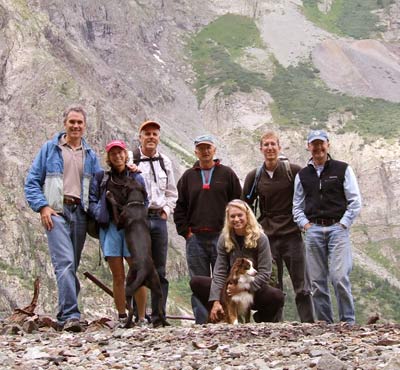
The organization’s work included conservation easements and the restoration of disturbed land. Its account of a former gravel pit in San Miguel County described years of stewardship after the heavy equipment had left. The practical point is familiar: finishing the conspicuous work does not necessarily finish the job.
Colorado Open Lands also listed Hoyl on its board of advisors in 2018. Together, these activities put conservation beside his mining and technology work, giving the landscape a place in his public record beyond the family ranch.
Credit, with a purpose
Another part of that record leads to Guatemala. Friendship Bridge’s 2023 leadership roster named Hoyl vice chair of its board and chair of its finance committee. He also appeared on the audit committee. These are working responsibilities inside an organization concerned with women’s economic opportunities.
In 2024, he described becoming more selective about the causes he supported after decades of involvement. His explanation centered on women’s education, agency and financial independence, and on access to well-managed credit. He said he had personally witnessed changes in Guatemalan women’s lives through Friendship Bridge’s work.
“I feel lucky to be involved in supporting Friendship Bridge’s programs,” he said. He wanted to help strengthen the organization’s capacity and enable more women to succeed. It is a stated ambition with an institutional task attached: an organization needs the ability to keep delivering the work its supporters value.
The garage is an excellent beginning. Hoyl’s career becomes fuller when it continues past that door: through the leadership handovers, onto the mountain site visit, into a finance committee and back to the ranch. There, the grass still grows at its own speed, and somebody still has to make the arithmetic work.