Steve Brown put pieces of his mother’s glass knives into the floor of his café. The fragments sit inside the stars in the terrazzo at The Glass Knife in Winter Park, Florida. Other knives are displayed intact. A family collection became a name, a design, and a reason for people to gather over cake. For someone whose other business involved getting millions of visitors through ticket purchases, it was an unusually literal way of putting a personal history underfoot.
Brown founded the namesake accesso business in 2008, sold it to the British queuing company Lo-Q in 2012, and twice became chief executive of the enlarged group. In May 2026, he handed the job to Lee Cowie. By then, accesso served more than 1,100 venues in 31 countries. There were plenty of numbers with which to mark the occasion. The knives offer another way into the story.
A merchandise host learns to count
His attractions career began in 1989 as a merchandise host at the newly opened Disney-MGM Studios. Brown was in college. Disney was adding parks, water attractions and hotel rooms, and a job selling merchandise placed him inside an expanding operation. The future ticketing executive started where a visitor could actually hand him money. There are less useful places to begin studying commerce.
After work in industrial engineering, he left to pursue an MBA. He earned that degree at Emory’s Goizueta Business School; his undergraduate degree was in marketing at the University of South Florida. Back at Disney, with support from executives Erin Wallace and Bruce Laval, he worked on ticket prices and promotional offers. He eventually helped bring operations, pricing, forecasting, technology and training together into a ticketing division.
The work required looking beyond the price printed on a ticket. A multi-day offer, an annual pass and a hotel reservation all touched the same visitor’s decisions. As director of Walt Disney World Ticketing from 1999, Brown oversaw the ticketing process across nine gated attractions. At Disneyland Resort, his later responsibilities included ticket revenue, hotel revenue management and attendance research, followed by the annual-pass programme ahead of the resort’s fiftieth anniversary.
That breadth helps explain his impatience with the annual ritual of raising admission by a dollar and debating discounts around a table. In 2009, he argued for continually examining economics and visitor behaviour. A ticket was an operating decision with consequences throughout a day out. Get someone through the gate sooner and there is time for another ride, another purchase, another reason to feel the visit was worthwhile.
Leaving the Disney bubble
Brown spent sixteen years with Disney before moving to Six Flags as corporate vice president of ticket strategy and sales. The change widened his view from destination resorts to regional parks. It also brought a geographical first: his interview was his first visit to Manhattan. His mother questioned the decision to leave Disney. A familiar employer can make even a senior executive’s departure feel like running away from a perfectly good home.
At Six Flags, he championed an overhaul of eCommerce that doubled online sales. That result mattered because buying a ticket on the internet was still developing into a serious sales channel for attractions. Brown could see room to improve the commercial decisions behind the transaction, as well as the transaction itself. A barcode could get a customer inside. A better sales process could change how and when that customer chose to visit.
His next move brought him to a small dot-com with twelve people. In his later account, he took the business through bankruptcy and rebuilt it into accesso. The official founding year for the namesake business is 2008. Its early proposition combined hosted ticketing technology with practical knowledge of the parks using it. Brown had spent enough time on the operator’s side of the table to understand why a busy Saturday could overwhelm a beautifully presented sales pitch.
“Weekends are their business.”
Steve Brown, on supporting attractions clients
That observation is a useful description of the service obligation. Attractions earn money while other people are off work. Technical support has to follow the customer’s calendar. Brown’s farewell reflection emphasised hiring, integrity and direct access to help. The software needed to work, and the people selling it needed to remain reachable after the contract was signed.
- 1989Starts as a Disney-MGM Studios merchandise host
- 2008Founds the namesake accesso business
- 2012Joins Lo-Q following the acquisition
- 2017The Glass Knife opens in Winter Park
- 2026Hands the accesso CEO role to Lee Cowie
The sale that kept him in the picture
Lo-Q’s purchase of accesso in December 2012 joined two neighbouring parts of a visitor’s day: buying admission and waiting for an attraction. Brown stayed in Florida and joined the combined business as president and chief operating officer for North America. The buyer subsequently adopted the accesso name. Selling the company gave him a larger operation to help run.
The acquisition announcement gives a sense of what his team had already built. The Florida company employed 44 full-time staff and served more than 100 venues across North America. It expected to process nearly $1 billion in transactions during 2012, including more than fourteen million print-at-home tickets. Those were customer transactions passing through its systems, a distinction worth keeping when contemplating the size of a software business.
The wider group added Siriusware, ShoWare, Ingresso and The Experience Engine between 2013 and 2017. Brown became group CEO in May 2016, with Tom Burnet moving to executive chairman. Revenue had risen from $30 million to $93 million in 2015 following the acquisition and expansion. The job now involved an assortment of technologies, customers and teams. Making the pieces cooperate became part of the product.
A different sort of counter service
While that corporate story unfolded, Brown was preparing a more intimate business. The Glass Knife opened on November 10, 2017. Its name came from the Depression-era glass cake knives collected by his mother, Jacque. The café gave physical form to his memories of baking alongside her. Chef Stuart Whitfield led the culinary team. Both Brown and Whitfield had worked at Disney.
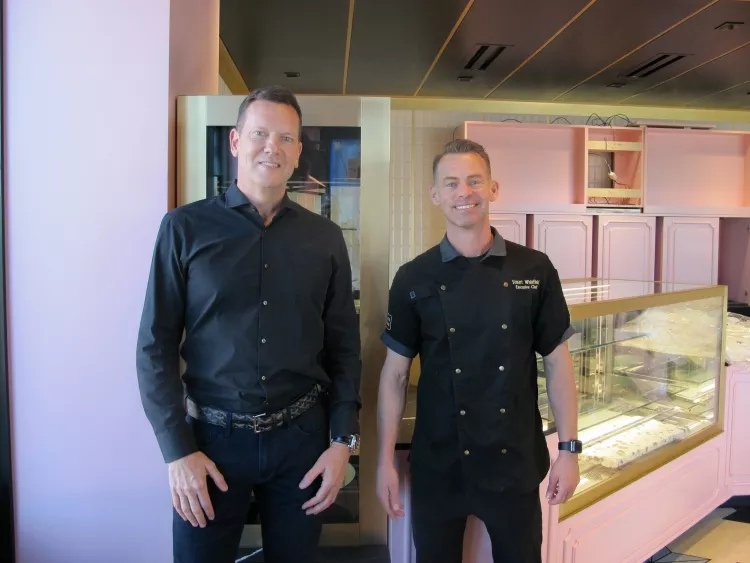
The room announced that this was a carefully considered venture: an eighteen-seat American-walnut communal table, pink cabinetry and a gold-coloured light fixture weighing 2,100 pounds. The floor incorporated chips from Jacque’s knives. A surviving collection and a working room shared the same address. An heirloom normally asks you to be careful; here, some of the heirlooms could tolerate a chair being dragged across them.
There was operational thinking behind the decoration. Early on, the café operated without cash. Brown explained that handling money slowed service because counter staff needed to change gloves between transactions. An empty till also removed cash from the premises overnight. These are the kinds of considerations a ticketing executive carries into a pastry shop. A beautiful counter still has to function when several people want something at once.
The family connection ran through the building’s details. A knife’s flower motif was reproduced on the exterior. The dining room’s soft colours recalled a pastry box, while a kitchen window let guests watch cakes being iced. The terrazzo installation later earned its contractor a 2020 industry Honor Award. Hospitality had become a design brief, right down to the aggregate.
Brown described the café as a comfortable local gathering place with food made from scratch. His own tastes were pleasingly specific: a morning cortado, a cheddar biscuit sandwich, and an oatmeal cream pie whenever the hour allowed. He also enjoys travel and reading. Earlier in life, he briefly worked as a television news reporter in Panama City. The news habit survived the change of profession.
Returning to a company full of moving parts
Brown left accesso in 2018 and returned as CEO in January 2020, replacing Paul Noland. His announced plan was practical: sharpen the company’s focus, improve service, reduce operational inefficiencies, review overlapping ticketing and point-of-sale products, and connect useful elements of the acquired technologies. The vocabulary was corporate; the problem was familiar. A collection of useful things still needs arranging so that somebody can use it.
That concern continued into his final period as CEO. In 2026, accesso acquired Dexibit and introduced accesso Intelligence. The proposition was to bring together operational information from different systems and make it easier for venue operators to ask questions of their data. In an April interview, Brown discussed that capability alongside the approaching leadership handover. His interest remained close to decisions made by people running attractions.
Cowie had joined as chief operating officer in January 2025 under a succession plan. Brown knew him first as a client, then as a colleague. That history offered an unusually long view of a successor: how he behaved when buying the technology, as well as how he worked inside the business supplying it. On May 1, 2026, Cowie became CEO and executive director; Brown stepped down from both positions.
Brown agreed to remain available for a period after the transition. The arrangement allowed relationships and knowledge to carry across the change. He expressed confidence in Cowie’s understanding of operators and in the team already in place. After nearly two decades associated with accesso, handing over the responsibility was itself a piece of operational work.
A theme park ticket and a slice of cake make different demands on software. They do share a customer with somewhere to be and an expectation that the purchase will be pleasant. Brown’s career repeatedly returns to that encounter. At Disney, it meant understanding admission. At accesso, it meant building systems around operators. At The Glass Knife, it meant making room at a table whose story began in his mother’s kitchen.