The first useful thing to know about Gatik is the journey that its truck did not attempt. No coast-to-coast haul. No taxi-like freedom to go wherever a customer fancied. In Bentonville, Arkansas, the assignment was to move orders between a Walmart dark store and a Neighborhood Market. The route was short, regular, and commercially necessary. In 2019, that was enough to start a company’s public life.
- Gatik sells driverless regional freight service to large businesses, especially retailers and consumer brands.
- Its early advantage was a defined operating area and trips that repeat every day.
- By August 2026, Gatik reported 85,000 completed fully driverless orders and 99% on-time delivery.
- Its next test is making that reliability survive a much larger network.
The task sounds almost insultingly ordinary. Goods wait at a warehouse; customers expect them at a store. Between those two points sits the middle mile, a part of logistics that rarely earns a photograph. Yet it is exactly where a retailer feels missed schedules, labor shortages, and an empty shelf. Gatik’s founders, Gautam Narang, Arjun Narang, and Apeksha Kumavat, built their company around that problem in 2017. Their premise was that autonomy could become useful sooner if it learned a business routine before trying to master the whole road network.
orders ready
road route
Market
A smaller map can make a larger business
For an autonomous vehicle, every new street adds its own peculiarities: intersections, sightlines, turning movements, loading zones, and emergency procedures. Gatik narrowed that world. Its early trucks ran fixed, repeatable routes, allowing the company to validate the vehicle within a defined operating domain. Walmart and Gatik spent 18 months operating before Arkansas approved the removal of the safety driver. Fully driverless commercial runs began in August 2021; the companies announced them that November.
The sequence matters. Gatik did not merely show that a truck could drive itself once. It sold a transport service, drove the route repeatedly, worked through approval, and then removed the person behind the wheel. A demonstration gets applause. A delivery schedule gets renewed. That distinction is the center of Gatik’s business model: customers buy transportation capacity and performance through commercial agreements, while Gatik supplies the autonomous system, trucks, operations, and the work that makes an empty cab possible.
“Autonomous trucking is no longer a promise. It’s a business.”Gautam Narang, CEO and co-founder, January 2026
The company calls the offer Autonomous Transportation as a Service. In plain terms, a grocer or manufacturer can place Gatik trucks inside an existing regional network to move goods between facilities and stores. These are medium-duty box trucks rather than the giant long-haul tractors that dominate the popular image of automated freight. They can carry ambient, refrigerated, or frozen products. Gatik has named Walmart, Loblaw, Kroger, Tyson Foods, and PepsiCo among its commercial relationships. The buyer is a supply-chain operator, not a consumer summoning a delivery robot from an app.
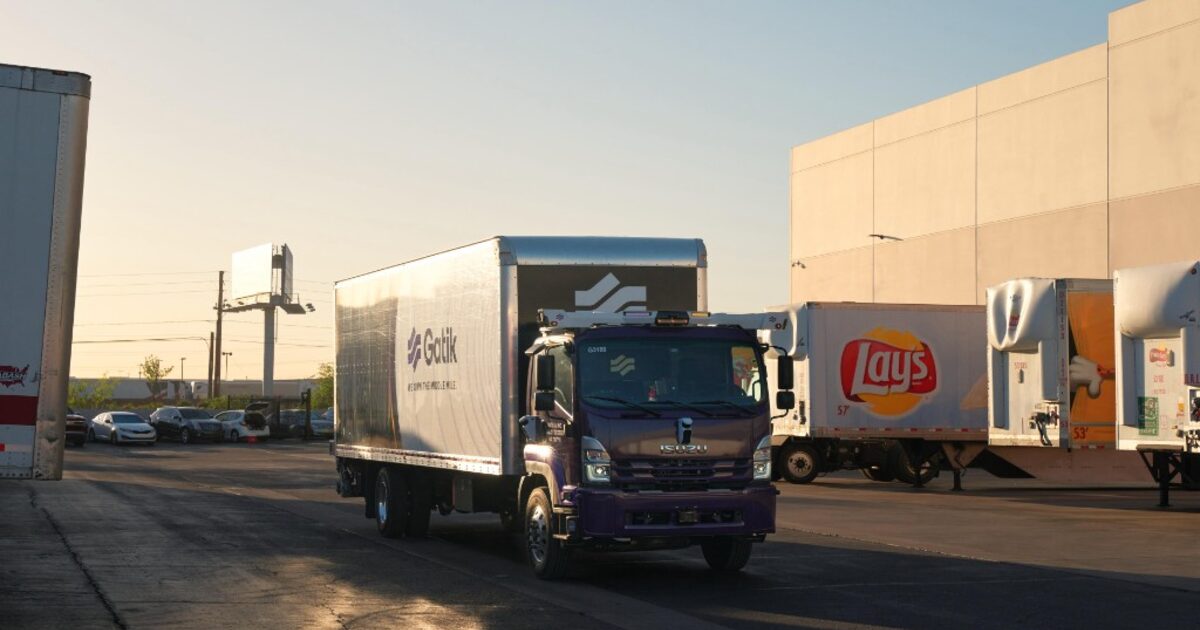
The customer changed the route
A fixed path was a sensible opening, but a large customer does not run its network like a clockwork toy. A distribution center gets busy. A pickup is added. Demand moves. By 2026, Gatik and PepsiCo described trucks that could handle highways and surface streets while adjusting route plans across networks with many pickup and drop-off points. PepsiCo said Gatik was already operating for it in Texas, Arizona, and Arkansas when the companies announced their multi-year agreement in June.
That is the quiet change in the story. The company that earned trust by limiting the itinerary now has to accommodate customers whose itineraries change. Gatik’s answer is Gatik Driver, its integrated autonomous driving system, plus a transport operation designed around the customer’s distribution network. The company says the system is in its third generation. It has also built Arena, an internal simulation platform that recreates roads and sensor inputs so engineers can test rare events and altered traffic conditions before they occur in a live route.
August 2026
August 2026
August 2026
Those figures are Gatik’s own and each answers a different question. Orders indicate completed work. On-time delivery suggests whether the service fits a real supply chain. Contracted revenue is the value of signed business, not money already recognized as annual sales. The distinction is useful because autonomous trucking can look impressive long before it works as a carrier. In January 2026, Gatik said its trucks were making daily deliveries with no driver or safety observer in the cab for Fortune 50 retailers in Texas, Arkansas, and Arizona. By August, it reported 85,000 completed fully driverless orders and a 99% on-time rate.
What it cost to make the cab empty
The public price of a Gatik delivery is not disclosed. The public price of building the capability is easier to see. Gatik announced a $25 million Series A in 2020, an $85 million Series B in 2021, and a $200 million Series D in August 2026, led by Qatar Investment Authority and Koch Disruptive Technologies. Isuzu separately announced a $30 million investment in 2024 while the two companies pursued mass-produced Level 4-capable trucks. These sums do not describe a simple software subscription. They help pay for vehicles, engineering, operations, safety validation, and geographic expansion.
Ryder supplies an example of the less cinematic work. Its partnership with Gatik includes leased vehicles, maintenance, sensor calibration, and inspections. Isuzu brings the medium-duty vehicle platform. NVIDIA is involved in computing and simulation. None of these jobs makes a memorable launch video. All of them are necessary if a truck is to leave the depot again tomorrow. Gatik’s safety process includes an external review of parts of its safety case, consultation with transportation agencies, and preparation with first responders. The company formed a Safety Advisory Council in 2025.
It is tempting to treat safety as a single score. A road operation resists that simplicity. A system can perform well on familiar routes and still face a new intersection, a new weather pattern, or a maintenance error. Gatik’s narrower starting domain made validation tractable, and its simulation work is meant to confront cases the fleet has not yet met often enough on public roads. The more routes it opens, the more evidence it must collect. That is why the move from one tidy Walmart run to a flexible PepsiCo network is consequential.
The useful part of the playbook
There is a lesson here for companies far from trucking. Gatik began with a recurring task, a paying customer, and a boundary around the problem. It measured whether the service could operate every day. It kept expanding the boundary only as the technology and commercial work allowed. Other autonomous trucking firms have aimed heavily at long-haul Class 8 routes; Gatik’s wedge was the regional distribution trip that larger networks perform over and over. The alternative for its customers remains a human-driven fleet, with all the flexibility and constraints that entails.
The model has conditions. A route must have enough frequency to justify equipment and operating overhead. The roads, weather, loading procedures, and local rules must fit a validated deployment. A customer must be willing to change the way it dispatches and receives freight. Gatik cannot turn every unusual shipment into a useful autonomous run by declaring it so. Its best case is a network with repeated demand and enough discipline to measure reliability honestly.
That may be why the original Bentonville trip remains the clearest explanation of the company. A truck moved goods from one ordinary place to another ordinary place, then did it again. The vehicle was the curiosity. The repetition was the business.
Follow the route
Explore the company, its operating updates, and video from the road.