The timetable gave Gary Yu a little more room. In December 2023, when Diodes Incorporated announced his promotion to president, it said Keh-Shew Lu would remain chairman and chief executive until at least May 31, 2027. Yu would run the operating organization. Lu would keep the top job. Then, on May 14, 2025, Yu became CEO. The succession arrived more than two years before that earlier date.
For anyone meeting him through the appointment announcement, the promotion might have looked like a sudden turn. Inside the business, it followed a long accumulation of responsibilities: selling chips, managing a wafer fabrication operation, running a region, and integrating an acquisition. Yu had joined Diodes in 2008. By the time his name reached the CEO line, he had spent roughly seventeen years learning the company from several directions.
That is the useful way into his story. Semiconductor leadership is often narrated through a single invention or a founder’s gamble. Yu’s career offers another plot: the person who keeps acquiring a larger piece of an existing machine until he becomes responsible for the whole thing. In his case, some of that machine was quite literally a factory.
Three degrees, several ways of counting
Yu’s education crosses the same boundaries as his work. He earned a bachelor’s degree in management information systems at Fu-Jen University in Taiwan, a master’s in telecommunication engineering at Southern Methodist University, and an MBA at the University of Dallas. Information systems, engineering, business: a reasonably demanding answer to the question of what to study.
Those qualifications connect Taiwan and Texas, two places that also frame his professional world. Diodes is headquartered in Plano. Yu is based in Taipei. His working responsibilities have stretched well beyond either city, including Asia-Pacific sales and management of the company’s Shanghai wafer fabrication operation.
Before joining Diodes, he worked at Lite-On Semiconductor, where his responsibilities included worldwide sales, and at Texas Instruments in information technology, finance, and capacity planning. These are different ways of looking at a semiconductor business. Sales asks what customers will buy. Finance asks what the business can afford. Capacity planning asks what it can actually make, and when. A promising order can become a very awkward conversation if those answers disagree.
His later appointments brought those perspectives together. At Diodes, he managed the sensor and satellite business unit, served as vice president of Asia-Pacific sales, and became president of the Asia-Pacific region. He also ran the BCD business unit and the Shanghai fabrication operation. The career does not reduce neatly to a single specialty. Its distinguishing feature is the number of operating questions he has been asked to answer.
A former employer, across the table
One assignment gives that range a particularly personal shape. Yu became senior vice president with responsibility for business groups and the integration of Lite-On Semiconductor. A company where he had previously worked had become part of the organization he was helping run. His résumé now connected both sides of an acquisition.
Integration is a modest word for a complicated obligation. An acquisition announcement puts two names in one sentence. The operating organization has to make that sentence work. Products, customers, manufacturing, and management must fit together well enough to justify the transaction. Yu’s responsibilities placed him in that less ceremonial part of corporate expansion, where signing a deal is the opening move.
By February 9, 2023, he had become chief operating officer. When his promotion to president was announced that December, the reporting structure made the scope clear: all executive officers and regional presidents would report to him. He would remain the principal operating officer while giving up the COO title. The new business card came with a substantial organization attached.
Lu’s endorsement emphasized Yu’s knowledge of customers and manufacturing operations. It also described a change in Diodes itself, from selling individual products toward a broader solutions approach. That gives the promotion some commercial context. A leader who has worked across sales, business units, and fabrication has experience with the different parts that such an approach asks to cooperate.
The lecture had factories in it
In 2024, Yu took a version of that experience to National Cheng Kung University in Taiwan. His contribution to its Industry Master Lecture Series was titled “Strategic Mergers and Acquisitions in the Semiconductor Industry.” The audience consisted predominantly of electrical engineering students. The subject matter reached into the practical geography of making chips.
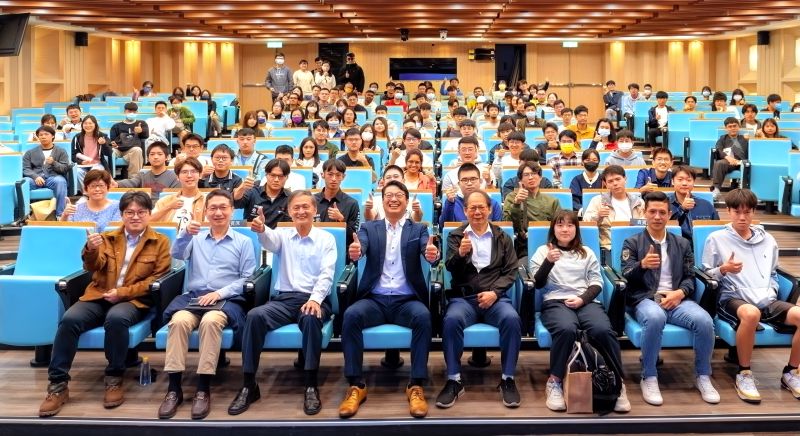
He discussed experiences involving Diodes’ acquisitions of a South Portland, Maine, fabrication facility in 2022, a semiconductor business in 2020, and a Greenock, UK, fab in 2019. It was a curriculum with an unusually large equipment budget. For students learning how electronic devices work, the talk offered a view of the decisions that determine where those devices get made and how businesses change hands.
The university visit also puts a public face on a career usually expressed in titles. In the event photograph, Yu sits among the participants in rows of blue lecture-hall seats. It is a group picture, a useful visual counterpart to his sprawling responsibilities. The subject of his talk was expansion; the setting made room for the people who might eventually have to operate it.
The handover, with the business still running
Yu became president on January 2, 2024, and joined the board that month. The staged arrangement initially left Lu as CEO. When Yu took that role in May 2025, Lu remained chairman. The company described the appointment as part of its long-term succession plan. The actual sequence moved faster than the schedule outlined when the presidency was announced.
Yu’s own account of his presidential year concentrated on relationships across the organization and the execution of operating objectives. His stated priorities as incoming CEO were revenue growth, wider margins, and higher profitability. The language was practical. There was no need to invent a new company identity before the next quarter closed.
“while expanding margins and profitability in the quarters and years ahead.”
Gary Yu, on his priorities when appointed CEO, May 2025
Leadership around him continued to change. In May 2026, Angie Chen Button became chairwoman after Lu left the board. Lu remained an employee as special advisor to the CEO. The distinction matters to Yu’s story: his predecessor’s formal responsibilities changed again, while Yu continued as president and chief executive. Succession had become the current operating arrangement.
His job also sits alongside other defined responsibilities. Brett Whitmire is chief financial officer; Emily Yang leads worldwide sales and marketing. On earnings calls, Yu speaks with colleagues whose functions carry their own part of the company’s performance. The breadth of his earlier jobs now meets the necessary division of work at the top.
The numbers catch up with the appointment
By the end of 2025, Diodes was reporting annual revenue growth of 13%. Yu pointed to computing-market demand, including AI server applications, alongside automotive and industrial growth. That result covered a year in which he had moved from president to CEO. It belongs to the company and its workforce, rather than to a single executive, but it establishes the commercial setting of his first months in the role.
The improvement continued into 2026. First-quarter revenue reached $405.5 million. In the second quarter, it rose to $445.5 million, compared with $366.2 million a year earlier. GAAP gross margin increased from 31.5% to 33.1% over the same comparison. These are two useful measures of the priorities he had set: more business, with more gross profit retained from each dollar of sales.
The earnings comparison needs the labels left on. Second-quarter GAAP earnings were $1.00 per diluted share in 2026, against $0.99 in 2025. Adjusted, non-GAAP earnings were $0.70 against $0.32. A large gain on investments was among the adjustments in 2026. The adjusted measure shows a different movement from the accounting measure; neither should quietly borrow the other’s name.
Yu also reiterated three-year goals of $2 billion in annual revenue and more than $4.00 in non-GAAP earnings per share. Those remain goals. They describe the scale of the assignment he has chosen to put before investors. The distinction between an ambition and a reported result is especially useful when the ambition comes with a dollar sign.
Another acquisition, another operating assignment
On August 27, 2026, Diodes completed its $250 million cash acquisition of ElevATE Semiconductor. Based in San Diego, ElevATE develops analog and mixed-signal integrated circuits for automated test equipment. The purchase expanded Diodes’ participation in the business of testing semiconductors, adding another application for its growing product portfolio.
The connection with Yu’s earlier work is direct. He had already carried responsibility for integrating Lite-On. He had lectured students on acquisitions involving semiconductor businesses and factories. Now, as CEO, he welcomed another company into Diodes. ElevATE would operate as a product line, with access to the larger company’s manufacturing infrastructure and sales organization.
Diodes expected approximately $50 million in revenue from ElevATE during the first twelve months after closing. That was a forecast at the time of the announcement. The completed transaction was the immediate achievement; the promised commercial contribution would have to follow. Once again, Yu’s work extended beyond the moment when the paperwork became news.
That is where his career becomes most coherent. The education crossed disciplines. The jobs crossed functions. The acquisitions crossed organizational boundaries. Each stage added something else he would eventually need to coordinate. The CEO title brought those responsibilities together under one name. Gary Yu’s next chapter will be written in the ordinary, demanding terms he has already chosen: customers served, products delivered, and the margin left when the work is done.
Follow the next chapter
Company news, public appearances, and professional profiles.