A speaker cannot play a number. Somewhere inside the device, a circuit must turn digital instructions into an electrical signal that moves something physical. It is an easily overlooked handoff, right up until the music distorts, the voice disappears into noise, or the battery runs down. Cirrus Logic has built a business around getting these awkward handoffs right.
- Audio and mixed-signal chips turn data into sound, touch, and other physical functions.
- Fiscal 2026 sales reached $1.997 billion. Apple represented approximately 91%.
- PCs, professional audio, and industrial measurement offer routes into more markets.
The Austin company sells to the people building electronics. Its name usually stays inside the enclosure. A consumer buys a phone, a laptop, or an audio interface; the manufacturer chooses the components. Cirrus supplies codecs, amplifiers, converters, camera controllers, haptic drivers, and power devices. Its expertise is making analog circuitry and digital processing cooperate under tight constraints.
The small part doing the awkward job
Consider an audio codec. It combines conversion in both directions: capturing an analog signal as digital information and turning digital information back into an analog output. A smart codec adds processing. An amplifier supplies the drive a speaker needs. Each part has to fit into a system whose designer is bargaining over space, power, noise, and cost.
This is Cirrus’s territory. It competes with companies including Texas Instruments, Analog Devices, Realtek, and AKM, depending on the component. Its pitch rests on low-power mixed-signal expertise, integration, software, and close customer collaboration. The practical comparison is between complete designs: the chip, its supporting components, the tuning work, and the performance the finished device delivers.
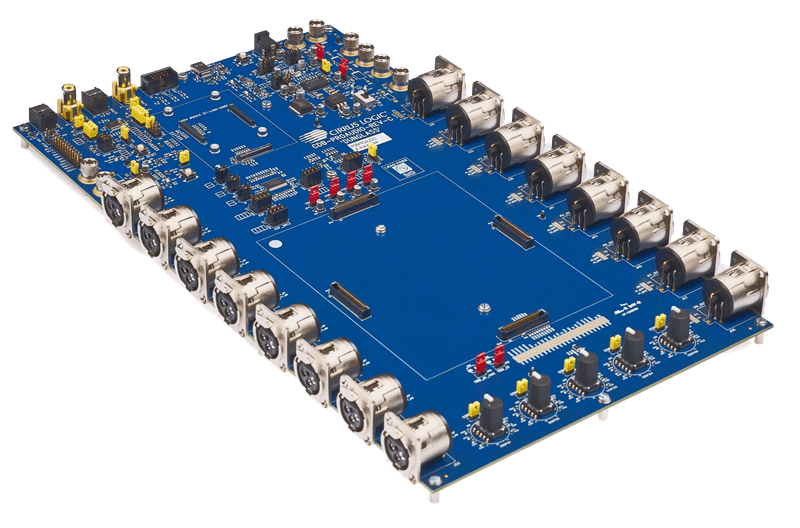
The CS4308P makes that proposition tangible. This eight-channel digital-to-analog converter supports 32-bit audio and sample rates up to 768 kHz. Cirrus specifies 123 dB of A-weighted dynamic range and 16 milliwatts per channel. These are component specifications under defined conditions. Loudspeakers, power supplies, board layout, and the rest of the signal path still have work to do.
A business built around one very large customer
Cirrus dates its founding to 1984, following Suhas Patil’s earlier Patil Systems business. Co-founders included Michael Hackworth and Kamran Elahian. Early products served the PC industry, including graphics and storage. The acquisition of Crystal Semiconductor in 1991 strengthened its analog and converter capabilities; Wolfson Microelectronics followed in 2014, deepening the audio portfolio and the company’s Scottish engineering presence.
It became a specialist with extraordinary exposure to one buyer. In fiscal 2026, Apple represented approximately 91% of net sales, up from 87% two years earlier. Purchases flowed through multiple contract manufacturers, but the end customer remained the same. Count the factories placing orders and the customer base can look broader than the economic reality.
Yellow: Apple · Pale remainder: all other customers
The attraction is understandable: a successful component can travel into a large production program. The obligation arrives earlier. Cirrus spent approximately $434 million on research and development in fiscal 2026, about 22% of revenue. Its customer-specific work can require substantial development before shipments begin, and some designs cannot readily be sold to another buyer.
Cirrus outsources wafer fabrication, assembly, and testing, using foundries including GlobalFoundries and TSMC. The fabless model concentrates resources on design. It also leaves the company dependent on outside manufacturing capacity. The customer relationship and the manufacturing relationship both have to hold.
The launch that vanished
In May 2023, Cirrus told shareholders that a new high-performance mixed-signal product expected that fall would not reach market as planned. With limited visibility into its customer’s future plans, the company removed the associated revenue from its internal model. A launch assumption had failed before the anticipated sales arrived.
“While this is undeniably a setback, we are proud of our execution in this program.”
Cirrus Logic · May 2023 shareholder letter
By August, Cirrus reported progress on reassigning the wafers. Its GlobalFoundries agreement allowed capacity to move among products using the same underlying 55-nanometer high-voltage process, including amplifiers, haptic drivers, and battery and power chips. The company did not expect the wafer disposition to have a material financial impact. That statement concerned the wafers, not the value of the lost revenue opportunity.
For anyone commissioning specialized hardware, the lesson is concrete: negotiate flexibility while everyone still expects the original plan to work. Reusable capacity gives a changed product roadmap somewhere to go. It helps only when other designs can actually use the process and the available capacity.
A different route out of the phone
Cirrus is extending its skills into neighboring applications. In May 2026 it introduced nine converters for professional and prosumer audio, targeting equipment such as musical instruments and podcast interfaces. In August, CEO John Forsyth reported customer interest in a smart codec for AI-enabled PCs. Those are opportunities; interest alone is not a shipped design.

A Scottish Enterprise-supported project is developing an analog front-end platform for precise energy measurement, with research collaboration at the University of Strathclyde. October brought the acquisition of Italy’s INVENTVM, adding audio and power-management expertise. A week later, Cirrus confirmed it had proposed acquiring Synaptics but was not currently pursuing a transaction. A broader future is still being assembled.
Put the part on the bench
For engineers, the useful entrance is a product page: datasheets, evaluation hardware, software, and sample requests. Cirrus lists the CS4308P at an indicative $10.31 in 1,000-unit quantities. The evaluation daughter card, motherboard, and USB streaming board are separately priced. A chip price is a starting point for a budget.
Evaluate the whole signal path against your actual power, noise, latency, and cost requirements. If those constraints do not fit, a different part may be a better choice. Cirrus’s business rests on making that choice worthwhile, repeatedly. Its next test is persuading more customers, in more kinds of equipment, to make it.