Gary M. Shiffman had been in rooms with generals, admirals, cabinet secretaries and the president of the United States. He had worked with executives at large companies. Yet when he considered the people who really tested him, he nominated eighteen Georgetown graduate students. A classroom, apparently, could be a more demanding place than a room full of brass.
He liked that. Teaching gave him somewhere to bring his professional experience and somewhere to have it questioned. The students benefited from the work; the work benefited from the students. It is an instructive detail about an economist whose career has included a war, government service, two technology companies and a book about violence. He seems to enjoy an idea most when someone else has a chance to take it apart.
Today, Shiffman is the founder and CEO of Giant Oak, creator of its GOST screening platform, and co-founder and board member of Consilient. He teaches economics at Clemson University. The titles cover considerable ground. Underneath them is a recurring inquiry: how do people organize coercion, and what can change the incentives that make it work?
A psychology degree goes to sea
His academic starting point was a psychology degree at the University of Colorado. His early professional life took him into the U.S. Navy as a surface warfare officer, including Gulf War deployments in 1990 and 1991. Assignments at the Pentagon followed, along with work advising the Senate on national security. Human behavior was no longer simply an academic subject. It was bound up with institutions, resources and decisions whose consequences extended well beyond the room.
He earned a master’s degree in security studies at Georgetown and continued into economics at George Mason University, completing an economics master’s in 2001 and a doctorate in 2002. He joined Georgetown’s School of Foreign Service faculty that year. In 2004, he became chief of staff at U.S. Customs and Border Protection. Later positions included executive work at L-3 Communications and a managing directorship at the Chertoff Group.
The sequence helps explain his interest in the machinery behind a policy. A government can announce a goal; organizations and individuals still have to respond to it. Shiffman’s economic inquiry concerns that response. Who faces which costs? What alternatives are available? What makes a choice attractive enough to repeat? These questions give a sprawling security problem something like handles.
Even a villain has operating costs
In his 2006 book, Economic Instruments of Security Policy, Shiffman examined ways to influence leaders’ choices. His 2020 book, The Economics of Violence, extended the inquiry into crime, insurgency and terrorism. It treats the people running violent organizations as decision makers who operate with limited resources, competitors and constituencies. The moral horror of their actions does not relieve an analyst of the need to understand how the organization functions.
There is an unsettling ordinariness to this approach. An organization that uses violence must still attract people, retain them and maintain access to resources. Its leaders make choices about expansion. Its members have interests of their own. A fearsome public identity does not abolish the difficulties of running the place. Even intimidation has an operating budget.
Discussing these questions with security students, Shiffman emphasized internal tensions and the pressures of maintaining revenue. His account gives economic tools a place alongside military force and policing. If an adversary needs an organization to carry out its ambitions, then the conditions sustaining that organization deserve attention. Understanding those conditions can help determine where pressure might matter.
His conversation with Russ Roberts on EconTalk made the argument available to a wider audience. He encouraged listeners to examine markets, firms and entrepreneurs rather than let familiar labels finish the analysis. It is a provocative choice of vocabulary. Calling a criminal leader an entrepreneur describes a way of organizing activity; the language carries no certificate of virtue. The useful question is what the description allows an observer to see.
The search engine with a theory
By 2009, Shiffman was incorporating machine learning into behavioral modeling as a principal investigator supporting DARPA. He subsequently built Giant Oak around the use of social science in large data environments. By late 2012, he had committed his professional time to the company. The progression from studying decisions to building software was a practical wager that a theory of behavior could help make information useful.
In an early interview about Giant Oak, he explained his interest in relationships that were not immediately visible. A pile of records does not tell its own story. The analyst needs a reason to look for a particular pattern and a method for testing whether that pattern matters. More information increases the opportunity for discovery, but also the opportunity to mistake a coincidence for an explanation.
GOST, short for Giant Oak Search Technology, brings that approach into screening. It searches and organizes publicly available information to help users identify risk. Its purpose is to make relevant material easier to find and assess across a volume that would overwhelm an ordinary manual search. The final judgment still involves people deciding what the information means.
“Keep humans in the loop;”
Gary M. Shiffman, congressional testimony, 2019
When he testified before the House Financial Services Committee in March 2019, Shiffman argued that machine learning needed better feedback from law enforcement. Training a system on previous reports could reproduce earlier weaknesses if the reports had not proved useful. His proposed reforms emphasized meaningful information sharing, understandable systems and human responsibility for consequential judgments. Counting outputs was a poor substitute for asking whether the outputs helped.
Let the learning travel
Financial crime presents a particular cooperation problem. Institutions hold different pieces of activity, and those pieces may become more informative when considered together. Yet customer information cannot be treated as communal office stationery. The desire to learn across boundaries meets real obligations to protect what lies within them.
In October 2020, Shiffman and Juan Zarate announced Consilient, a venture formed through Giant Oak and K2 Intelligence Financial Integrity Network. Zarate brought experience building the U.S. framework for combating illicit finance. Intel supplied technology intended to protect computation. PNC was among the institutions named at launch as looking to evaluate the approach.
Consilient’s design uses federated learning to develop insights across institutions while keeping their underlying data in place. The analogy is a visiting lesson: the model can benefit from experience in different locations without collecting all the original records into one repository. Shiffman’s collaboration with Zarate and Intel colleagues later set out this architecture in a white paper.
Records stay within institutions. Learning crosses boundaries.
Conceptual illustration of the published architecture.At a 2021 AI conference, Shiffman emphasized cooperation alongside privacy. By March 2023, Consilient was announcing a next-generation financial crime solution with a library of eighteen models. The ambition was to make suspicious behavior easier to recognize across the financial system. The design also reflects a lesson from his earlier work: institutions affect what people can do, so improving the connections between institutions can matter as much as improving an individual tool.
A muffin enters the classroom
For someone dealing with coercion and financial crime, Shiffman has an unexpectedly domestic teaching aid. He uses the internet’s chihuahua-and-muffin visual joke to explain machine learning. Small round faces and baked goods can look inconveniently alike. The resemblance offers a cheerful entrance to questions about examples, labels and errors.
His intended audience included regulators and people working in financial services. They needed a way to evaluate unfamiliar technology. The lesson becomes serious when a mistaken classification concerns a person rather than a muffin. Shiffman also emphasizes the human choice involved in setting a threshold for review. A score needs an operating decision attached to it; the mathematics does not settle every question of judgment.
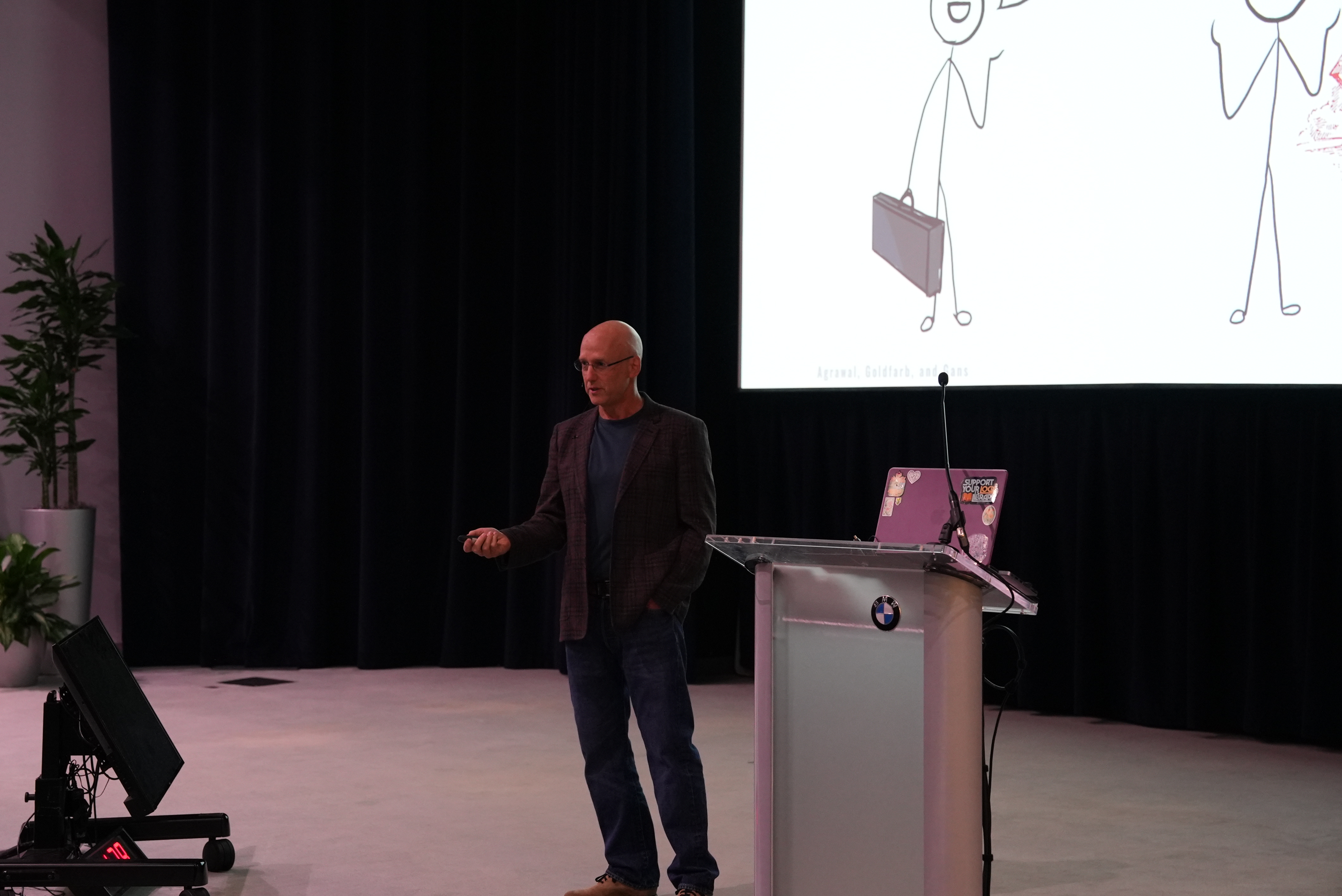
There is a related taste for fictional villains. At Giant Oak, he has described conversations about Keyser Söze from The Usual Suspects. Fiction supplies a memorable puzzle about hidden activity and inference. The trick for the analyst is to enjoy the puzzle while demanding evidence. A compelling story, after all, can be compelling for entirely the wrong reasons.
Greenville, with a return ticket
Building a company demanded a decision about his own incentives. Shiffman described leaving consulting and part-time research to commit fully to Giant Oak as a stressful step. He chose it because the work offered the combination he wanted. “Meaningful and challenging is the magic formula for a happy day for me,” he said. It is a modestly revealing formula: difficulty itself appears on the list of benefits.
In 2021, he moved from northern Virginia to Greenville, South Carolina. He built connections through the Atlas Local coworking community and NextGEN, later helping launch its entrepreneur-in-residence program. Teaching at Clemson added another setting for the questions that had followed him through Washington and into business. Experience accumulated elsewhere could become useful to founders much closer to home.
Washington still had a claim on him. In November 2025, Treasury invited him to return as a national security economist. Clemson’s account describes work from January through May 2026 developing a framework for economic security policy. A career that appeared to have found a new geographical center acquired another commute back to an old one.
The continuity is less a job title than a habit of inquiry. Across a classroom, a screening platform and an economic policy discussion, Shiffman keeps asking what people are responding to and what might change their choices. He has built companies around that question. He has written books about it. And he has kept teaching, where someone may still raise a hand and point out what the explanation missed.
Continue the conversation
- Gary Shiffman’s website and essays ↗
- Gary Shiffman on LinkedIn ↗
- Watch: TEDxGreenville talk on AI and economies ↗
- Watch: The Economics of Violence on EconTalk ↗
- The Economics of Violence, Cambridge University Press ↗
- Consilient biography ↗
- Listen: Fighting Financial Crime with Science ↗
- Greenville’s growing founder community ↗
- Clemson’s update on his return to Washington ↗