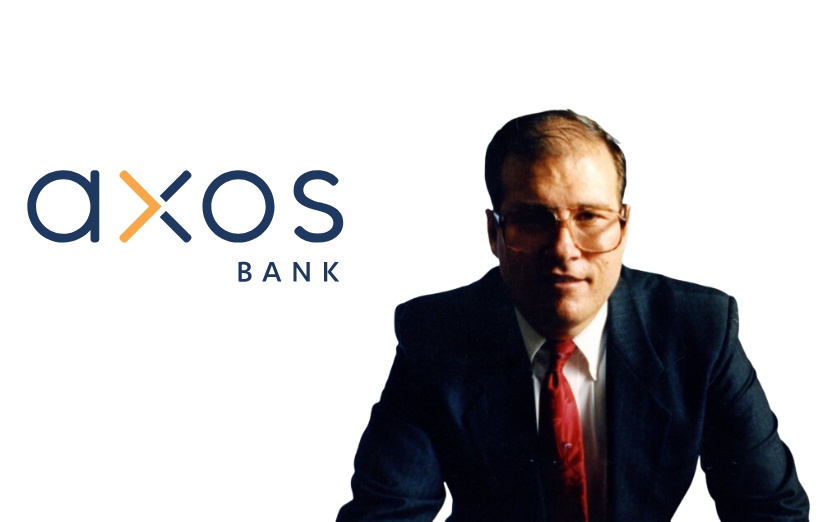
July 4 is an awkward date to open a bank. The country has other plans. The branches are closed. For Gary Lewis Evans and his fellow founders, that was part of the attraction. On Independence Day in 2000, Bank of Internet USA began doing business online, making its opening day an argument for the business itself: a customer should be able to bank when the customer had time.
The enterprise had $14 million in startup capital and a name that explained the proposition before anyone reached the second sentence. Today it is known as Axos Bank. Back then, the internet was still something a bank could put in its name and expect people to notice. Evans was its founding president and chief executive, working alongside fellow founder Jerry Englert.
A holiday launch makes a tidy origin story. Evans's career is more interesting when you look behind the date. He had already spent decades in banking. His preparation included finance, operations, lending and the awkward work of dealing with institutions in trouble. The appeal of an internet bank, in that context, was practical. It offered a chance to reconsider how the work moved through the building, as well as whether a customer needed to enter it.
Before the browser, the balance sheet
Evans dates his banking career to 1971. His education took him through Pierce junior college and California State University, Northridge, where he earned degrees in business administration and finance. In his account of his upbringing, he describes a working-class family and being the first in that family to attend college. Industrial arts at Reseda High School belongs in the picture too. The future banker had an interest in making things before he began making financial institutions.
That interest survives in his recollections of building hot rods and furniture as a young man. It is a pleasingly tangible detail in a career increasingly occupied by things that cannot be parked in a driveway. A piece of furniture has joints. A bank has procedures. Evans's later work repeatedly returns to the connections between the parts.
From June 1988 to June 1996 he was president of La Jolla Bank. During that period, he began experimenting with internet banking. He places that work in 1994, when the technical arrangements were sufficiently unusual that the server was hosted at the UCSD Supercomputer Center. A bank website was then a project requiring explanation, equipment and considerable patience.
He left La Jolla Bank in 1996 and formed an internet consulting business. DFIN became his research and development base. The following year brought The Financial Institutions Internet Sourcebook, which he co-authored with economist Kenneth J. Thygerson for McGraw-Hill. There was also educational work on internet banking with the American Bankers Association. Evans was helping bankers understand the medium while working out what he could build with it.
The paperwork inside the internet
Bank of Internet's early operating problem sounds almost comic now: an online bank still had to handle paper. Evans recalls physical signatures and the administrative work surrounding new deposit accounts. The screen visible to the customer was only one end of the transaction. Behind it sat verification, routing and people who had to know what happened next.
His account of the build describes an assembly-line approach to account opening, distributing tasks instead of asking one employee to complete the entire process. He worked between the operations staff and the technology team, translating banking requirements into systems. Software could do more useful work when someone first understood the work in detail.
The bank's intended audience also complicates the familiar picture of early internet adoption. Evans says seniors were a deliberate focus: people with deposits who would spend time looking for better terms. FDIC insurance helped establish trust. The pitch depended on an ordinary financial consideration, the value of a savings account, rather than a customer's enthusiasm for new technology.
By 2005, the bank described a nationwide business gathering deposits across all 50 states. Its stated mission was to lower banking costs, giving customers a share of the savings through rates and pricing. For Evans, efficiency ran through the operation. A website could bring someone to the door; the process behind it determined the expense of serving them.
There is a useful distinction between a bank looking modern and a bank changing its operating habits. Evans spent his attention on the latter. The customer saw a form and an account. He and his colleagues had to decide what information would be checked, which task would follow which, and where a person still needed to intervene. Those decisions rarely make a commemorative photograph. They do affect the cost of every account that follows.
onlineInformation
checkedWork routed
through the bank
A public company, with the decimal places intact
BofI's public offering came in March 2005, with shares trading on Nasdaq. It used a Dutch auction, a method in which investor bids help establish the offering price. Evans later recalled the roadshow with W.R. Hambrecht & Co. and the satisfaction of raising more capital than he had expected. The company reported net IPO proceeds of $31.3 million.
The early figures give the experiment a more useful scale than a retrospective victory lap. At December 31, 2004, the bank had $513.1 million in assets and $320 million in deposits. By June 30, 2006, assets had reached $737.8 million. Fiscal 2006 net income was about $3.27 million, up 14 percent from the previous year.
That same earnings announcement contained a less celebratory detail: diluted earnings per share declined even as total earnings rose, reflecting additional shares associated with the offering. Banking progress has a habit of arriving with footnotes. Evans was running a public institution whose results needed to survive that kind of reading, with operating gains set beside the costs and consequences of financing growth.
The numbers describe a team effort. Credit, finance and technology executives were already part of the bank's early management. Englert brought his own banking experience to the founding group. An internet bank still required people who understood loans, deposits and financial reporting. The distribution channel changed; the responsibilities remained substantial.
Please direct your questions to Gary
One small feature of the bank's 2006 website redesign deserves its own place in Evans's story. The homepage offered an “Ask Gary” link. Customers could send comments, suggestions and questions to management. In a business built around remote access, the chief executive's first name served as a modest substitute for walking into someone's office.
The redesign also dealt with navigation, account opening and search engines. Evans talked about making the site easier for existing customers to use and easier for prospective customers to find. The details are familiar to anyone who has run a website. They are also reminders that an internet bank has to earn attention before it can earn a deposit.
His role changed in October 2007, when Gregory Garrabrants became chief executive. Evans remained the bank's president and chief operating officer. The distinction matters: the change in the CEO chair did not mean an immediate departure from the operation. In 2008 he resigned his board seat to pursue directorships at other banks.
His letter to Englert explained the attraction of helping institutions facing difficulties and the possibility of finding opportunities useful to BofI. It also acknowledged the personal prospect of director fees. That plainness gives the document some personality. Careers contain a mixture of service, curiosity and earning a living, and Evans put the mixture in writing.

The next set of banking chores
The bank acquired the Axos name in 2018, years after Evans's CEO tenure. His own attention had moved to other projects. Through Paymency, he explored mobile payments and a platform for financial products. A January 2017 letter to the Office of the Comptroller of the Currency described plans to serve consumers, including people poorly served by existing banking arrangements, while keeping merchant costs low.
In December 2018, he proposed a limited-purpose payments charter in comments to the Federal Reserve. The idea included access to settlement infrastructure for qualifying payment companies. It was a proposal, and its ambitions should be read as such. What connects it to the earlier bank is Evans's continued interest in the cost and structure of moving money.
He also served as a CyberCatch director and audit committee chair, a role documented in the company's 2023 shareholder circular. More recently his DFIN work has concentrated on banking automation and AI. His published implementation outline calls for executive oversight, defined decision rights, controlled access to information, pilots and continuing review. Even in a discussion of software agents, the organizational chart gets a seat at the table.
Evans now offers an AI version of himself through Delphi, built around material from his interviews, publications and records. Visitors can ask it banking questions. He presents the experiment partly as a way to imagine training staff and sharing company philosophy. The old “Ask Gary” invitation has acquired a conversational interface.
The appeal of another project comes through in his description of what he wants to do next: help institutions manage change and apply intelligent automation. He writes about human judgment alongside the machinery. His GUARD framework asks users to assess information, consider alternatives and make deliberate decisions. The banker who once had to connect a customer-facing website to a paper-heavy office is again occupied with what happens between the promise and the procedure.
“I work seven days a week. I love what I do,” he said in 2023. The remark fits a career in which a successful launch has rarely ended the tinkering. On that first July 4, the useful novelty was being able to reach a bank while its conventional counterparts were closed. Evans is still looking around the office for the next task that could work differently.
“People do like Internet banking.”Gary Lewis Evans · 2005