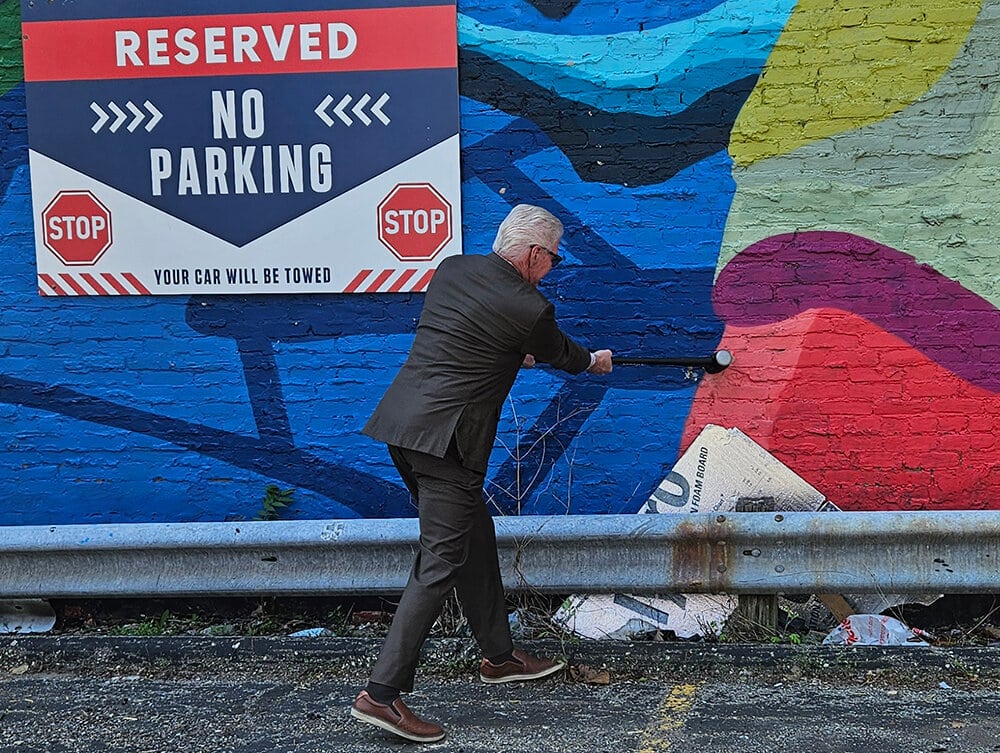
Gary Granger wore a suit to knock down a wall. At the Walter Neller Building in downtown Lansing in June 2025, the developer took a sledgehammer to the brickwork while a painted mural supplied a rather cheerful background. It was a small, physical act at the end of a long argument about a property. A city can spend years discussing a building before someone finally gets to hit it.
Granger had arrived with a replacement in mind: housing and commercial space. The building behind the ceremony had become a familiar object of frustration. The photograph catches the easy part to understand, the swing. Around it lies the more complicated story of Gary Granger: a construction family, an engineering education, a company he started after nearly twenty years working for his father, and a continuing attachment to Lansing.
The family business had already split once
The Granger family’s construction history contains an earlier departure. In the 1930s, Dorr Granger went from West Michigan to Lansing for college and worked part time for a construction company. When its owner encountered financial trouble, Dorr took over. His brother Keith, Gary’s grandfather, joined him. They built churches and commercial buildings, among other structures, and developed a kit approach to log cabins.
In 1958, the brothers divided their venture into two businesses. Keith and his three sons, including Gary’s father Alton, began the enterprise that became Granger Construction. Gary entered that business in 1977 after completing an architectural engineering degree at the University of Colorado.
In 1996, he left to establish Granger Group. The family name accompanied him; the company was his own. There is a pleasing symmetry in that history. What looks from a distance like one uninterrupted construction dynasty includes distinct decisions to begin again. Gary’s departure belongs to a family sequence of people carrying practical experience into a different arrangement of their own.
A field engineer with a reading habit
His first position in the family company was field engineer. He eventually served as its president for five years. That route matters because his later work brought together activities often encountered separately: financing, development, design and construction, asset management, and property management. The practical sequence begins on a site and continues into the business that has to support it.
Asked about a difficult challenge in a published business profile, Granger pointed to rebuilding Herpolsheimer’s, describing a large project with many moving parts. Asked about downtime, he turned to something considerably quieter. He reads books, newspapers, magazines, and devotionals.
“I am the type of person who always wants to better myself and learn continuously.”Gary Granger
The contrast is useful without needing to turn it into a personality legend. Here is a developer who chose an intricate construction assignment to describe difficulty and reading to describe time away. His public account of himself puts learning beside execution. It also offers a modest human detail amid the language of investment: somewhere behind the project list is a person opening another book.
Another classroom, another generation
Granger completed Harvard Business School’s Owner/President program in 1992. It was executive education following his engineering degree, a second course of study suited to someone already responsible for a business.
His connection to Ferris State University unfolded over a longer period. Governor John Engler first appointed him as a trustee in 2001; he served through 2008. He returned in 2011 for a term ending in 2018. University governance placed him in a different kind of institution, one whose results emerge through students and careers.
The family connections were close. His parents, Alton and Janice, supported Ferris’ Granger Center for Construction and HVACR. His son Jason graduated from the College of Business in 2004, had been student government president, and subsequently worked at Granger Group. An engineering graduate from Colorado thus became part of a family story tied to a Michigan university. Trusteeship, a teaching building, and a son’s education gave that relationship several forms.
The center’s dedication in May 2004 made the practical appeal visible. A 45,000-square-foot addition, together with renovated space, gave the construction and HVACR programs 75,000 square feet. Mechanical systems were open to view. Students could follow their operation through the building, while four rooms could function as environmental test chambers.
Granger spoke at the ceremony, praising the program’s “go-to-work type of school.” His parents’ support had helped make the facility possible; the construction company built it. It was a particularly literal meeting of teaching and building. The structure itself supplied things to study.
That episode adds something to the usual developer biography. The family’s participation reached beyond supplying a completed facility. The finished space also became a place where future workers could examine how buildings function. For a person whose career began as a field engineer, the connection is easy to appreciate.
The corner that kept waiting
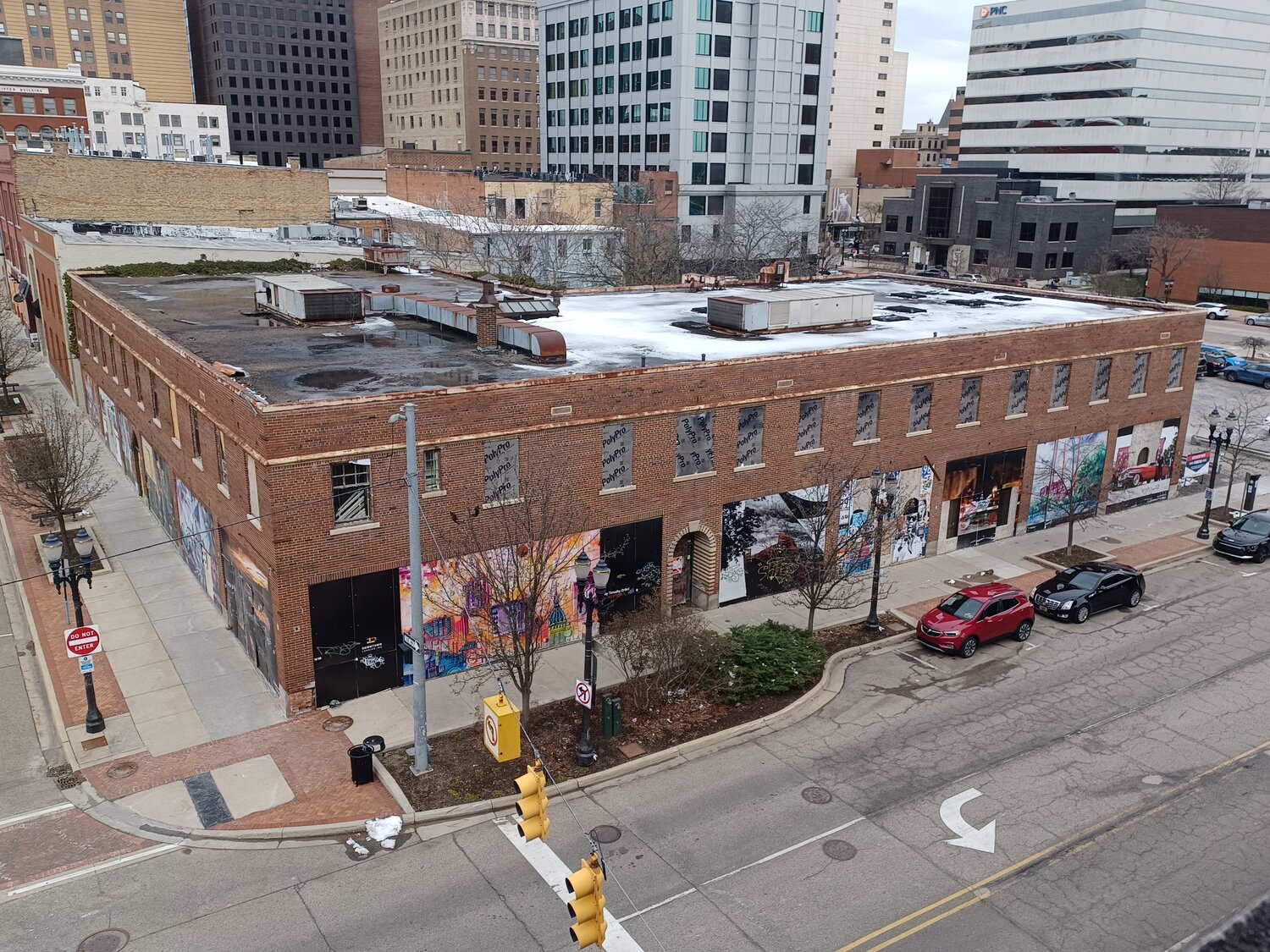
Lansing’s Walter Neller Building offered a less agreeable lesson in the passage of time. Built in 1938, the property had served several purposes, including hotel, restaurant, bus depot, and offices. By 2022, vegetation was growing inside and neighboring businesses were questioning why it had been allowed to deteriorate.
The ownership history stretched back decades. In 1997, Walter Neller Enterprises sold the building for $865,000 to Summit Partners, an entity for which Granger was listed as resident agent. The property later passed to Summit Associates. The city deemed it dangerous in 2016; it was boarded up and red-tagged in 2018.
Those dates are part of Granger’s story because a development property has neighbors throughout the waiting period. An owner may be considering its next use while someone across the street is looking at the same damaged windows each morning. Both are living with the building. The prospective replacement and the existing condition occupy the same address, but they ask very different things of the people around it.
A gift with conditions
In March 2024, Granger offered the Neller property to Lansing for a new city hall. His proposal attached conditions: exclusive rights to redevelop the existing City Hall and Lansing Center, plus assistance with development at the former Waverly Golf Course in Lansing Township.
Mayor Andy Schor declined. He wanted to retain the existing hotel proposal for the current City Hall. He also objected to granting Lansing Center redevelopment rights without allowing others to bid and to city spending on infrastructure outside Lansing’s boundaries. The city hall funding carried a deadline, adding another constraint to an already contested decision.
Granger’s son Jason addressed the City Council in an effort to revive interest in the plan. The family was still arguing for its approach, but the administration was weighing a different collection of obligations. This is the awkward territory where a developer’s package meets a city’s purchasing process, competing proposals, geographical limits, and calendar. A property offered as a gift can come with a considerable amount of paperwork attached.
The rejected proposal did not settle the future of the corner. It narrowed one route forward. Housing would become another.
A spark, then the work
At the June 2025 event, Granger spoke about opportunity for young people in their own community. His colleague James Sharba emphasized the collaboration needed to reach the demolition stage. The building was beyond repair, the company said, and the proposed redevelopment would include housing and commercial uses.
“This is a spark to get some things going.”Gary Granger, June 2025
A spark is an apt measure for a ceremony. It signals a beginning while leaving most of the job ahead. The wall can come down on camera; the building that follows has to be financed, approved, built, and occupied. The picture makes Granger’s participation tangible. It cannot carry the whole promise of the site.
Homes, offices, and the years afterward
Other parts of the company’s work show different stages of that sequence. In January 2025, Granger Group announced leasing at The Flats of Acme Village in northern Michigan. The described homes had single-level layouts, no steps, open floor plans, and large kitchen islands. The announcement included pet accommodations and access to nearby outdoor recreation. These are domestic details, the things a resident encounters after the investment presentation has been put away.
The company’s current capital portfolio lists the Acme development as nine phases, with the first complete. It also lists redevelopment at 111 Commerce in Grand Rapids. The distinction between phases and completion gives a more useful picture than a single sweeping claim of growth. Different properties move on different schedules.
In March 2025, the firm announced its acquisition of the former Cooley Law School building in Grand Rapids, with plans for office and retail uses. Its projected construction schedule ran from fall 2025 to fall 2026. The plan called for an existing educational property to take on a different commercial purpose, extending the company’s attention to buildings already present in a downtown.
Property management supplies the continuing chapter. IPM, the group’s management operation, lists Reserve Flats in Wyoming, Grand City Heights in Grand Rapids, and the Acme apartments among its properties. Its services include physical maintenance, tenant management, financial management, lease oversight, and lender compliance. A new building eventually becomes somebody’s ordinary Tuesday. The accounts and repairs remain when the ceremonial tools have been returned.
Lansing, again
By October 2026, Granger was discussing a downtown Lansing investment program of roughly $300 million to $400 million. The plan involved four properties at different stages. He had closed on One Michigan Avenue on September 3 and intended to rename the office building Granger Place. His company was under contract for the former Kositchek’s building and had made an offer on the neighboring former YMCA. Housing plans and a brownfield application remained prospective.
“I believe the time is now,” he said.
After an engineering education, years in the family company, his own firm, university service, and a rejected municipal proposal, Granger was still making a case for the city where his family’s business history took root. The next chapter will be written in transactions, plans, and the eventual uses of those properties. Lansing already has the addresses. Granger is working on what happens inside them.