Gary Goldman had already built companies when he decided to become a business student. The move has a pleasing disregard for the usual order of things. First comes the business plan, then the company, then the lessons - and, somewhere much later, the diploma. A career adviser might have preferred a straighter line. Goldman’s line had already taken him through online education, international staffing and software. Returning to a classroom was another turn in a career that has made a habit of them.
He now leads Global Health Impact Network & Funds, an organization that puts professional experience alongside investment capital. Its name is lengthy; the business question underneath is compact. How do you give people who know a field from the inside a meaningful part in deciding which new companies deserve support? Goldman’s answer combines a venture fund with a community. The work includes investment, introductions, education and advice. To understand why he arrived there, it helps to begin well before the fund.
The workshop before the boardroom
Goldman grew up in Brooklyn, an only child whose parents, he recalls, had limited means. One of the people who caught his attention was Irving Elman, a dentist who made things. Elman would take the boy into his workshop and show him the instruments and technologies he was developing. The attraction was the sight of an established professional still experimenting. A grown-up could have a proper job and keep inventing. That was an appealing arrangement.
The memory survives in Goldman’s telling with the warmth of an introduction that mattered. There is also a little Brooklyn self-recognition. His accent, he jokes, gives him away.
“Everyone knows where I'm from if I say water and car.”
Gary Goldman, med+Design conversation
His subsequent education took him to Stony Brook University, New York University and Drexel. Those institutions supplied successive qualifications, but the sequence also shows a willingness to revise a plan. A degree usually signals that someone has finished something. In Goldman’s career, finishing repeatedly became the point at which another possibility appeared. The initials accumulated. The curiosity kept finding new work.
A classroom with a modem
One of Goldman’s early businesses was The Continuing Education Channel. It brought professional education onto an online platform, giving a familiar requirement a new delivery system. That sounds ordinary now, when a browser tab can contain an entire course. In the internet’s earlier years, putting education online was itself a business proposition. Convenience had to become a product someone could build, distribute and sell.
The company was eventually sold. Its place in his career is more interesting than a neat exit on a résumé. Goldman had moved from having expertise to organizing access to expertise. An education platform needs content, technology, an audience and a reason for that audience to return. The product sits between people who know something and people who need to learn it. That middle space would recur in his later work.
International Medical Staffing Solutions followed in his business history. Goldman served as CEO in the early 2000s, and his work included preparing professionals internationally to enter the U.S. workforce. The practical problem had changed from distributing education to connecting trained people with a new employment system. The change brought a different set of operating demands. A staffing company has to work in the world of institutions, qualifications and placements, where an introduction is only the beginning.
The sequence offers a useful way to read his career: education, people, systems. Each venture dealt with something a professional already possessed - knowledge or training - and the difficulty of making it useful somewhere else. There is little glamour in that difficulty. It is also where a business can find work that needs doing.
The paperwork has a business model
Goldman also co-founded Modio Health, established in 2014. The software company digitizes credentialing and professional data management, tasks that had depended on manual processes. This is an entrepreneurial subject with limited cinematic appeal. A folder of qualifications seldom gets the dramatic lighting. Yet administrative work has a way of becoming everybody’s problem when it is scattered, repeated or slow.
Credentialing software makes the company builder face a precise question: how should an organization keep track of the evidence that someone is qualified to work? The answer involves documents, records and processes. It also involves users who have other things to do. A product can be technically sound and still require too much attention from the person expected to use it.
That concern belongs comfortably beside Goldman’s earlier education business. Both are concerned with the machinery around professional knowledge. One helps deliver learning. Another helps organize the proof of qualifications. They occupy the workaday territory where a software demonstration eventually meets a person’s desk. The desk generally has other plans.
His advisory biography also describes experience in strategy, business development, partnerships, sales and marketing. These are the less photogenic parts of entrepreneurship: explaining the offer, finding a partner, negotiating a relationship, keeping the organization moving. By the time Goldman entered venture investing, he had worked on several sides of the table. A founder’s request for money came with an operating story he could recognize.
The student returns
Then came the Executive MBA. Goldman publicly described taking the program at Quantic School of Business and Technology after retiring from professional practice. He spent thirteen months studying and marked the graduation by acknowledging his cohort and capstone project colleagues. For someone with an established entrepreneurial career, it was a particularly candid return to the role of learner.
He said the curriculum gave him a deeper understanding of business. Experience had supplied one education; formal study added another. It is easy to imagine a successful operator considering the subject already settled. Goldman’s decision suggests a more useful relationship with experience: enough confidence to use it, enough curiosity to examine it again. Returning to study makes room for both.
The timing adds character to the story. Business school often comes before the first major operating job. Goldman brought companies, partnerships and years of practical decisions into the classroom. The concepts had somewhere to land. Finance and strategy could be examined against work he had already done, and against the network he wanted to build.
There is a quiet joke in the expanding collection of initials after his name. DDS, MD, MBA: a small parade of completed courses attached to someone who keeps finding an unfinished assignment. The qualifications are real. So is the willingness to begin again.
Who gets a seat at the investment meeting?
Global Health Impact Fund dates to 2018; the network’s company profile gives 2019 as its founding year. The two parts belong together. The fund invests in young companies, while the network offers a community of practitioners whose experience can contribute to company assessment, mentoring and business connections. Capital and knowledge have separate jobs, even when the people supplying them overlap.
The organization’s description of Goldman’s purpose is consistent: give experienced professionals a role as investors, advisors, educators and collaborators. That ambition moves expertise earlier into company building. Instead of waiting for a finished product to arrive, a knowledgeable practitioner can participate while a company is still choosing its direction.
Membership also has an educational dimension. The network offers resources in business, finance and investment, along with consultative opportunities and events. That matters to the shape of Goldman’s project. Expertise in one profession does not automatically supply the vocabulary of venture capital. A community that wants people to participate needs ways for them to learn the new assignment.
A conceptual view of the network-and-fund model. Expertise can contribute before an investment and during a company’s development.
Goldman’s public appearances put him in that conversational world. During January 2025’s conference week in San Francisco, he took part in a panel about company growth and exits at the H7 investment forum aboard the Historic Klamath. Ella Li, a founding partner of H7 BioCapital, hosted the gathering. The event brought Goldman together with colleagues and other investors, including members of his own network.
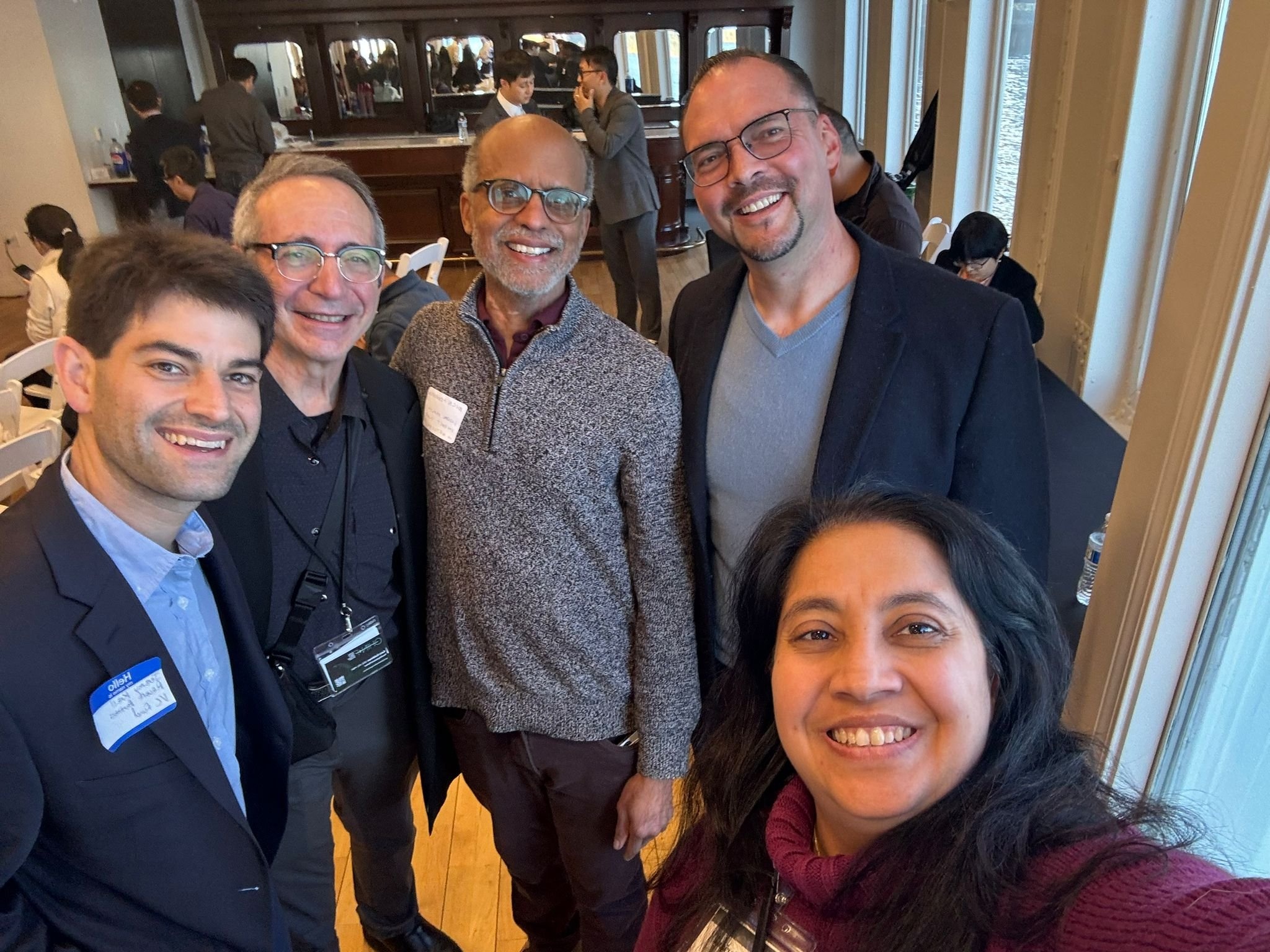
An introduction across the Atlantic
In May 2026, the organization formalized a European partnership with Sojo.consulting and appointed Wojciech, known as Voytek, Majewski as its regional director for Europe. The arrangement connects European founders and investors with named U.S. experts. Sojo leads European client relationships; GHIN supplies access and U.S. experience. The announcement followed nine months of joint pilot work.
That division of responsibilities is telling. An international network needs someone who can manage the relationship from one end to the other. A list of contacts cannot do the whole job. The partnership gives the introduction an operating structure, with people responsible for following it through. Goldman’s project is moving beyond the idea that useful people ought to know one another and into the business of making that connection work.
His career has kept circling that problem. How does knowledge travel? Through an online classroom, a staffing organization, a software platform, a professional community. Each answer requires another company, another set of relationships or another period of learning. Goldman’s own description of his appetite for the next assignment is plain enough:
“okay, I accomplished that. Now what can I do next?”
Gary Goldman, Physicians and Properties
The question gives the career its motion. Even the late MBA fits: another beginning, undertaken with experience rather than in its absence. For Goldman, completing the course has often meant finding a different classroom. This one happens to contain founders, investors and a growing number of introductions.