In Ganesh Gopalan’s version of the IPL, the sought-after performance was a voice. His young company needed recordings to teach software how people spoke. Cricket already had everyone’s attention. So the founders made an app and called it the Indian Pronunciation League. The initials did some useful work. The recordings would do considerably more.
It is an appealing little episode in a business often described through forbidding numbers. Before a speech model can understand anybody, somebody has to persuade people to speak. Gopalan remembers the app as one of the inventive ways Gnani.ai gathered its early data. An enterprise technology company had begun with something close to a word game.
He also supplies his own test case. Gopalan is Tamil, born and raised in Mumbai. He describes his speech as carrying Marathi, Hindi, Kannada and Gujarati influences. A conversation with him therefore presents a machine with several places at once. The speaker has lived a life; the software must catch up.
That personal detail makes his work easier to understand. The co-founder and CEO of Bengaluru-based Gnani.ai has spent years arguing for technology that accommodates how people actually talk. Regional accents, mixed languages and untidy telephone audio belong inside the problem. Asking customers to become more convenient speakers would rather defeat the exercise.
A long apprenticeship, then a difficult bet
Gopalan’s route to entrepreneurship included computer science at the University of Mumbai, consulting in the United States and an MBA in the Indian School of Business’s founding batch. He worked at IBM and Texas Instruments. These were years spent inside established technology businesses before he became responsible for establishing one himself.
He had been keeping entrepreneurship in view for much longer. A diary held monthly and annual goals, including the ambition to start a company. There is something pleasingly uncinematic about that. No thunderbolt, no napkin destined for a museum. An intention written down, then carried through a working life.
At Texas Instruments, he found a prospective partner in colleague Ananth Nagaraj. The attraction was a difficult technology problem with enough room to build a business. Gnani.ai dates its beginnings to 2016, years before the current enthusiasm for conversational AI made such a choice seem obvious.
“We started when deeptech and AI were unfashionable.”
Ganesh Gopalan, recalling the early decision
In retrospect, the corporate exit mattered as much as the technical challenge. Gopalan has described leaving a settled career for a startup as the hardest transition. That admission gives the chronology its weight. Experience provided useful tools; it also meant there was something comfortable to leave behind.
Nagaraj had brought a specific incident into their discussions. In 2015, he had encountered a turmeric farmer travelling toward Bengaluru to sell his crop. During the journey, better information emerged: Coimbatore offered a more attractive price. Nagaraj shared the experience with Gopalan. The episode gave their language work a practical purpose. Better connectivity alone could leave people struggling to get useful information. A service they could speak to, in a language they used comfortably, offered another route. The question concerned what a person could actually do with access once they had it.
First, persuade people to talk
The language work required patience. Gnani.ai’s early speech systems included Kannada and Tamil, followed by Hindi. The company spent its first years building its underlying technology. Data collection took the team into cities and colleges. The pronunciation app belonged to that practical, laborious phase of making something a machine could learn from.
In an April 2026 conversation, Gopalan was cheerfully severe about the original business plan. They had expected to build the technology first and have customers follow. Looking back, he said he would not advise new founders to take the same route. A useful piece of founder candour: the successful survivor declining to recommend his own itinerary.
The early work eventually met an external test when Samsung evaluated Gnani.ai’s technology. Samsung Ventures became an investor in 2019. Commercial work with TVS Credit followed in that period, bringing speech recognition into the decidedly practical setting of collections. The company now needed to understand conversations with consequences attached.
The appeal of local-language voice systems was already clear in Gopalan’s explanations. A person seeking an account balance should be able to ask in Hindi over a telephone or through an app. The business proposition began with an everyday transaction. Its usefulness depended on making the technology accessible in the customer’s language.
recognitionAudio becomes text
modelWork out a response
generationText becomes audio
The day he wanted more time
One customer request compressed the distance between a promising system and an operating business. Gnani.ai had to scale its automation overnight to handle more than a million conversations in a day. Gopalan’s first instinct was to tell the customer they needed longer. His team made it happen.
He told that story in 2023, with the credit going to the people who delivered. It is revealing because he leaves his hesitation in the telling. The CEO remembers being the person inclined to ask for time. The achievement belongs to a team whose capacity exceeded his immediate estimate.
The overnight scaling challenge Gopalan recalled in 2023.
His description of the daily job is similarly grounded: talking to customers to understand their service problems. He traces a product that supplied real-time hints to customer service staff back to those discussions. Customers helped suggest it and then participated in piloting it. Listening became a way to decide what the engineers should build.
This makes an instructive companion to his criticism of the original technology-first plan. The account of his working life is full of conversations: first to collect speech, then to understand the market, then to work out what a buyer needs. A company built around listening eventually had to make listening a management habit.
The invoice gets a vote
By 2024, Gopalan was explaining why Gnani.ai used specialized small language models for enterprise voice applications. His priorities included speed, lower inference costs and the ability to deploy on private infrastructure. A system handling a specific customer task has a different brief from one expected to answer questions about almost anything.
He returned to ownership of the software pipeline in March 2026. Building speech recognition, language processing and speech generation internally, he argued, gave the company more control over cost and performance. This is his commercial thesis as well as his engineering preference. Each external dependency can affect the price and pace of a conversation.
Inya.ai, Gnani.ai’s no-code agent platform, offered a way for businesses to put such systems to use across voice and messaging channels. The underlying work might be intricate; the customer still needed a manageable route to deployment. Gopalan’s account of the company’s development moves repeatedly between those two demands.
“The only proof here is did the customers’ outcomes improve or not?”
Ganesh Gopalan, August 2026
By that August, he was describing a sales conversation organized around revenue, productivity and collections. Some engagements tied pricing to outcomes. He also identified companies’ existing systems as a major competitive obstacle. A buyer already has a process, people using it and reasons to resist changing it. A model demonstration must eventually survive that meeting.
A voice carries more than words
Gopalan’s next technical ambition concerned what happens when speech becomes text. The words survive, but a speaker’s pitch, timing and tone carry information too. He has argued that a voice system should preserve more of those signals. Anyone who has received an ambiguous one-word message can appreciate the difficulty.
Gnani.ai’s voice-to-voice work pursues that idea directly. At the India AI Impact Summit in February 2026, it presented Inya VoiceOS in research preview. The model was designed to process and generate speech without the conventional intermediate text pipeline. Gopalan’s interest was in both conversational nuance and the delays introduced by separate processing stages.
The company’s selection under the IndiaAI Mission also brought a larger, multilingual voice-model project into the picture. These ambitions have unfolded through previews, releases and further development. In September, Gopalan still described the planned 14-billion-parameter speech-to-speech model as forthcoming. His public account left room for the engineering calendar to continue.
The next question is who owns it
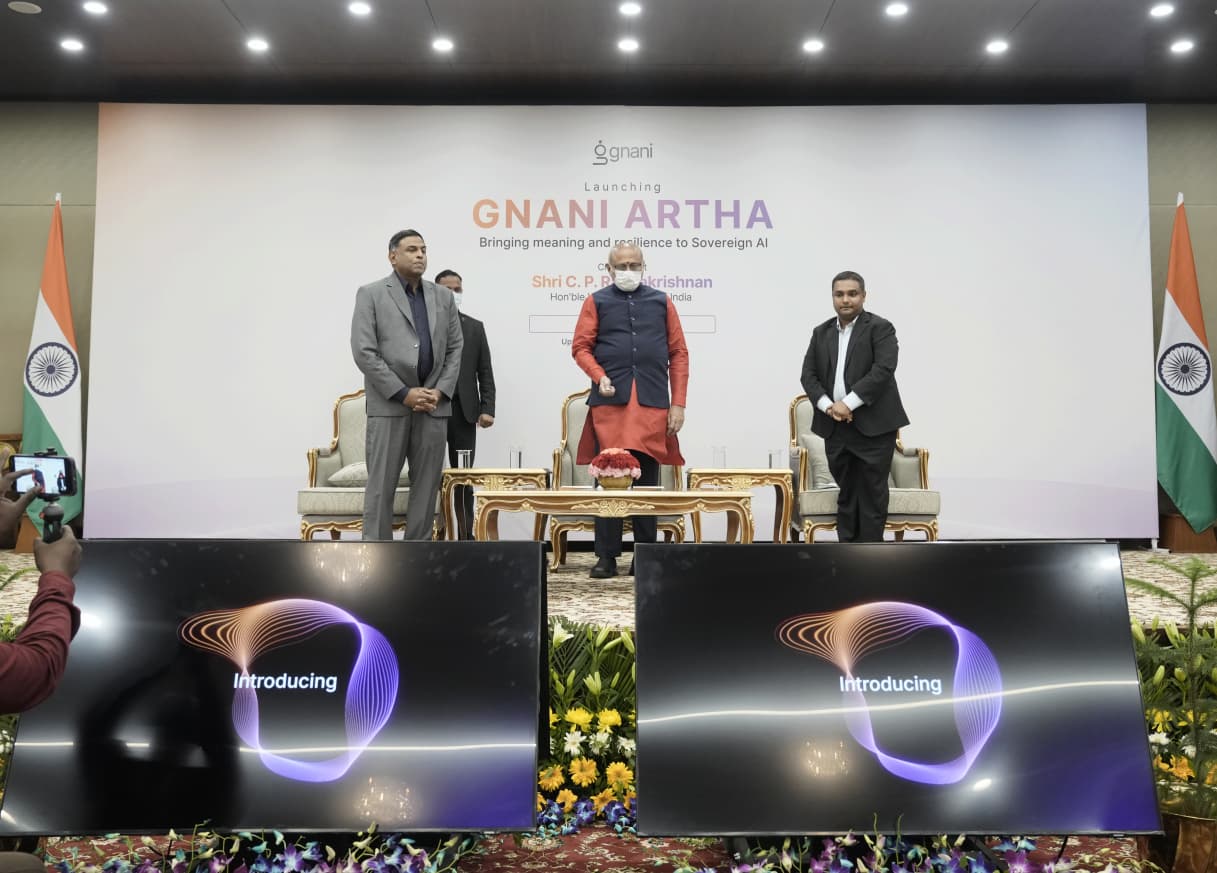
On 28 August 2026, Gnani Artha was launched at Uprashtrapati Bhavan in New Delhi. It combined Evon 3.3, a language model, with Plexus, a platform intended to connect AI with work inside organizations. Gopalan’s early interest in building technology from India had acquired a new setting and a broader enterprise brief.
His argument about sovereignty had also expanded. Businesses, he said, wanted control over their own intelligence. Evon’s open-weight release was intended to let organizations adapt and host the model themselves. In his telling, the commercial opportunity includes companies that want technology they can shape around their data and operations.
The geographic ambition has widened too. During 2026, Gopalan discussed customers and expansion in Japan, West Asia, the Philippines and the United States. In October, Gnani.ai announced Ascent, a partner program for enterprise adoption. The next phase involves getting systems into businesses, with the implementation work that accompanies them.
Away from the product discussion, his interests include tennis, cricket and science fiction. Cricket, at least, found an unlikely second life inside the business: a familiar tournament’s initials became the name of an app for collecting speech.
The useful thread is Gopalan’s willingness to revisit his own assumptions. He can acknowledge a naive starting plan, remember wanting extra time and describe customers changing what the company builds. Those are concrete admissions from someone whose business requires machines to improve through exposure to real conversations. His own Mumbai-shaped Tamil remains a handy reminder of the assignment: understand the person who is speaking.
Keep the conversation going
- WEBSITEGnani.ai ↗
- SOCIALGanesh Gopalan on LinkedIn ↗
- SOCIALGanesh Gopalan on X ↗
- WATCH / YOUTUBEThe Offline Network: the pronunciation league and the early bet ↗
- WATCH / 48 MINA conversation about voice, text and enterprise AI ↗
- INTERVIEW / 2023Customer listening and the overnight scaling challenge ↗
- INTERVIEW / 2026Gopalan on enterprise control and sovereign AI ↗
- READ MOREThe longer route from corporate work to Gnani.ai ↗