Gana Govind offered a customer a discount with a condition attached. He would build the warehouse management system a major consumer goods company needed. The price would be lower if he could keep the code and use it to start a software business. The customer agreed. An individual project became the foundation for Softeon. In a business devoted to knowing where everything belongs, the ownership of the code was a consequential item to get right.
The bargain is a useful place to begin with Govind. It involves an actual customer, a practical problem and a decision that would outlast the original assignment. Today, as founder and chief executive of Roboteon, he is working on another problem of choice: helping companies coordinate robots from different manufacturers. Between the two ventures lies a career spent dealing with the peculiar demands of warehouses, where an elegant idea must eventually persuade a carton to arrive at the right place.
A discount with a future
Govind founded Softeon in 1999. His academic qualification was a master’s degree in physics from the University of Madras in India. His business became warehouse management software, the systems that help operations keep track of inventory and execute the work of fulfillment. The company developed a broader supply chain offering around that core.
The early customer arrangement explains something specific about the economics of that beginning. Retaining the code meant the work could become a product for other buyers. The first customer received a price concession; Govind retained an asset with a future. There is a certain economy to starting a software company with somebody already waiting for the software.
By 2016, Softeon’s customer roster included names such as Anheuser-Busch, Sony, CEVA Logistics and Duluth Trading. Its early emphasis had been on products and customer results, with sales and marketing receiving less attention. That makes the first bargain especially apt: the business began with the work itself.
When two seconds matter
Govind’s public writing gives the story a more technical register. In April 2014, he addressed why warehouse management had been slow to move to the cloud. He considered supplier reluctance, limited functionality in some cloud offerings, concerns about response times and the shortage of IT resources available to configure systems.
In a warehouse, he explained, even a delay of a second or two could create trouble for communications or moving cartons. His argument for cloud adoption therefore included practical accommodations, such as local servers for demanding communications tasks in high-volume facilities. The details were the argument. A cloud system still had to meet the timing requirements of a physical operation.
He also advocated configuration tools that could guide operational managers through setup, reducing their dependence on scarce IT support. Read alongside his current work, the essay establishes a recurring professional concern: making sophisticated software usable within the constraints of the operation that buys it. A conveyor belt has limited patience for a discussion about architecture.
Twenty years, then outside capital
In October 2019, Warburg Pincus made a minority investment in Softeon. The intended uses were concrete: larger sales and marketing teams, geographic expansion and further product development. Financial terms were undisclosed. Govind, then the company’s president, described the point from which it was expanding.
“Softeon has been fully self-funded and profitable since its inception.”
Gana Govind · October 2019
That statement places roughly two decades of company building before the investment. It also explains why the transaction belongs in his story. Softeon had an established product business; outside capital would support an expansion of its reach. The next phase involved giving more customers a chance to buy what the company had already spent years developing.
A new company, a familiar floor
Roboteon unveiled its Robotics Fulfillment Platform on February 29, 2024, following more than a year of product development. Govind was its founder and CEO. The launch addressed a problem familiar to companies adding automation: getting robots connected to warehouse software can take time, and adding a different robot vendor later can introduce another set of complications.
The company’s answer is a software platform spanning integration, execution and orchestration. Those words describe separate jobs. Integration connects systems. Interoperability allows equipment from different vendors to participate. Orchestration coordinates the work across resources and processes. People remain part of the operation, with tasks synchronized between human associates and machines.
Consider the distinction from the buyer’s side. A company may want another manufacturer’s robot because its cost or features better suit a new requirement. It also wants to keep using the equipment it already owns. Roboteon’s proposition is to let those choices coexist, with software managing visibility and task assignment across the mixed fleet.
In July 2024, Roboteon announced certified integration with SAP Extended Warehouse Management. The connection routes warehouse orders and tasks toward automation resources according to conditions on the floor. Its later partnership with Stellium brought SAP EWM implementation expertise into the offering. Govind’s second venture was assembling connections to systems customers already used.
That is a detailed sort of connection to build. SAP’s warehouse system can provide the orders and tasks; Roboteon’s software directs them toward appropriate automation pools. The company lists mobile robots, robotic picking and automated storage and retrieval among those resources, with other material-handling systems also supported. The benefit it proposes depends on the handoff working across both the software and equipment involved. Govind’s experience with warehouse operations gives this second business a concrete starting point for understanding those handoffs.
Three thousand square feet of show me
Near San Jose airport, Roboteon put its proposition into a room. Its May 2024 lab announcement described 3,000 square feet for demonstrations, testing, integration and development. Different mobile robots could operate under the platform, alongside applications involving carts, collaborative picking and fleet management. Automated picking arms were among the additions.
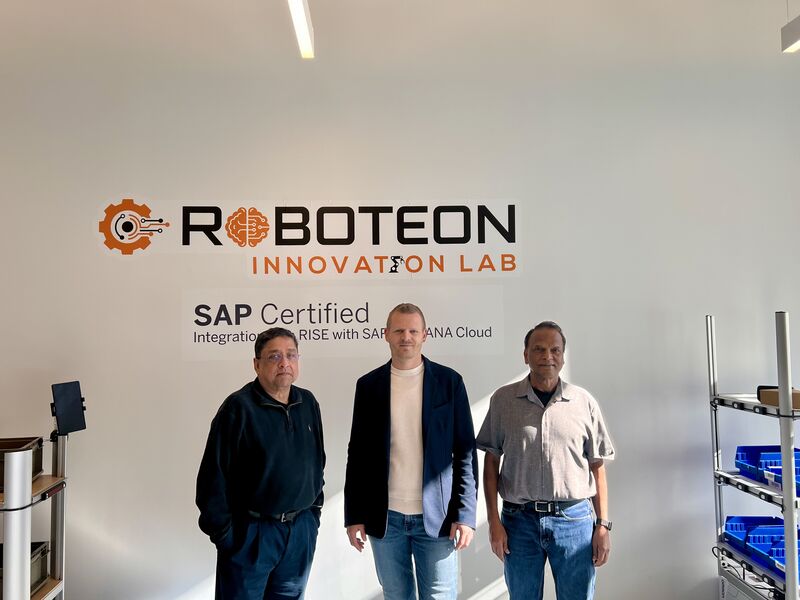
The lab makes the sales conversation unusually tangible. Customers can examine equipment and software together. New robot types can be integrated and tested. The development team has a place to work on applications before taking them into somebody else’s operation. Govind described its purpose as a way to accelerate platform development and demonstrate automation options.
A January 2025 visit brought that purpose into a small public scene. LeverX’s Dmitry Antanovich thanked Govind and Shyam K. for welcoming him, describing automation and robotics integration in action and discussion of the next steps in collaboration. The photograph places Govind among people and equipment, in the setting his company built to connect the two.
This interest in a place to test the equipment has a precedent in Govind’s earlier company. Softeon opened its Warehouse of the Future Innovation Lab in May 2020 to test sorting and weighing technology for broader use. The two facilities belong to different businesses, but both put a physical testing environment beside software development. A warehouse system eventually has to answer to the things moving through it.
The team also carries experience from his previous company. Dan Gilmore, Roboteon’s chief marketing officer and the founder of Supply Chain Digest, previously held the marketing role at Softeon. Sales executive Dennis Nicholson also worked at Softeon and CEVA Logistics. In July 2025, former Gartner analyst Dwight Klappich joined as strategic advisor, with responsibilities including channels and go-to-market strategy.
Rehearsing the warehouse
Roboteon’s simulation tools add another setting for testing an idea: a model of the operation. The software can represent aisles, locations, inventory and orders, using historical demand or a generated order profile. Different combinations of robots and people can then be considered across design, peak-season planning and daily execution.
The attraction is straightforward. Before changing the physical warehouse, a business can examine its assumptions. What resources would a particular order pattern require? How would the design behave during a peak? The company describes outputs including costs, throughput and dwell times. These are planning measures, with their value tied to the quality of the inputs and assumptions.
In February 2026, Roboteon introduced a complimentary Robotics Investment Impact Analysis built on the simulation tool. The service compares scenarios using information such as warehouse layouts and order profiles. Roboteon said an analysis takes two to three weeks. It gives prospective buyers a structured way to discuss expected costs, resource needs and return on investment.
The next stop is the factory floor
By July 2026, the company was announcing expanded capabilities for manufacturing. Its platform covered fleet management across mobile robots and autonomous guided vehicles, task assignment, material tracking and path planning. Applications included supplying production lines, managing work in progress and moving finished goods toward packaging and shipping.
The setting broadens Govind’s current work while retaining its central demand: coordinate movement across systems that must function together. A factory needs materials at a station; a warehouse needs an order at a dock. The software must account for available resources, priorities and the changing state of the floor.
For the manufacturing offering, the company describes task assignment that takes demand, priorities, robot availability and location into account. Its path-planning functions also address congestion. These details bring the discussion back to the floor: a resource can be available in principle while being in the wrong place for the next job.
The manufacturing announcement also connects the new applications to the platform’s enterprise integrations, including SAP EWM and Microsoft Dynamics 365. For a customer, that places robotics within an existing software environment. Work arrives from business systems, becomes a task for a person or machine, and needs to remain visible as it progresses. Govind’s company is working on the connections along that route, extending the same coordination problem into another operational setting.
Govind’s career now contains two distinct businesses joined by that practical attention. One began with permission to reuse code. The other offers customers room to combine equipment and alter their automation choices. The early discount bought him something lasting. His current company asks what freedom a warehouse can retain after it has bought its machines.