In 2013, General Electric gave James W. Preuninger a suggestion. GE was using software from Amber Road and from a Shanghai company called EasyCargo. The two systems did different jobs around the same complicated movement of goods. Perhaps, GE thought, their makers ought to talk. It was the sort of customer request that can become another integration project. For Preuninger, it became a reason to reconsider what his company should build for itself.
EasyCargo understood a particularly demanding stretch of the journey: materials entering China, passing through manufacturing and leaving as finished products. Amber Road’s executives examined the technology. They liked what they saw. They also recognized how long it would take to reproduce. The discussions ended with Amber Road buying EasyCargo in September 2013. A customer had pointed out the missing connection, and a software founder had accepted that another team already knew how to make it.
That episode offers a useful entrance to Preuninger’s career. Global trade is full of things that look straightforward from a distance. Buy the material. Make the product. Send it somewhere. Up close, the journey involves contracts, classifications, suppliers, schedules and rules that have an inconvenient habit of changing. Preuninger built his working life around those details. The container gets the photograph. The information has to turn up for work.
Two brothers, and a business that kept changing
Known professionally as Jim, Preuninger studied at Drexel University; the university identifies him as a 1983 management information systems graduate. He began his career in sales and marketing at IBM. His later responsibilities would keep both the commercial and technical sides of a software business within view: understanding what a system could do, and persuading a customer that doing it was worth the disruption of adopting it.
He co-founded Management Dynamics, the business that became Amber Road, with his brother John. The company’s commonly reported founding year is 1990. Its development was less tidy than a single anniversary suggests. By 1999, Management Dynamics was responding to the Ocean Shipping Reform Act with tools for carriers managing contracts and rates. In 2002 it extended similar services to transportation buyers, including logistics managers, importers and exporters.
The brothers had distinct operating responsibilities. Jim handled sales and marketing, finance, corporate development and other corporate functions. John, as president and chief operating officer, oversaw internal processes including development, professional services and customer support. Jim’s documented CEO and board tenure began in 2002. The business kept moving toward a broader question: how could companies coordinate the separate activities required to trade across borders?
- 2002Transportation
buyers - 2013EasyCargo
acquisition - 2014NYSE
debut - 2019E2open
acquisition
The customer who knew where to look
By the time of the EasyCargo discussions, Preuninger was dealing with customers whose operations crossed jurisdictions as readily as their goods crossed oceans. A tool that handled the entrance and exit of a shipment could still leave a difficult gap inside the manufacturing process. GE’s suggestion exposed that gap in practical terms. It already used both suppliers and wanted their capabilities connected.
Preuninger explained the decision with a builder’s preference: “We like to build technology.” Yet the depth of EasyCargo’s work changed the calculation. Buying the specialist brought China-specific capability and a base for expansion in Asia. Kae-por Chang, EasyCargo’s founder, became managing director of Amber Road China. There was expertise attached to the code.
The episode makes an acquisition intelligible at a human scale. A customer asked a question. Two teams spent months examining the answer. The company that usually preferred building saw a reason to buy. It is also a reminder that international software can become intensely local. A common platform still has to accommodate the particular requirements of the place where the goods are being made.
A stock ticker meets the paperwork
Amber Road began trading on the New York Stock Exchange on March 21, 2014, under AMBR. The offering price was $13 a share. When the offering closed, including the underwriters’ additional shares, approximately 8.5 million shares had been sold. The company expected about $54.1 million in net proceeds for itself; shares sold by existing shareholders brought it no proceeds.
Those distinctions matter in a founder’s story. A public offering involves several kinds of money, several kinds of owner and a fresh set of expectations. For Preuninger, it also marked the arrival of a specialist trade software business on a much more visible stage. In the same year, he was named a New Jersey finalist in the EY Entrepreneur Of The Year program.
The organization had expanded considerably. It had 16 employees in 2002 and more than 500 by the 2014 award announcement. Behind the software were people maintaining trade information, implementing systems and helping customers use them. The product depended on a combination of software and knowledge. Country-specific rules were part of the work, and keeping that knowledge useful required continuing attention.
Amber Road’s workforce, as reported in its 2014 EY finalist announcement.
The software company that bought lessons
In 2015, Amber Road acquired Global Trade Academy. At launch, its offering included more than 60 courses covering customs and trade compliance, import and export management, logistics and related subjects. Training came in several forms, including classroom instruction and online learning. For a software company, buying a training business might seem like a detour. Preuninger described a direct connection to the customer’s ability to do the job.
“Our best software customers are also those who invest in talent development.”
Jim Preuninger · 2015
His argument gave the people using the systems a substantial role. Organizations needed their own trade professionals who understood regulations and could apply them to particular products, processes and places. The software could support that work; knowledgeable employees still had to make sense of it. The acquisition put instruction alongside automation in Amber Road’s offering.
That attention to expertise also appeared in his earlier advice to software buyers. He urged them to look for experience solving complex trade problems and to visit a customer with similar issues. Demonstrated work mattered. A presentation could describe a solution; another customer could explain what happened when it met an actual operation. The distinction is familiar to anyone who has bought enterprise software and then had to live with it.
A season can last a few weeks
In a 2015 video interview, Preuninger talked about product lifecycles shrinking until a selling season could last only weeks. Manufacturers had to coordinate design, materials, cost calculations, sourcing, assembly and delivery. The timetable left little room for a missing document or a shipment held at customs. Outsourcing design added another relationship to manage, with another opportunity for information to go astray.
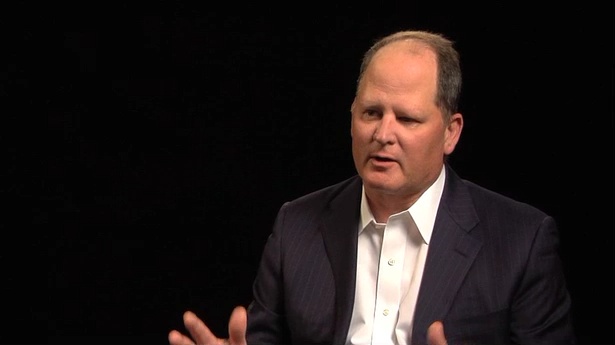
This was a broader view of logistics than a route drawn between two ports. Choices made during product development affected the eventual shipment. Coordination had to begin earlier, across businesses that might be halfway around the world from one another. Working with multiple tiers of suppliers was still developing, he said. Companies were beginning to see opportunities for earlier investment.
Preuninger’s public arguments repeatedly returned to that imbalance between complicated international operations and the systems used to manage them. In his outlook for consumer goods companies in 2015, he urged investment across the international supply chain, including sourcing and supplier management. The ambition reached into decisions made before a product was ready to travel. By then, many of its costs and constraints were already taking shape.
The public years had their own friction
The listed company’s results complicate an easy march from founding to exit. In 2017 Amber Road reported revenue of about $79.1 million and a net loss of about $13 million. Its expanding scope did not remove the difficulty of turning the business into profit. Running software for other companies’ operations brought its own operating problems.
Shareholder pressure followed. Altai Capital criticized performance and executive compensation and pressed for a sale. E2open’s pursuit extended across earlier proposals that Amber Road rejected in 2018. The eventual agreement came in May 2019, at a reported transaction value of roughly $425 million. Those negotiations belong in the career alongside the product decisions and the public offering.
E2open completed the acquisition on July 2, 2019. Shareholders received $13.05 per share in cash, and Amber Road stopped trading on the NYSE. Its trade capabilities joined a larger supply-chain platform. For the company Preuninger had helped build, the transaction ended the independent public chapter. For him, work in the field continued.
Still following the freight
After the disruptions of 2017, Preuninger had argued for supply chains that could withstand trouble and recover from it. His recommendations included connecting business partners, seeing beyond immediate suppliers and improving collaboration. He acknowledged that risk could never be eliminated entirely. The practical task was to improve a company’s ability to respond.
His next chapter kept him close to those questions. From early 2020, he served as chairman and a full-time executive at Overhaul, according to his professional profile. Overhaul works on supply-chain visibility and risk. The company’s current board page includes him alongside Nathan Pieri, who had been Amber Road’s chief product officer. The organizational setting changed; some professional connections continued.
Read across the years, Preuninger’s career follows an accumulation of dependencies: carrier rates, transportation buyers, customs processes, sourcing partners, the people trained to use the systems. The GE episode remains particularly revealing. Faced with a customer’s specific problem, he examined what another team knew and adjusted the plan. Goods still had to move. Understanding the details between here and there remained worth the effort.
Follow the route
Profiles, conversations and the business record.
- Jim Preuninger on LinkedIn ↗
- Overhaul’s board and leadership ↗
- The EasyCargo acquisition and the GE connection ↗
- The Global Trade Academy acquisition ↗
- Video: linking sourcing and product design ↗
- Preuninger on supply-chain resilience ↗
- Amber Road’s 2014 IPO prospectus ↗
- The completed E2open acquisition ↗
- Amber Road’s 2018 company and financial profile ↗
- The negotiations behind the 2019 deal ↗
- Preuninger’s 2012 advice on choosing supply-chain systems ↗