Sanjay Mirchandani’s mother had a useful way of dealing with executive inflation. Whatever his standing in the technology industry, she reminded him, it did not travel through the front door. “You may be an executive out there, but you’re my son when you walk in that door.” A promotion could enlarge his responsibilities. It would do nothing for his rank at home.
He repeated that advice in 2023 while explaining how he thought about leadership. Listen. Show appreciation. Leave the ego outside. These are inexpensive instructions, which may explain why companies occasionally overlook them in favour of more elaborate programmes. For the president and chief executive of Commvault, they also offer a useful introduction to a career spent moving between people who make technology and people who must somehow get it to work.
Mirchandani has sold enterprise systems, run them as a chief information officer, and led companies that automate and protect them. Each job changes the view. The seller can finish a presentation and leave. The CIO remains in the building with the consequences. By the time he joined Commvault in February 2019, he had occupied enough of those seats to know that a promising demonstration and a dependable working day are separate achievements.
A first journey, then a change of direction
He grew up mostly in Mumbai. Going to Drew University in New Jersey was his first overseas experience. He arrived from India and found a small international student community within a college that made him feel welcome. Years later, he still described that feeling of belonging as something the university had given him, rather than something he had been required to manufacture alone.
He graduated in 1986, having studied mathematics and computer science, and earned an MBA at the University of Pittsburgh. His working life initially involved developing technology. But making it was only part of the attraction. The more absorbing question became what happened when another person tried to use it. That curiosity took him towards customers and eventually into management.
Drew recognised him with its Achievement in Business Award in 2011. His account of success was unusually interested in unfinished work: assembling people from different countries, experimenting with new technology, periodically trying a new programming language. He kept returning to a question simple enough for a student and demanding enough for an executive: “What can I learn from this?”
The habit matters because his career crosses successive versions of enterprise computing. A leader who begins with a fixed answer will eventually find the industry has changed the question. Mirchandani’s route gave him repeated opportunities to discover that the customer’s difficulty rarely fits neatly inside the vendor’s product description.
The customer’s side of the desk
At Microsoft, where he spent eleven years, his work included leading India, South Asia and the Asia Pacific region. He joined EMC in 2006 and went on to become CIO as well as lead its Global Centers of Excellence. In October 2013 he moved to VMware to run Asia Pacific and Japan. These were different businesses, but each required him to connect technology with organisations large enough to make a straightforward idea complicated.
The EMC job was a particular education. Looking back on it as he arrived at Commvault, he said running IT had taught him more about the subject than the preceding twenty years. It is a revealing admission from someone who had already spent much of his career in the business. Purchasing, deploying and living with technology impose their own syllabus.
It also meant Commvault was familiar territory before it became his employer. He had encountered its technology as a CIO, worked in companies around its market and competed with it. His interest came with several angles of view. He understood both the appeal of new infrastructure and the awkward duty of maintaining what a customer already owned.
In his first-day assessment of the job, he described customers spanning mainframes, virtual machines and containers. The point was practical: businesses do not replace their entire history whenever a more fashionable architecture arrives. Someone has to make the old and new arrangements work together. For that customer, integration is part of the purchase, however untidy it makes the slide.
Regional leadership
Chief information officer
Automation and resilience
An operator in a founder’s chair
Puppet supplied another change of scale and temperament. Mirchandani joined the automation company as president and chief operating officer in 2016, then became CEO that September. Founder Luke Kanies remained on the board. The handover brought a manager formed in multinational technology businesses into an organisation built around an open-source tool and its users.
That transition required respect for two constituencies. Developers had to keep finding the software useful. Enterprises needed confidence in the business behind it. Mirchandani’s experience in international operations was relevant to the second task, while Puppet’s technical community kept the first task close at hand. An expanded sales operation would have little to sell if it lost touch with the people doing the work.
By the time Commvault announced his appointment, Puppet’s open-source and commercial user base had reached more than 40,000 organisations, including 75 percent of the Fortune 100. Those were users, a broader category than paying customers. During his tenure the company also opened offices in Seattle, Singapore, Sydney, Timisoara and Tokyo.
The experience sharpened his familiarity with automation and the way software teams build and release applications. When he moved to Commvault, he explicitly connected that experience to the challenges its customers faced. Data protection would have to keep pace with a computing environment increasingly assembled and changed by software.
The new boss starts by listening
Commvault had been led by Bob Hammer for more than two decades. Replacing a leader with that tenure introduces a delicate question: which parts of the inheritance deserve protection, and which need changing? Mirchandani’s first response involved travel and conversations. By March 2019, he reported meeting more than 60 percent of employees across the United States, Europe, the Middle East, Africa and Asia Pacific during a sixty-day listening tour.
He also spoke with dozens of customers and partners. This was the incoming chief executive gathering the company’s own account of itself before offering a new one. The exercise did not mean he intended to leave everything in place. His early interviews paired respect for the existing business with a clear appetite for movement.
“I didn’t come here to tread water.”
Sanjay Mirchandani, March 2019
The subsequent changes included a move from perpetual software licences towards subscriptions and the launch of Metallic, its software-as-a-service offering. Metallic passed 4,000 customers and $100 million in annual recurring revenue within three years. In 2023, Itron appointed him to its board, bringing his experience into a business serving energy and water utilities.
A subscription changes the commercial rhythm. The relationship continues beyond the initial transaction, and the supplier must keep giving the customer reasons to stay. For a leader who has repeatedly returned to the experience of using technology, that model places an old interest inside a recurring commercial obligation.
Having the data is only the beginning
The next problem was larger than retrieving files. An organisation needs its applications and the environment around them functioning again after a disruption. Commvault’s April 2024 acquisition of Appranix addressed that task by adding technology for rebuilding cloud applications and their dependencies. Recovering the contents is less useful if the surrounding machinery cannot run them.
Imagine recovering the manuscript of a newspaper while the printing works remains unusable. You have preserved something valuable, but subscribers are still waiting. The analogy explains the scope of the ambition: recovery must reach the arrangements that turn stored information into a working service. The company’s acquisition programme made that ambition more concrete.
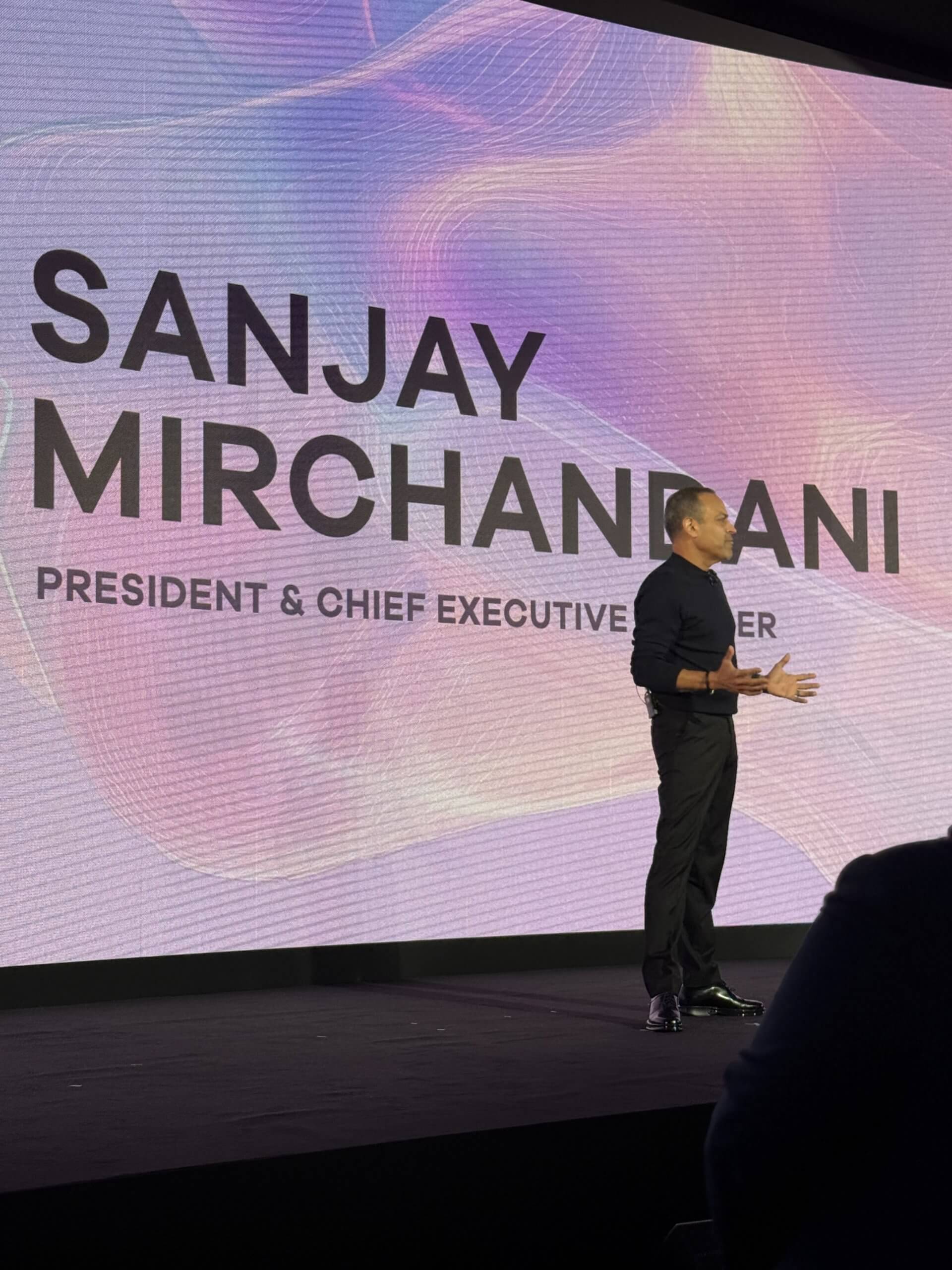
At SHIFT in London in 2024, Mirchandani described the goal as continuous business. The phrase changes the conversation from the mechanics of a backup to the activity a customer needs to sustain. The stage photograph gives him a name several metres wide. The underlying proposition is more modest and more demanding: help the customer carry on.
That same year, he explained why having the chief customer officer in Bengaluru made sense. Customers’ global capability centres and technology partners were already there, alongside Commvault’s engineers. Putting people closer together could make it easier to understand a deployment and resolve its difficulties. Geography, in this account, follows the work.
He was particularly interested in engineers talking directly with customers and seeing how their features were used. It is a recurring concern across his career: the gap between building something and understanding its reception. The useful conversation begins when the product leaves the demonstration and enters somebody else’s working day.
The numbers, and the work still ahead
By the quarter ended June 30, 2026, Commvault reported subscription annualised recurring revenue of $1.054 billion, up 22 percent from a year earlier. Quarterly SaaS revenue had crossed $100 million. Those measurements describe a business with a different revenue mix from the one Mirchandani joined. They also give a dated, concrete measure of the subscription strategy.
There is another chapter approaching. In September 2026, Commvault announced SHIFT in Nashville for November, with Mirchandani among the keynote speakers and AI attack and recovery simulations on the programme. The agenda links the possibilities of AI with the operational question that has followed him through several employers: can customers depend on the systems they are adopting?
The public executive can be lighter than the subject matter. In 2020 he wrote about becoming a bread baker, complete with a pun about what customers “knead.” A chief executive prepared to publish that headline has at least accepted that dignity is a negotiable asset. The detail is small, but it puts a person beside the product strategy.
His mother’s instruction offers a firmer ending than any quarterly target. A title can secure the meeting. It cannot do the listening. Across Microsoft, EMC, VMware, Puppet and Commvault, Mirchandani has accumulated reasons to take that distinction seriously. The interesting part of his next presentation will begin when somebody tells him what still fails to work.