At a perfume counter in Saudi Arabia, a customer could buy a bottle, collect a receipt and disappear into the ordinary fog of retail data. On the website, the same person might look like somebody else. In the app, somebody else again. Deraah, a fragrance and beauty chain with more than 850 stores, spent three years looking for a way to make those encounters add up to one customer. This was the problem Gameball was hired to solve. The games came later.
The short version
- What it sells: software for points, tiers, challenges, referrals and automated messages.
- Who buys it: retailers, ecommerce brands and apps that want repeat purchases.
- What failed first: scattered data at Deraah; an internal build at Yassir.
- The useful lesson: design the path from earning to redemption before inventing prizes.
Gameball calls itself a gamified loyalty platform. That phrase invites images of spinning wheels and digital badges, and the product does indeed offer both. But a reward program is also a set of promises: spend here, earn there, redeem later, and do not lose the balance when you switch channels. The promise becomes awkward when a company runs one system at the cash register, another on the website and a third in the app. Gameball’s offer is to make the customer and the reward legible across all three.
The company was founded in 2019 by Ahmed Khairy, Ahmed El Assy and Omar Alfar. Khairy had closed earlier entrepreneurial ventures in 2014, according to an interview with Inc. Arabia, then returned to start Gameball with his co-founders. The Cairo-based company announced a $3.5 million seed round in 2023. Its current pitch has widened from gamification to a common customer record that supports loyalty, referrals, promotions, messages and reporting. It serves consumer brands through subscriptions and integrations with platforms such as Shopify, along with web, mobile and point-of-sale systems.

The three-year problem
Deraah’s case is a useful antidote to the idea that loyalty begins with a clever discount. Its retail operations used Microsoft Dynamics 365, its main web operation used Salesforce Commerce Cloud, and its smaller brand sites ran on still other platforms. The company could not reliably see frequency, retention or lifetime value across those islands. Its “Mukafaati” program needed a unified profile before it could deliver a unified reward.
In 2024, Deraah partnered with Gameball to connect store transactions, websites and mobile activity. The program offered points and a three-tier ladder. It also rewarded narrower actions: 500 points for completing a profile, 1,000 for a first app order. These are tiny bribes with a practical purpose. The first improves a customer record; the second asks a store shopper to try a channel the retailer owns. A wheel or a challenge board then gives the request a little theater.
A simple loyalty loop. The hard part is keeping all four steps connected.
Gameball says the Deraah rollout reached more than 850 branches and digital channels in four months. Its case study reports that redeemers had four times the lifetime value of non-redeemers and 32% higher purchase frequency. Those are comparisons between groups, not proof that points alone caused the difference: regular customers are more likely to redeem in the first place. The striking operational result is simpler. After years of searching, a shopper could finally have one balance.
The year that went nowhere
Another customer, Yassir, reached Gameball from the opposite direction. The multi-country app had tried to build loyalty and referrals itself. Its requirements spanned six markets, several currencies and languages, and services that included rides, food and grocery delivery. After a year, the internal project had stalled. The company had 37 requirements, and the Gameball case study says the platform met 97% of them out of the box. That was the moment the economics of building changed.
Yassir used Gameball’s SDKs and APIs to put a challenge board on its home screen, show expected points at checkout, offer two-sided referrals and let customers redeem service-specific coupons. The case study is inconsistent on exact implementation time, describing both a three-month rollout and a six-month delivery against an expected 12-month internal build. The defensible conclusion is the one Yassir itself makes: buying the loyalty layer freed engineers from maintaining it. The case study reports 50% less development time than its forecast and a 75% year-over-year lift in redemption rate.
“We felt like we had a squad called Gameball working closely together.”Khaoula Tijani, Yassir product lead
That praise hints at a less visible part of the business model. Small Shopify merchants can start on Gameball’s free plan; its published Shopify Starter plan is $34 a month, Pro is $159, and Guru is $999. Larger direct programs are sales-led. But the subscription is only the software bill. A merchant also pays for rewards, integration work, campaign operations and the occasional mistake in a rule. The platform can make those costs visible; it cannot make them vanish.
The points must show up
Trolley, a Kuwait convenience chain, supplies the wonderfully unglamorous detail that makes the product tangible. Its app shows a points offer on the home screen. In the cart, the customer sees how many points the order will earn, beside an “add more to earn more” nudge. A wallet card makes the balance reachable without opening the app. Trolley also tried games at self-checkout and a challenge to make qualifying purchases at 50 branches, with a car as the prize. One can imagine the meeting in which the car won. The cart preview probably did more quiet work.
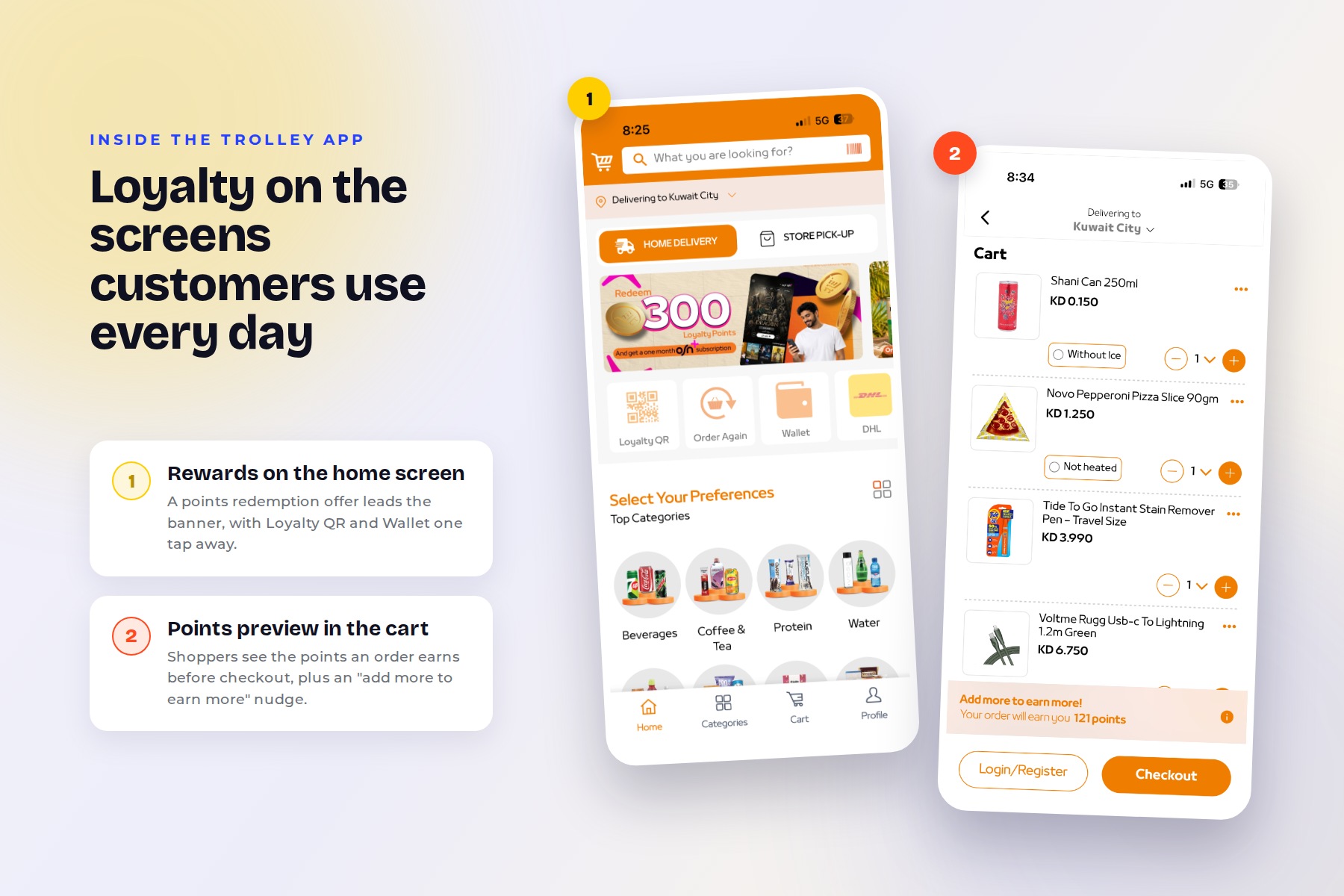
Trolley’s published case study reports 30% sales growth, 33% higher customer lifetime value and a 40% year-over-year rise in redemption rate. These are customer-reported outcomes attached to a broader program, not a controlled experiment on the value of a single game. Still, the mechanics are worth copying: show the reward before checkout, make redemption easy, and reward actions beyond purchase only when those actions matter to the business.
When finance enters the arcade
Gameball’s 2026 product updates have a revealing tone. Alongside challenges and personalization came a data warehouse connection, an audit trail and advanced budget control. The latter lets a team set a campaign budget and compare rewards issued with actual redeemed spend. That is the grown-up side of the spin wheel. Issued points are a liability until a customer uses them or they expire. A campaign that boosts engagement while quietly swelling that liability is a poor game for the retailer.
There are familiar alternatives: a Shopify loyalty app, an enterprise loyalty suite, or an in-house system. Gameball’s distinctive claim is the combination of rewards, game mechanics, referrals, automated journeys and analytics on one record, with enough integration range to follow customers into stores and apps. Its documentation says more than 3,000 brands across over 70 countries use the platform. The market is crowded; the real contest is over how much complexity a merchant can avoid owning.
The company’s own Black Friday analysis gives the story a final turn. It says one in five November 2025 orders on its network came from customers who had already redeemed a reward earlier in the year. That is an argument for patience. A loyalty program must give someone time to join, earn, notice and redeem before the annual discount frenzy arrives. You can install a widget in an afternoon. You cannot manufacture a habit on command.
For a reader building a program, the first useful sketch is not a prize wheel. Draw a customer moving from store to phone to cart. Mark where identity is captured, where points appear, how a return changes the balance, what a reward costs and who can see that cost. Then add the game. Gameball’s story suggests that play works when the underlying promise survives the ordinary mess of retail.