A broken door handle is an awkward place to begin a story about the future of design. It has none of the glamour of a virtual world. It will not impress a dinner guest. But Gabriela Trueba once described a customer who used 3D technology to replace one, making the new part stronger than the original. The example fits her ambitions rather well. Somebody had a problem, an idea and a reason to make something. The interesting question was how much machinery, expertise and expense had to stand between those three things.
Trueba is the founder and CEO of Womp, the browser-based 3D platform whose name sounds agreeably like an accident in a cartoon. It came from listening to printers. Years later, that origin remains useful: before the software, there were machines making objects. Her career has kept moving between the object and the system that allows a person to create it.
A painter encounters the machinery
Originally from Quito, Ecuador, Trueba went to the United States to study art. She attended New York University and worked in the New York art world, including fabrication work for Jeff Koons. The path put her close to the practical labor behind an artwork: the translation from an artist’s intention into something with dimensions, materials and a place in the world.
She also began teaching herself 3D. In her recollection, the learning started in 2013. The encounter was discouraging enough to leave a memorable phrase: “I felt pretty stupid.” The software presented a dense vocabulary before offering much reassurance. A person might know what she wanted to make and still find herself unable to persuade the tools to cooperate.
There is a peculiar social arrangement inside complicated software. The novice does the struggling, so the novice tends to accept the blame. Trueba eventually treated the difficulty as a design problem. The tools were powerful; the route into them could be reconsidered. That distinction would give her more work than simply mastering another application.
Her background included co-founding MatterLab and building the aro app. Those earlier projects belonged to the same territory of digital forms, fabrication and new ways of encountering objects. Womp grew from repeated exposure to the work itself. Accessibility was becoming a specification.
The workshop gets a browser
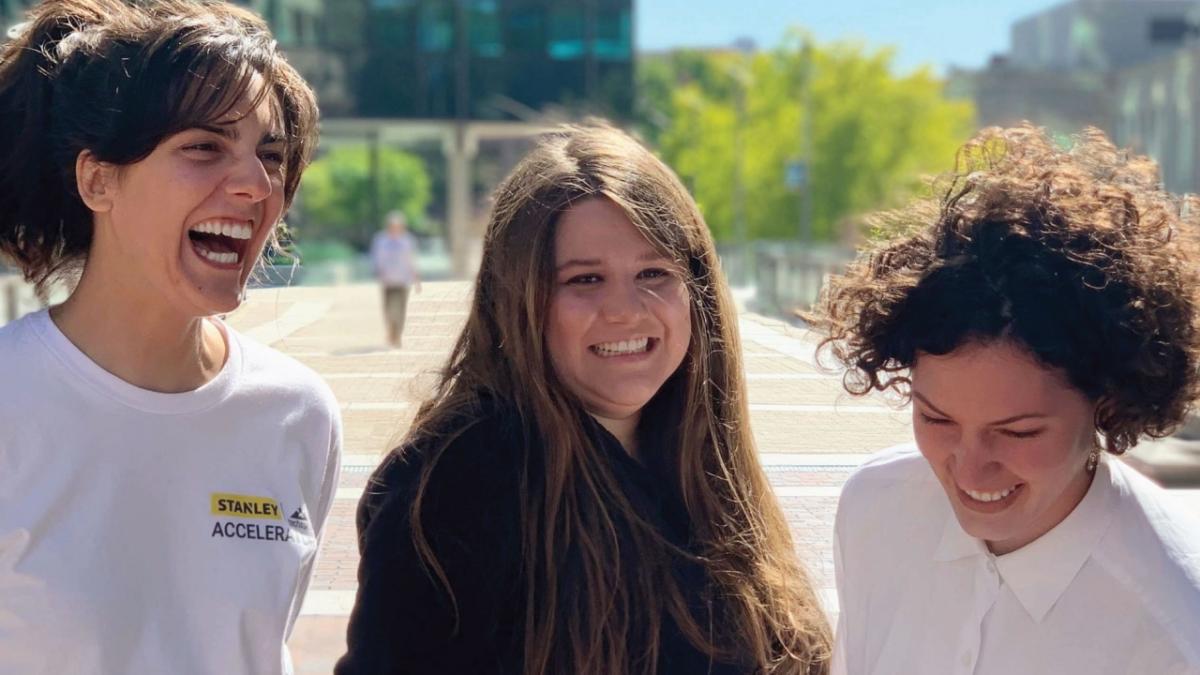
By 2019, Womp was part of the STANLEY+Techstars accelerator. Trueba described an all-women team, hiring for people’s ability to contribute rather than insisting on a particular degree. Her account of its culture emphasized open discussion. For a company trying to widen participation in making, the question of who got to help build the tool was already close at hand.
The workshop experience also gave the software a practical test. Could someone change a shape without creating another technical problem? Could a person work without owning a powerful computer? Could the result become a physical thing? Those questions are less glamorous than an elaborate demonstration. They are also the ones a user encounters after the demonstration is over.
Womp’s approach uses signed distance fields, a way of describing form that supports blending and subtracting shapes. Its rendering happens in the cloud and reaches the user through a browser. The complicated computation has somewhere else to live. A creator can concentrate on changing the model instead of wondering whether the machine on the desk is qualified for the task.
The distinction matters to Trueba’s story because she had occupied both positions: the maker who wanted a result and the person learning how the system worked. A simpler surface still needs substantial engineering underneath it. Someone must take responsibility for that complexity. Her company’s assignment was to move more of it away from the beginner.
A simplified view of the making process, rather than a promise about how long any project takes.
A launch needs other people
In April 2022, Womp announced a $4.7 million seed round led by Female Founders Fund and Haystack, with participation from NEO Investment Partners. Director Ari Aster and A24’s Daniel Katz were among the angel investors. The money was intended to improve the core technology. A private beta was planned for roughly 1,000 people.
That announcement put collaboration alongside the design tools. People would be able to share their work and learn from each other. For a newcomer, another person’s model can perform a service that a feature list cannot: it makes an unfamiliar activity imaginable. You can see something you might want to attempt.
The later launch brought a much larger audience. In November, Trueba reported passing 15,000 users within 72 hours. Neo’s December recap said the number had subsequently exceeded 70,000. These are dated snapshots of a launch, rather than a current user count. They capture the moment a tool built through years of work began meeting people at a different scale.
The appeal had a visual language, too. Womp called its approach liquid 3D. Shapes could blend together, inviting experiments that looked closer to playing with a material than administering a technical document. A forgiving first move matters. It gives the second move a chance to happen.
Three shapes, more possibilities
In May 2024, Trueba introduced PrimFusion V0, an AI model trained on Womp’s liquid engine. Its starting vocabulary consisted of a sphere, a cylinder and a cube. A small cast, certainly, though geometry has always found plenty of employment for those three.
Her explanation connected the experiment to Womp’s earlier purpose. She wanted AI to reduce technical obstacles in making and editing forms. That is a more specific ambition than producing a striking image. The person needs a way to continue working with the result. Creation includes revision, and revision usually begins when something is almost right.
By that announcement, she described the engine as having reached nearly half a million creatives. The figure belongs to her May 2024 account. More revealing than the number is the continuity of the question: how could someone get a useful foothold in 3D without first becoming an expert in every convention surrounding it?
AI changes what a system can generate. Trueba’s longstanding interest concerns what a person can then do. The relationship between those two capabilities will shape whether a creative tool becomes a passing spectacle or something a maker returns to for work.
“Making professional 3D easy for anyone.”
Gabriela Trueba
A more domestic example of product development appeared in Trueba’s account of Smart Templates. Her design team had ideas for prints and trouble making them work. She described failed attempts and time spent adjusting tolerances. The response was to ask the developers for a tool that would let the designers concentrate on the form. A repeated annoyance became another piece of the product.
Her demonstration showed a radial grid whose objects, spacing and scale could be adjusted before turning the arrangement into editable forms. The appeal is easy to understand without knowing the mathematics. A designer can explore a family of possibilities and keep changing her mind. The product lesson resembles the one Trueba encountered while learning 3D: a technical obstacle can be a request for a better tool.
The users get the last word
Trueba’s public accounts of users’ projects supply a more personal measure of progress. She celebrated New Zealand designer Abbey Barlow bringing her character Sally into Womp and using resin printing to make it physical. The project began with the designer’s own character. Womp became one part of a creative practice that already existed.
She also singled out Guilherme Rocha’s transformation of YouTube into a character that could sit on a desk. Her pleasure came from seeing a use she had not anticipated. A founder can spend years imagining what people will do with a tool and still be surprised by what arrives. That surprise is a useful check on the founder’s imagination.
Another project, Liangliang Luo’s illustration series “HIT!”, gave her a different reason to celebrate. Trueba highlighted its recognition in the Communication Arts Illustration Annual and the fact that the work had been made in Womp. An accessible starting point could lead into a professional creative practice. The creator, of course, remained responsible for the work.
These examples keep the story attached to people. A character, an illustration, an object on somebody’s desk: each has a particular author and a particular purpose. Software earns its place by helping that person carry an intention far enough to become visible.
Still thinking about the object
In July 2026, Trueba appeared on the Slant 3D podcast to discuss Womp’s printing roots, its geometry engine, GPU servers, ray tracing and AI-generated models. The episode moves between the approachable experience and the technical decisions supporting it. Even the chapter called “Time to Goop” makes room for the company’s willingness to sound a little ridiculous while discussing serious engineering.
Today, Womp’s website puts design, generation and ordering physical production on the same canvas. That direction returns Trueba to familiar ground. The maker’s job continues after a model looks convincing on a screen. An object must eventually survive contact with a material, a process and somebody’s expectations.
Trueba has also described wider ambitions: opening technical creative fields to more people and improving the environmental consequences of manufacturing through better processes and materials. She connects that sense of responsibility to growing up in Ecuador. These are goals to work toward, with their meaning decided by practical results.
The customer with the broken door handle had a modest, specific request. He wanted a replacement that would work. Years of Trueba’s career have gone into making that request easier to answer. Somewhere, beyond the screen and the vocabulary, a door still has to open.