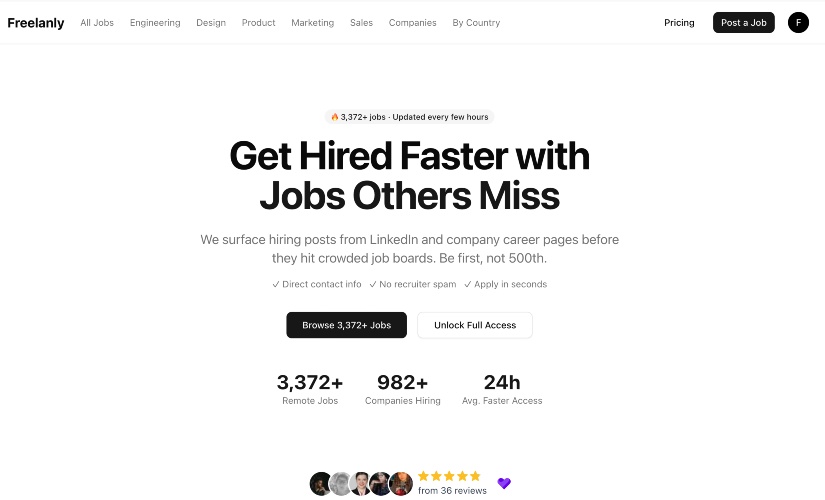
The interesting thing about a job opening is that it can exist before it looks like a job opening. Someone writes a hiring post. A manager mentions a project. A company adds a role to its own careers page. For the person refreshing a large job board, none of this has happened yet. Freelanly has built its current proposition around that interval: find the signal, identify the fit, get an application ready.
- Finds openings in public hiring posts and career pages.
- Matches your background, then drafts an application.
- You review and send. Paid access starts at $0.50 a send.
Its argument is easy to understand if you have ever spent an evening applying for work and finished with nothing to show except open tabs. Discovery is labor. So is deciding whether an opening fits. So is explaining, for the seventeenth time, why your experience belongs in somebody else’s project. Freelanly tries to join those chores into one sequence.
The opening before the opening
The company says it scans public LinkedIn hiring posts and company career pages, checking for fresh opportunities every few hours. Its current homepage addresses frontend and full-stack developers, data and machine-learning candidates, DevOps specialists, and QA engineers. The raw material is often an informal announcement rather than a polished vacancy. That is both the opportunity and the mess.
A post containing “React” might be a developer looking for work, rather than an employer offering it. Freelanly says its matching considers the post’s intent alongside the candidate’s stack, seniority, language and location. The expertise it sells is partly collection, partly interpretation: deciding which scraps of public information deserve a place in your morning.
- 01FindPublic hiring posts
- 02MatchSkills + eligibility
- 03DraftAI writes + reviews
- 04DecideYou edit + send
First, it spoke in language pairs
There is a clue to Freelanly’s earlier life in its unusually long LinkedIn address: “professional-community-of-freelance-translators-and-interpreters.” Its company page lists a 2019 founding year. In August 2022, Localization Today interviewed founder Fedor Khatlamadzhiev about his service for freelance linguists. This was a product with a very specific audience.
An advertisement in MultiLingual’s April 2023 issue made the mechanics plain. Choose your language pairs, choose the type of work and work mode, and receive vacancies by email or Telegram. New members were also offered a year of the magazine’s digital edition. The bundle makes sense: a linguist needs both the next assignment and a view of the profession around it.
Today, the front door speaks in technology stacks. A PitchWall listing published in February 2026 already presented a broader remote-work proposition, covering engineering, design, marketing and sales. The continuity is more revealing than the new vocabulary. Whether the filter is English-to-Hungarian or Python-and-SQL, the task is to spare a specialist a general search.
There is a smaller, more domestic origin story in a public LinkedIn comment from Theodor Khatlamadzhiev, the name used on the founder-linked profile. He described maintaining spreadsheets for only a month or two before abandoning them, then trying to automate the work. It is a recognizable freelancer problem: the system for managing work becomes another job.
A letter with a second reader
The current workflow begins with a résumé or LinkedIn URL. Freelanly builds a candidate profile, surfaces matches and prepares a letter tied to the opening. A second AI pass checks the draft against the requirements. The user can edit it before sending, with a CV attached, through a personal Gmail account or SMTP connection.
“You send. Always.”
Freelanly’s published product principle
That short rule gives the product a useful boundary. The candidate still owns the claim being made. A reviewer model can inspect a letter, but the person whose name appears at the bottom must decide whether it is accurate. Freelanly also advertises a reply inbox and pipeline tracking, keeping the aftermath beside the application rather than leaving it scattered across tabs.
This puts the business between several familiar alternatives. A remote board such as Remote OK helps with discovery. A writing tool helps with prose. A marketplace such as Upwork organizes opportunities inside its own transaction environment. Freelanly’s pitch connects an external opening to a direct application. Its value depends on how well those handoffs work for your particular search.
The company reports more than 25,700 signed-up tech candidates across over 90 countries, many pursuing US and European opportunities. Those are its own figures, and sign-ups do not establish how many people are actively applying or getting hired. They do suggest the audience it is addressing: specialists trying to make a geographically scattered search manageable.
The ten-application calculation
The current pricing page advertises two free applications, followed by $0.50 per sent application from a prepaid balance. Top-ups start at $3. PRO costs $5 a month and removes the per-application charge; it also adds an overnight queue of matches. On price alone, ten paid sends equal the monthly subscription. The eleventh makes PRO cheaper.
Illustration excludes the free allowance. Prices checked October 23, 2026.
The candidate pays, which helps explain the company’s stated emphasis on time saved rather than recruiter advertising. Yet cheap software can still be expensive attention. A useful subscription must produce openings worth considering, not merely letters that cost less to generate. Counting sends is easy. Counting credible opportunities takes a little more honesty.
Read the small geography
Freelanly’s own writing supplies a corrective to the early-access pitch. Its September 7 self-review acknowledges that listings can come from staffing agencies recruiting for unnamed clients, and that coverage varies by specialization. Its August guide to Remote OK warns readers that “remote” can still carry country or timezone restrictions. An earlier application cannot remove those constraints.
There is another distinction worth keeping: more collected listings do not necessarily mean more hiring. Freelanly explicitly says that expanding its collection changes its feed counts. Treat those numbers as a description of the product’s coverage, rather than a thermometer for the entire labor market.
Here is a practical way to borrow the idea. Inspect thirty matches. Count the fresh ones, the eligible ones, and the ones with a usable route to a person. Review every factual claim in your draft. Track replies. That experiment works whether you buy Freelanly or search manually. The question is wonderfully unglamorous: did this help you reach someone who could actually hire you?