A missed flight is an expensive way to discover a city. For Frank Wei, it also supplied an introduction. On May 30, 2009, an interruption to his itinerary left him with a day in San Francisco. He went sightseeing and fell for the place. Three years later, he established his translation company’s Silicon Valley branch. The airport had provided an unusually circuitous business development service.
Wei is the founder and CEO of MultiLingual Technologies, the California business he established in 2012, and the founder of Master Translations in China, which dates to 2000. His professional life connects Xiamen and the Bay Area, literary study and commercial documents, translators and the software they use.
His route has included interruptions as well as expansion. Businesses change direction. A venture fails. A document arrives in a format nobody particularly wants to handle. Much of the work lies in finding a practical way through.
An English student meets the internet
Wei entered Xiamen University in 1984 to study English. He continued into graduate study and received a master’s degree in English language and literature in 1991. Comparative literature occupied those university years: a discipline built around reading across boundaries, attending to differences and resisting the convenience of treating superficially similar things as identical.
His subsequent work included translation, foreign trade, business management and investment. In other words, a literature education became the beginning of a commercial career. A sentence in a poem and a sentence in a contract have different jobs to do. Both become troublesome when their reader understands something their writer never intended.
During the 1990s, Wei became involved with ChinaVista, an early Chinese website. He helped put English-language information about travel, business and government online. In Xiamen, getting online itself involved dialing connections elsewhere. Before a website could introduce a city to the world, somebody had to get the connection to work.
That episode gives his later interest in language technology some history. Software entered his career well before the current fascination with AI translation. The internet offered a distribution system for information; language determined who could use it. Those two problems have remained close neighbors throughout his working life.
“I started it by myself.”
Frank Wei, recalling the beginning of Master Translation Services
The company built around the next job
In August 2000, Wei started Master Translation Services in Xiamen. He recruited his university classmate Stanley as he began building a team. The business offered a recognizable service to organizations dealing across borders: translation that could be commissioned, managed, checked and delivered.
Growth acquired a geography. The company opened in Fuzhou in 2003 and established a Quanzhou subsidiary in 2005. Shanghai followed in 2007. Its work included a JavaOne online-course localization project and translation support for the bilingual weekly of the Xiamen Daily. These are different assignments with a shared requirement: the reader at the other end needs the material to work.
Its investment in tools also predates the present AI cycle. In 2007, the company bought SDL Trados software and a project management solution. A translation company’s technology can be distinctly unromantic: terminology, repeated passages, project tracking. Clients, reasonably, tend to prefer a correctly repeated term to an excitingly inconsistent one.
By the time of his 2018 LocWorld biography, MTS was described as a CSA Research Global 100 language service provider with seven offices across mainland China, Taiwan and the United States. That historical snapshot marks how far the operation had traveled from its Xiamen beginning. It also helps explain the international meetings that recur in Wei’s working calendar.
His industry roles included membership of the Translators Association of China’s council and deputy leadership of its Translation Service Committee. Running a company and helping discuss an industry’s standards require different kinds of patience. The first involves getting today’s assignment out. The second involves persuading other people how tomorrow’s assignments should be done.
California, with an introduction from a classmate
The Silicon Valley expansion had a human support system. When Wei began setting up there, fellow Xiamen University alumna Xiao Jing offered advice on office location, establishing the company and everyday life. She also introduced him to more alumni. His account of the move remembers those people alongside the business milestone.
He began traveling repeatedly between Xiamen and Silicon Valley in 2012. His public professional profile dates his presidency of MultiLingual Technologies to April that year. The distinction between the 2000 Chinese founding and the 2012 California chapter matters: international expansion has its own beginning, even when the founder arrives with years of experience.
The American Translators Association describes MLT as a Santa Clara translation and localization provider serving technology companies and other clients worldwide. It singles out capabilities in Chinese, Japanese and Korean. Such work puts the company between businesses developing products and the people expected to understand their instructions, websites and documents.
Seen from that position, geography is a daily operating condition. A client’s audience may live somewhere the client’s staff does not. A technical document can be perfectly familiar to its author and still require painstaking work before it becomes useful elsewhere. Wei’s companies occupy that space between familiarity and comprehension.
A book launch, and a different kind of accuracy
Wei has also remained a practicing translator of books. With the MTS translation team, he co-translated the Chinese edition of William N. Brown’s Off the Wall - How We Fell for China. Its launch took place at Xiamen University on December 22, alongside a celebration of Brown’s thirty years at the university.
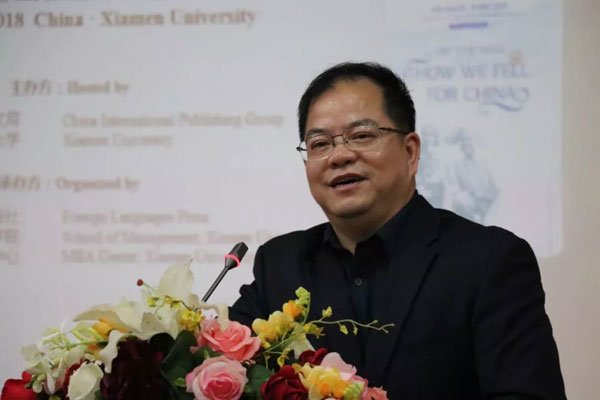
More than two hundred teachers, students and alumni attended. Wei spoke about Brown’s humor. It is a pleasing assignment for a translator: explaining the humor of somebody whose writing you have already had to carry into another language. A joke can survive a border crossing, but it rarely enjoys traveling unattended.
The book work continued into business publishing. Wei’s professional profile lists a Chinese edition of Andreas Ramos’s Startup, translated with J. N. Lin, in 2020. It also records his co-translation with Yan Lilan of Renato Beninatto and Tucker Johnson’s The General Principles of the Translation Company, published in Chinese in 2021.
These titles put the founder on both sides of his trade. He operates a language services business, then helps translate a book about operating one. The overlap makes the work unusually tangible. Business principles arrive as sentences; another language makes him examine what, exactly, those sentences promise.
The human-machine experiment has a history
In July 2018, Wei attended the signing of an agreement between MTS subsidiary 99YEE and IFLY Record. The proposed cooperation connected a human translation platform with speech recognition and machine translation. Its stated aim was a combined service that could improve access, speed and accuracy.
That agreement belongs in the story because it complicates the idea of a sudden conversion to AI. Wei’s business was experimenting with combinations of people and automated language tools years before BabelBee. The practical question was already familiar: how should the machine’s output reach someone who can evaluate it?
His work extends into other language ventures, too. Lingolet identifies Wei as a co-founder and advisor. His conference appearances have included a 2021 session titled “Going Far East: Challenges and Opportunities.” In 2024, MTS reported his participation in expert groups compiling reports on China’s and the global translation industries.
For a founder working between China and the United States, these connections form part of the job. A market changes through customer expectations, software and the decisions of other language companies. Conversations across that network offer a way of seeing changes before they arrive as an urgent request.
The file still has to leave the building
On May 29, 2026, MLT’s Chinese affiliate announced BabelBee, an AI document translation workspace for teams. The announcement described document uploads, preserved formatting, AI drafting, review and shared terminology. Wei’s accompanying explanation focused on teams caught between copying text into a chatbot and maintaining a traditional translation-tool workflow.
It is a revealing choice of complaint. He was discussing the hours spent restoring a document’s layout and the effort required to maintain a process. The glamorous part of translation software is producing words. The less photogenic part is getting a usable file back to a colleague.
- UploadBring the document
- DraftAI produces a translation
- ReviewCheck flagged passages
- DeliverExport the finished file
An August 2026 BabelBee article under Wei’s byline extends that concern to audio and video. It describes a workspace for transcription, editing timed text, labeling speakers and exporting captions. Transcripts can then proceed into translation using the workspace’s terminology and review tools.
The article acknowledges that overlapping speech, similar voices and noisy recordings still require human checking. That detail is close to the center of Wei’s working world. An automatic label may say “Speaker 1.” A person must sometimes establish who was actually speaking, and whether the sentence says what they meant.
From comparative literature to captions, the scale and machinery have changed considerably. Wei’s career keeps bringing him back to the moment when language must become useful to somebody else. A flight can be missed. A business can change direction. Eventually, the words have to arrive.